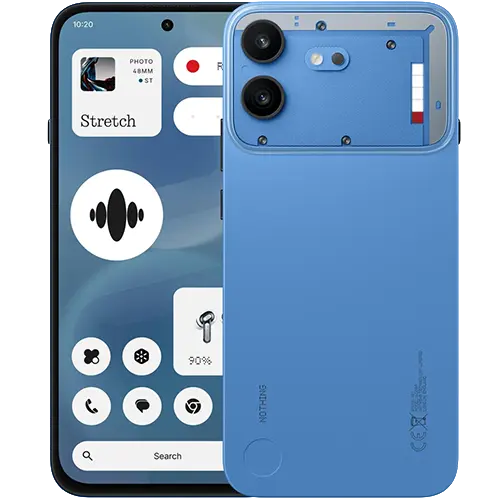
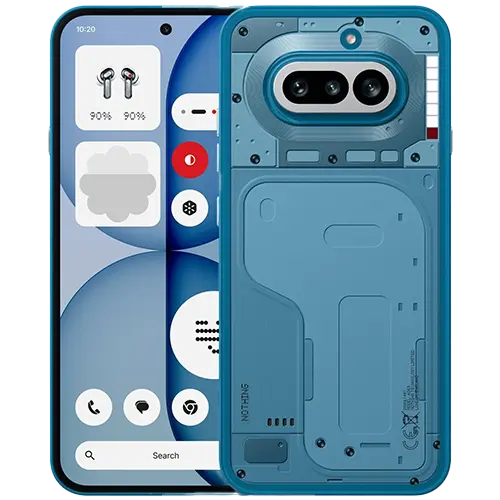
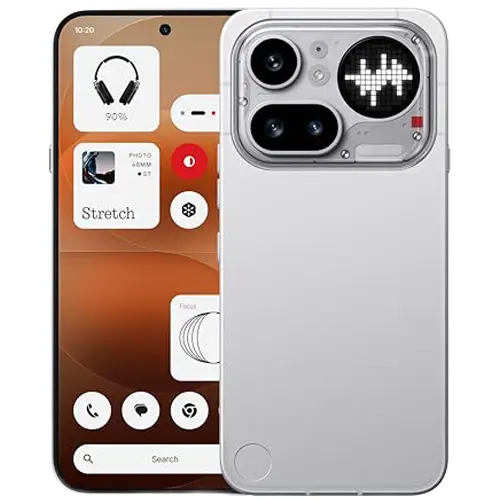
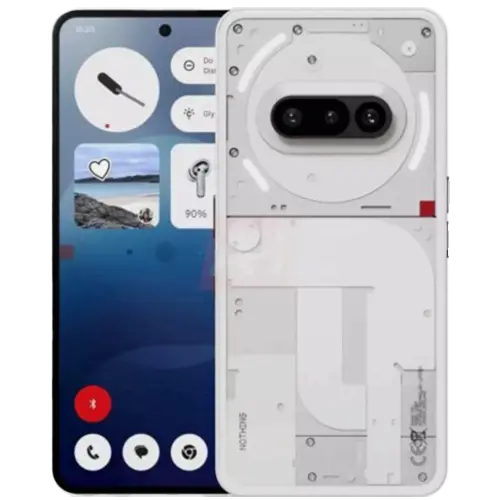
Nothing Phone (3a)
Score Overview
The Nothing Phone (3a) is a mid-range Android phone positioned at $379, aimed at buyers who want a distinctive design and a versatile camera system without spending flagship money. Nothing's brand identity leans heavily on transparency and visual flair, and the Phone (3a) continues that tradition while trying to deliver genuine substance in its camera hardware, including a dedicated telephoto lens rarely seen at this price. It has been replaced by the Nothing Phone (4a).
The phone's strongest suit is its camera system. A three-lens rear setup with a dedicated telephoto is unusual for a device under $400 and produces solid results across the main and telephoto lenses. Battery life for video playback is respectable, and charging speed is reasonable for the price. The display, performance, and speaker system are weaker points. The screen is dim compared to most competitors, color accuracy is loose, and the Snapdragon 7s Gen 3 delivers processing power well below competitors in this range.
Here’s how the Nothing Phone (3a) performed in our testing.
Design
Specifications
The Nothing Phone (3a) measures 163.5 x 77.5 x 8.4mm and weighs 201 grams. It uses a plastic frame with Panda Glass on the front. It carries an IP64 rating, meaning it's protected against dust ingress and water splashes but is not submersible. That falls short of the IP68 rating on competing devices, which can handle full submersion.
The 6.7-inch display fills 85.8% of the front face, with a 19.9:9 aspect ratio. At 201 grams it's heavier than most rivals in this range, meaning the larger footprint and weight make it a notably bigger phone in hand.
Bandicoot Lab does not formally test design or durability, so this section describes specifications and materials only.
Display
The Phone (3a) has a 6.7-inch AMOLED display running at 1080 x 2392 resolution (387 pixels per inch), with a 120Hz maximum refresh rate that can drop to 30Hz to save power.
Brightness is a weak point. Manual brightness tops out at about 761 nits. In direct sunlight, the Phone (3a) will be noticeably harder to read than much of the competition. HDR peak brightness reaches 1,275 nits. The display held 100% of its HDR peak over the 30-minute stress test, meaning it doesn't throttle under sustained HDR load. That's excellent stability, even if the absolute brightness ceiling is low.
Color accuracy is below average. The best available mode (Standard) returned an average Delta E of 3.15, meaning colors deviate moderately from their sRGB reference targets. Some individual colors drift further, with a maximum Delta E over 9. Standard mode covers about 98% of the sRGB gamut. The wider Alive mode extends to 96% of Display P3 coverage, but color accuracy doesn't improve.
Touch latency averages 12.7 milliseconds, which is fast.
Performance
The Phone (3a) runs on a Qualcomm Snapdragon 7s Gen 3 with 8GB or 12GB of RAM. Our test unit had 12GB.
CPU performance is modest. Geekbench 6 returned a single-core score of 1172 and a multi-core score of 3290. Everyday tasks like app switching and multitasking will feel slower than flagship devices.
GPU output is similarly limited. The 3DMark Wild Life Extreme stress test returned a best loop score of 1068. Stability was excellent at 99.4%, and the phone barely warmed up, peaking at 35°C. It won't throttle during gaming, but the baseline frame rates it can achieve in demanding 3D titles are low.
Camera
The Phone (3a) carries a three-lens rear camera system, including a 50-megapixel main camera, an 8-megapixel ultrawide, and a 50-megapixel telephoto with 2x optical zoom. The front camera is 32 megapixels. Having a dedicated telephoto at this price is uncommon and gives the Phone (3a) an advantage in versatility.
Overall camera performance is solid for the price tier. The main and telephoto lenses are the strongest performers, with the telephoto delivering particularly good color and dynamic range. The ultrawide is weaker, limited by its small 1/4.0-inch sensor and 8-megapixel resolution. The front camera performs adequately but sits behind the rear lenses.
Sharpness is a strength through the main lens and at moderate zoom levels. At 1x in bright light, the main camera resolves good detail. At 2x, the dedicated telephoto sensor delivers strong detail too. As you push further into digital zoom at 5x, 8x, and 10x in bright light, the Phone (3a) holds up well. At the phone's maximum 30x zoom, detail drops heavily, of course. Deep zoom performance degrades in low light, but mid-range zoom from 2x to 10x holds up reasonably well across conditions.
Main
The main sensor is 50 megapixels on a 1/1.57-inch sensor at a 24mm equivalent focal length. In bright light (1000 lux), sharpness is strong. In mid-light (100 lux, simulating indoor conditions), it drops a little, but still performs well. In dark conditions (10 lux), it falls a lot more, but is still usable.
Color accuracy is mixed. In bright light, the main camera oversaturates by about 10% and pushes skin tones further from reference, giving images a slightly warmer, punchier look than reality. In mid-light indoor conditions, accuracy improves substantially, with saturation close to neutral and color errors much smaller. In low light, hue shifts increase and there's a noticeable warm pink bias, which is partly a white balance issue under warmer test illumination. Noise is well controlled across all conditions in processed output.
Dynamic range is good. The main camera in auto mode captures a wide tonal range, preserving shadow detail and retaining depth in high-contrast scenes. Highlights do clip in very bright areas, but the overall range is wide.
Ultrawide
The ultrawide uses an 8-megapixel sensor at 1/4.0 inches, with a 15mm equivalent field of view and f/2.2 aperture. The small sensor and low resolution limit its capabilities.
Sharpness is noticeably lower than the main camera. In bright light, the ultrawide resolves good detail, but in medium lighting it drops significantly. Color follows a similar pattern to the main lens, with moderate oversaturation in bright conditions and a warm bias creeping in under dimmer lighting. Dynamic range is narrower than the main camera but still functional.
Telephoto
The telephoto carries a 50-megapixel sensor on a 1/2.74-inch chip at 50mm equivalent, providing a native 2x optical zoom at f/2.0.
Color accuracy is the best of any lens on the phone. In bright conditions, saturation is pushed about 16% above neutral, giving subjects a vivid but not unnatural appearance. In indoor-style mid-light, the warm bias is present but moderate, and overall color errors stay relatively contained. In low light, skin tones shift more noticeably warm, a white balance correction issue similar to the other lenses.
Dynamic range from the telephoto is particularly wide in auto mode, the strongest of any lens on the device. High-contrast scenes retain good shadow and highlight separation. Video stabilization at the telephoto focal length is also reasonable.
Front
The front camera is 32 megapixels on a 1/3.44-inch sensor at 22mm equivalent, f/2.2. Sharpness is moderate, but definitely more than usable.
Color accuracy varies by lighting. In medium indoor light, the front camera is quite accurate, with low color errors and near-neutral saturation. In bright and dark conditions, errors increase, though saturation stays close to neutral. Dynamic range from the front camera is decent, capturing a reasonable tonal range in auto mode.
Battery
The Phone (3a) has a 5,000mAh battery. Video playback at 200 nits brightness lasted 24 hours and 44 minutes. That's roughly a full day of continuous video, translating to solid endurance for typical mixed use.
Web browsing drain was 27% over the five-hour test, meaning the Phone (3a) consumes noticeably more power during active browsing than some competitors.
Gaming drain was 17% during the 3DMark stress test. That's a low figure, but it reflects the fact that the Snapdragon 7s Gen 3's GPU is working far less hard than more powerful chips.
Standby drain was 2% over eight hours, which is good. The phone won't bleed charge sitting on a nightstand overnight.
Charging
The Phone (3a) supports 50W wired charging with no wireless charging option. After 10 minutes on the charger, the battery reached 28%. After 30 minutes, it hit 70%. That 30-minute figure is reasonable. The higher wattage does translate to meaningfully faster top-ups compared to lower-wattage chargers.
For users without access to wireless charging pads, the absence of wireless charging won't matter. For those who rely on it, this is a notable omission.
Speaker
The speaker system reaches a maximum volume of 71 dB, which is below average.
Average total harmonic distortion measured 10.15%, which is on the high side. At louder volumes, you'll hear more harshness and crackling.
The frequency character leans toward the upper range, with clearer treble reproduction but thin bass. Low-end presence is weak, so music and video playback will sound hollow and lacking body. If speaker quality matters, this is one of the Phone (3a)'s weaker areas.
Microphone
The microphone's frequency response has a standard deviation of 8.6 dB across its range, indicating uneven pickup across different frequencies. That's a below-average result. Some frequencies will be captured more prominently than others, which can make voice recordings and calls sound less natural. This won't be an issue for basic phone calls, but for voice memos, video recording, or any use where audio fidelity matters, the microphone is a limitation.
Other
Measurements
Specifications
The Phone (3a) uses an optical under-display fingerprint sensor, with an average unlock time of 219.4 milliseconds. That's quick enough to feel responsive in daily use. There is no hardware-based face unlock.
Data transfer over USB-C 2.0 is slow. Large file reads averaged about 40 MB/s and writes about 35 MB/s. Transferring large files like photos and videos to a computer will take noticeably longer on the Phone (3a). Storage configurations are 128GB or 256GB.
Conclusion
The Nothing Phone (3a) makes its strongest case through its camera system. A dedicated 2x telephoto at $379 is uncommon, and the image quality from the main and telephoto lenses holds up well against phones costing significantly more. Extended zoom performance is a particular highlight, resolving more detail at 5x through 10x than some flagship devices despite costing less. Dynamic range is strong across lenses, and color accuracy, while not perfect, is reasonable for processed output.
Outside of the cameras, the Phone (3a) does make plenty of compromises. The display is dim and color-loose compared to competitors. The Snapdragon 7s Gen 3 delivers adequate but not impressive processing power, and the gap to flagship devices in CPU, GPU, and browser benchmarks is large enough to be felt in daily use. The speaker is thin and the microphone uneven. Battery endurance for video playback is solid, but web browsing drain is heavier than some competitors. IP64 water resistance is a step below the IP68 rating most competitors carry. Buyers who prioritize camera versatility and value will find the Phone (3a) compelling. Those who weigh display quality, performance, or audio more heavily should look elsewhere.