Xiaomi 15T Pro
Score Overview
The Xiaomi 15T Pro sits in the upper-mid-range tier, positioned as a feature-rich alternative to flagships from Samsung, Google, and Apple. It targets buyers who want fast charging, a versatile triple-camera system, and a high-refresh-rate display without paying flagship prices. At €799, it competes directly with the iPhone 17, Google Pixel 10, and undercuts phones like the OnePlus 15 and Samsung Galaxy S26.
The phone has a few strengths, like its charging speed. Its 120W wired charging is fast, reaching nearly full in about half an hour. The camera system produces sharp images from its main lens, and the 4x telephoto delivers solid color accuracy. The 144Hz display is responsive. The weaknesses include that the display brightness falls short of similarly priced phones, color accuracy across display modes is below average, the speaker is weak relative to the competition, and the microphone performs poorly.
Here’s how the Xiaomi 15T Pro performed in our tests.
Design
Specifications
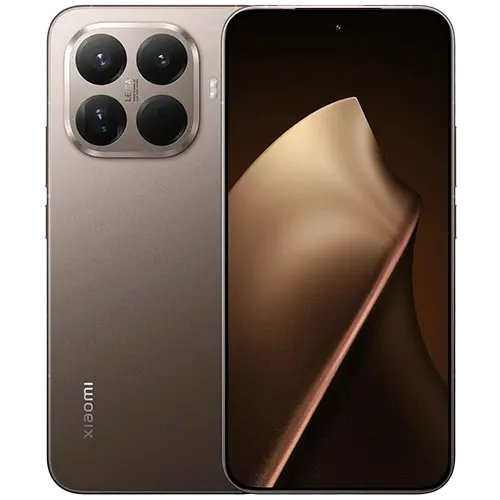
The Xiaomi 15T Pro measures 162.7 x 77.9 x 8mm and weighs 210g. It has an aluminum frame, Gorilla Glass 7i on the front, and a glass fiber back. It carries an IP68 rating, meaning it is rated for submersion in fresh water to a depth of 1.5 meters for up to 30 minutes. The display has a 20:9 aspect ratio and an 85.5% screen-to-body ratio, which means its bezels are larger than phones like the Samsung Galaxy S26 (90.8%) or the OnePlus 15 (90.8%).
At 210g, the phone is comparable in weight to the OnePlus 15 (211g) and Google Pixel 10 Pro (207g), but it is physically larger than both in length and width. The Samsung Galaxy S26, by contrast, is substantially smaller and lighter at 149.6 x 71.7 x 7.2mm and 167g, though it has a smaller 6.3-inch display. The glass fiber back is lighter than a traditional glass panel, which helps keep weight in check for the phone's footprint.
Display
The Xiaomi 15T Pro has a 6.7-inch AMOLED display running at 1440 x 3200 resolution (447 PPI), with a variable refresh rate from 30Hz to 144Hz. The 144Hz ceiling is higher than the 120Hz offered by most competitors, including the iPhone 17, Pixel 10 Pro, and Samsung Galaxy S26.
Maximum manual brightness reaches about 860 nits, which is adequate for indoor use but falls well behind the Google Pixel 10 Pro (roughly 1,450 nits) and the Google Pixel 10 (about 1,496 nits). In HDR content, sustained brightness holds at 1,273 nits over a 30-minute playback session. The iPhone 17 reaches over 3,000 nits in brief HDR peaks, and the Pixel 10 Pro exceeds 3,400 nits. The 15T Pro maintains its sustained brightness with minimal dimming at 97.76%, so the panel doesn't fade during prolonged use.
Color accuracy is a weak point. The best-performing mode is Vivid, with an average Delta E of 2.74, meaning colors deviate modestly from the Display P3 target. In practice, most people would not notice individual color errors at this level, but the maximum Delta E of 6.96 means certain colors are pushed noticeably off-target. The Original Color Pro mode, which targets sRGB, performs slightly worse on average (2.81) and has a higher peak error (8.12). In Vivid mode, the display covers nearly all of the Display P3 gamut (98.73%) and 99.88% of sRGB. The Saturated mode stretches to essentially 100% Display P3 coverage and 78.33% of Rec. 2020. Phones like the Google Pixel 10 Pro (average Delta E of 1.35 in Natural mode) and iPhone 17 (1.77 in Standard mode) are meaningfully more accurate.
Touch latency averages 9.8ms, which is very low. It’s faster than phones like the Pixel 10 Pro at 11.6ms and the iPhone 17 at 57ms. In practice, the difference between 9.8ms and the low teens is imperceptible for most tasks, but the gap to the iPhone 17's 57ms may be noticeable during fast-paced interactions like gaming.
Performance
The Xiaomi 15T Pro runs the MediaTek Dimensity 9400+ with 12GB of RAM. Storage options are 256GB, 512GB, and 1TB.
In Geekbench 6, it scores 2,596 single-core and 8,206 multi-core. The Snapdragon 8 Elite Gen 5 in the OnePlus 15 and Samsung Galaxy S26 pulls noticeably ahead. The iPhone 17's Apple A19 also leads. The generation gap is apparent in CPU-heavy workloads.
GPU performance tells a similar story. The 3DMark Wild Life Extreme stress test peaks at 5,434, with stability dropping to 67.9% and a worst-loop score of 3,691. For context, the OnePlus 15 peaks higher at 7,160 and the Samsung Galaxy S26 at 7,740. In the Solar Bay benchmark, the 15T Pro scores 9,880 at peak with 63.3% stability, compared to 13,230 peak for the OnePlus 15 and 13,860 for the Galaxy S26.
Browser performance, measured by Speedometer, comes in at 35.6, which is quite good. This means web page interactions and JavaScript-heavy content feel responsive.
Camera
The Xiaomi 15T Pro carries a triple rear camera system, including a 50-megapixel main lens, a 12-megapixel ultrawide, and a 50-megapixel telephoto. The front camera is 32 megapixels. Maximum digital zoom reaches 100x.
The main lens is the strongest performer, producing high sharpness across lighting conditions. The telephoto delivers good color accuracy, particularly in medium and low light. The ultrawide is competent but trails the main sensor in sharpness and highlight retention. The front camera is below average overall, with weak sharpness and color accuracy compared to rivals.
Sharpness is where this camera system differentiates itself. At 1x and up through about 6x, the 15T Pro resolves a high amount of detail in bright and mid-light conditions. The 4x telephoto lens maintains strong sharpness at its native focal length, and even through digital crop to 10x, detail holds up reasonably well. Beyond 20x, sharpness drops progressively, and by 80x–100x in anything other than bright light, usable detail is essentially gone. The Pixel 10 Pro handles deep zoom much better, maintaining usable sharpness even at 100x in mid and dark conditions thanks to its computational approach. In bright light at 100x, the 15T Pro resolves some detail but substantially less than the Pixel 10 Pro.
Main
The main camera uses a 50-megapixel sensor (1/1.31") with an f/1.6 aperture and 23mm equivalent focal length. Sharpness is a strong suit. In bright light, the main lens produces clean, detailed images with minimal artifacts. Sharpness remains high in mid-light and drops only modestly in dark conditions, where the sensor's large size helps gather more light.
Color accuracy in auto mode is mixed. In bright light, saturation is pushed to about 113%, with a noticeable cool-toned shift. Skin tones in particular are pulled away from their reference values. In mid-light at 4000K, hue shifts increase, but the camera corrects white balance reasonably well. In dark conditions, hue accuracy degrades further, and a warm yellow shift emerges. This progression suggests incomplete white balance correction under warmer test illuminants is the primary driver.
Dynamic range in auto mode is moderate. The processing retains highlight detail reasonably well in bright scenes, but heavy tone-mapping introduces some tonal compression. Shadow detail is preserved, but the overall tonal range is narrower than phones like the Samsung Galaxy S26 or iPhone 17, both of which distinguish more steps in high-contrast scenes. Scenes with strong shadows and bright skies will show less separation between dark and light areas.
Ultrawide
The ultrawide uses a 12-megapixel sensor (1/3.06") at f/2.2 with a 15mm equivalent focal length. Sharpness in bright light is good, and it holds up reasonably in mid-light. In dark conditions, the small sensor produces softer results, as expected. Overall sharpness is lower than the main lens, which is typical for an ultrawide, but the gap is noticeable.
Color handling is similar to the main camera. Bright-light images push saturation modestly (about 106%) with a slight cool bias. In mid and dark conditions, hue shifts increase and a warm yellow bias emerges, consistent with the white balance correction behavior seen on the main lens.
Dynamic range is decent for an ultrawide, with the auto mode producing a usable range that retains shadow detail.
Telephoto
The telephoto is a 50-megapixel sensor (1/2.76") at f/3.0 with a 115mm equivalent focal length, providing 4x optical zoom. Sharpness at its native 4x zoom level is solid, and it holds up well in mid-light. In dark conditions, the slower f/3.0 aperture and smaller sensor mean noise increases, but the phone still resolves usable detail.
Color accuracy is the telephoto's strongest quality. In bright light, the telephoto's auto mode pushes saturation to about 118%, but hue accuracy stays relatively tight. In mid-light, overall color error drops to low levels, with skin tones tracked closely. Dark conditions show some hue shift increase, but performance remains better than the main and ultrawide lenses. The telephoto produces some of the most accurate color output across all lenses on this phone.
Dynamic range in auto mode is broad, with the processing aggressively tone-mapping highlights and shadows. This results in a wide usable range but introduces uneven tonal transitions. Video stabilization on the telephoto is the weakest of the three rear lenses, with noticeable residual shake.
Front
The front camera uses a 32-megapixel sensor (1/3.44") at f/2.2 with a 21mm equivalent focal length. Sharpness is below average in bright light. Mid-light and dark-light sharpness is moderate.
Color accuracy is uneven. Bright-light auto shots push saturation to about 117%, and skin tones shift noticeably from reference values. The front camera's color performance trails that of the rear lenses and competitors like the OnePlus 15's front camera.
Dynamic range in auto mode is reasonable, with the processing recovering shadow detail and retaining highlights in typical selfie scenarios. Video stabilization is adequate for handheld selfie video.
Battery
The Xiaomi 15T Pro has a 5,500 mAh battery. In our video playback test at 200 nits, it lasted 26 hours, which translates to comfortable full-day use for most people and potentially stretching into a second day for light users. At maximum brightness, playback drops to about 22.5 hours. The OnePlus 15, with its much larger 7,300 mAh battery, lasts over 46 hours at 200 nits, nearly double. The Samsung Galaxy S26 reaches 30 hours despite a smaller 4,300 mAh cell, and the Google Pixel 10 manages about 23 hours.
Web browsing drain is 24% over the five-hour test, which is average. The Samsung Galaxy S26 and iPhone 17 drain at similar rates (24% and 22%, respectively). The OnePlus 15 is more efficient at 16%.
Gaming drain is 25% during the 3DMark stress test, which is good. The smaller-battery Samsung Galaxy S26 drains 27% and the iPhone 17 also drains 27% during the same test, so the 15T Pro is more efficient under sustained GPU load.
Standby drain is 3% over eight hours overnight, which is typical. The iPhone 17 and Samsung Galaxy S26 lose 2%, while the OnePlus 15 loses 4%.
Overall battery life is average for a phone in this price range. The 5,500 mAh capacity doesn't translate into particularly long endurance relative to competitors, though gaming efficiency is a bright spot.
Charging
The Xiaomi 15T Pro supports 120W wired charging and 50W wireless charging.
Wired charging is fast. After 10 minutes, the phone reaches 37%, and after 30 minutes it hits 87%. This matches the OnePlus 15 almost exactly (37% and 88% at the same intervals), and both are far ahead of the Samsung Galaxy S26 (21% at 10 minutes, 58% at 30 minutes) and iPhone 17 (28% and 73%). For users who charge in short bursts, a 10-minute charge before leaving the house gets over a third of the battery back.
Wireless charging reaches 23% at 10 minutes and 56% at 30 minutes, which is strong. The OnePlus 15, despite matching the 50W wireless spec, only reaches 10% and 28% at the same intervals. The Google Pixel 10 Pro manages 12% and 34%. Wireless charging on the 15T Pro is usable as a primary charging method if the wired charger isn't available.
Speaker
The speakers reach a maximum of 72.5 dB, which is average. The iPhone 17 hits 75 dB, the Google Pixel 10 reaches 76 dB, and the Google Pixel 10 Pro hits 75.6 dB.
Average total harmonic distortion is 7.64%, meaning there is moderate distortion at higher volumes. The Samsung Galaxy S26, at 3.44%, is substantially cleaner. The Google Pixel 10 and Pixel 10 Pro also produce less distortion.
The speaker's frequency character leans heavily toward bass and midrange, with a notably weak high-frequency response. Treble reproduction is poor relative to competitors, meaning vocals and instruments in the upper registers lack clarity and presence. Music and podcasts will sound somewhat muffled at the high end compared to phones like the Samsung Galaxy S26 or Google Pixel 10, both of which deliver a more balanced frequency response. Bass output is full and midrange clarity is decent, but the overall speaker experience falls below average for this price segment.
Microphone
The microphone has a frequency response standard deviation of 7.43 dB, which indicates uneven reproduction across the frequency range. Most competitors perform noticeably better — the Samsung Galaxy S26 measures 4.06 dB, the OnePlus 15 at 4.31 dB, and the Google Pixel 10 at 4.3 dB. This means voice recordings and phone calls may sound less natural, with some frequencies emphasized or suppressed relative to others. Microphone quality is below average.
Other
Measurements
Specifications
The Xiaomi 15T Pro has an optical fingerprint sensor with an average unlock speed of 230.6ms. This is average. The OnePlus 15's ultrasonic sensor averages 204.2ms, and the Xiaomi 17 reaches 162.5ms. The Samsung Galaxy S26 is comparable at 226.4ms. There is no hardware-based face unlock.
Data transfer via USB-C 2.0 is a limitation. Maximum read speed is about 41.6 MB/s and write speed is about 34.9 MB/s. The OnePlus 15, with USB-c 3.2, achieves 298 MB/s read and 230 MB/s write. The Samsung Galaxy S26 reaches 335 MB/s read. Transferring large files, such as photos or video, to a computer will be noticeably slower on the 15T Pro.
Storage is available in 256GB, 512GB, and 1TB configurations. RAM is fixed at 12GB.
Conclusion
The Xiaomi 15T Pro delivers fast wired and wireless charging, a responsive 144Hz display, and a camera system with genuinely good main-lens sharpness and strong telephoto color accuracy. Charging speed is its most distinctive advantage at this price, matched only by the OnePlus 15.
The trade-offs are that the display brightness and color accuracy fall below what similarly priced phones offer. Speaker quality is weak, microphone performance is poor, and USB-C 2.0 limits data transfer speeds. Battery life is average despite the large cell. The camera system is capable in good light but doesn't match the dynamic range or deep-zoom performance of phones like the Pixel 10 Pro. Buyers prioritizing charging speed and main-camera sharpness will find value here. Those who weight display quality, speaker output, or data transfer speed more heavily will find better options at or near this price.
Related
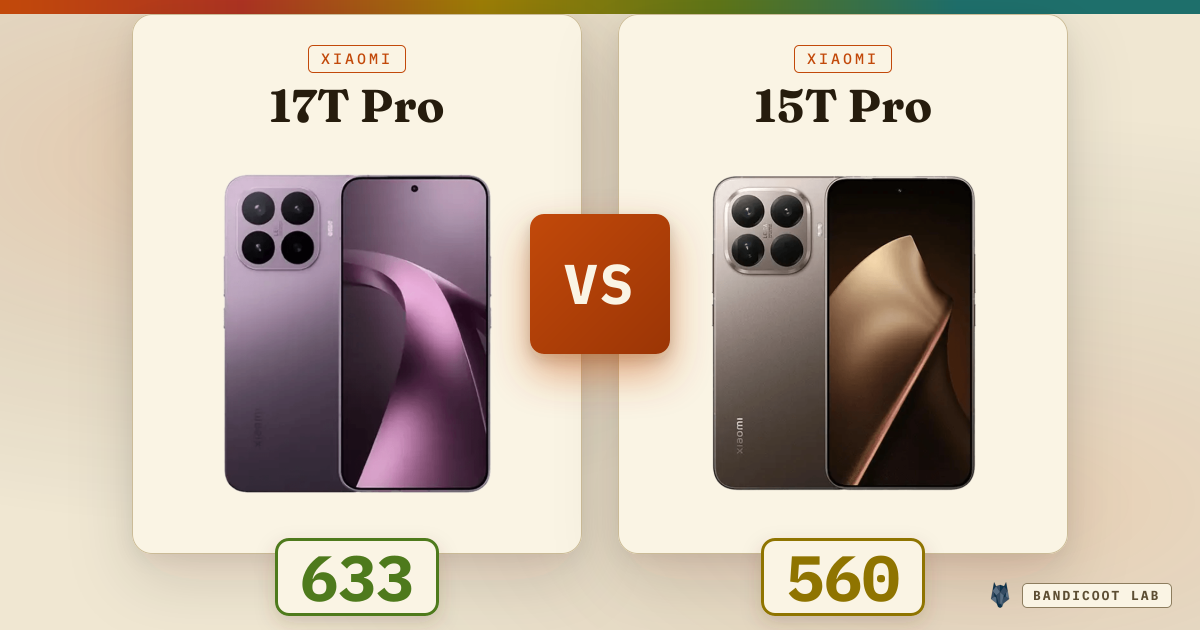
Xiaomi 17T Pro vs Xiaomi 15T Pro
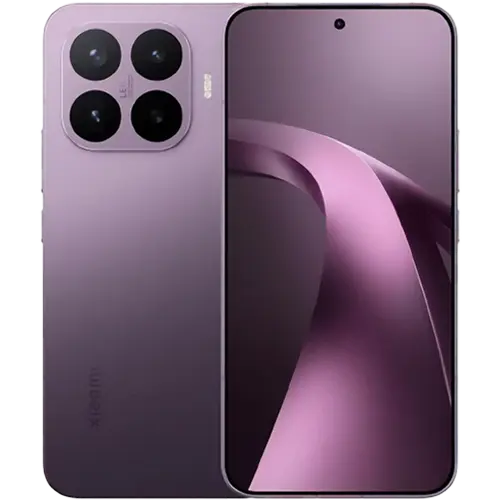
Xiaomi
17T Pro
Xiaomi
17
Xiaomi
17 Ultra
Poco
F9 Ultra
Poco
F9 Pro

RedMagic
11S Pro

OnePlus
13
Apple
iPhone 17

OnePlus
15R
Samsung
Galaxy S25