RedMagic 11 Air
Score Overview
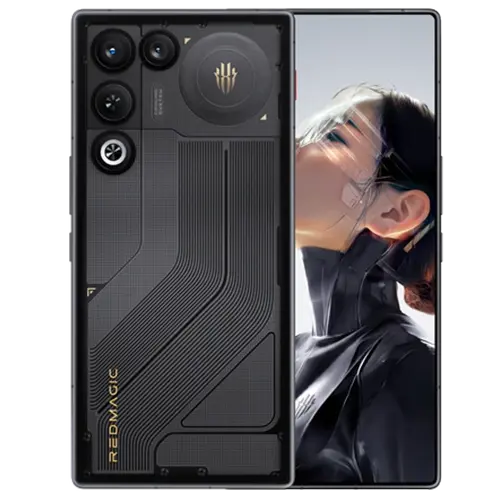
The RedMagic 11 Air is a gaming-oriented smartphone that undercuts most flagships on price while packing top-tier silicon and a massive battery. At $529, it targets buyers who want raw performance and endurance above all else, particularly mobile gamers who don't want to pay $1,000+ for a phone that can sustain demanding workloads.
The phone delivers on its core promises. Battery life and processing power are genuine strengths, and the 144Hz display is responsive to touch input. The camera system, speaker quality, and charging speed are weaker areas. The phone leans heavily into performance and longevity at the expense of a more balanced experience, and buyers who care about photography or audio will notice the tradeoffs.
Design
Specifications
The RedMagic 11 Air measures 163.8 x 76.5 x 8mm and weighs 207g. It uses an aluminum frame with Gorilla Glass 7i on the front and Gorilla Glass 5 on the back. The IP54 rating provides splash resistance but not full submersion protection. The Google Pixel 10a ($499) offers IP68 rating, and the OnePlus 15R ($700) offers IP68/IP69K rating.
The 6.85-inch display yields a 90.7% screen-to-body ratio with a 19.9:9 aspect ratio, making it a tall, large-screened device. It's slightly taller and wider than the similarly priced OnePlus 15R (163.4 x 77 x 8.1mm, 213g) but a touch lighter. Compared to the Google Pixel 10a (153.9 x 73 x 9mm, 183g), it's substantially larger in every dimension.
Bandicoot Lab does not formally test design or durability.
Display
The RedMagic 11 Air has a 6.85-inch AMOLED display running at 1216 x 2688 resolution (431 pixels per inch) with a 144Hz maximum refresh rate.
Manual brightness tops out at 665 nits, which is low. The Google Pixel 10a reaches about 1,403 nits manually, and the OnePlus 15R hits 788 nits. Outdoor visibility in direct sunlight will be noticeably limited. HDR peak brightness reaches 1,896 nits. Over a 30-minute sustained brightness test, brightness stability is strong. Minimum brightness drops to 3.8 nits, adequate for comfortable use in the dark, but higher than much of the competition.
Color accuracy is reasonable. The best-performing mode is Standard, which targets the Display P3 color space (97.7% coverage) with an average Delta E of 1.78, meaning colors are close to their reference values and most deviations won't be visible to the eye. The Colorful mode covers nearly 100% of Display P3 and 80.1% of Rec. 2020 with an average Delta E of 2.29, which is still good. The Soft mode targets sRGB with 94.9% coverage and an average Delta E of 2.57.
Touch latency averages 11.1 milliseconds, which is excellent. The Pixel 10a averages 15ms, and the OnePlus 15R sits at 24.1ms. While better, the difference is unlikely to be all that perceptible.
Performance
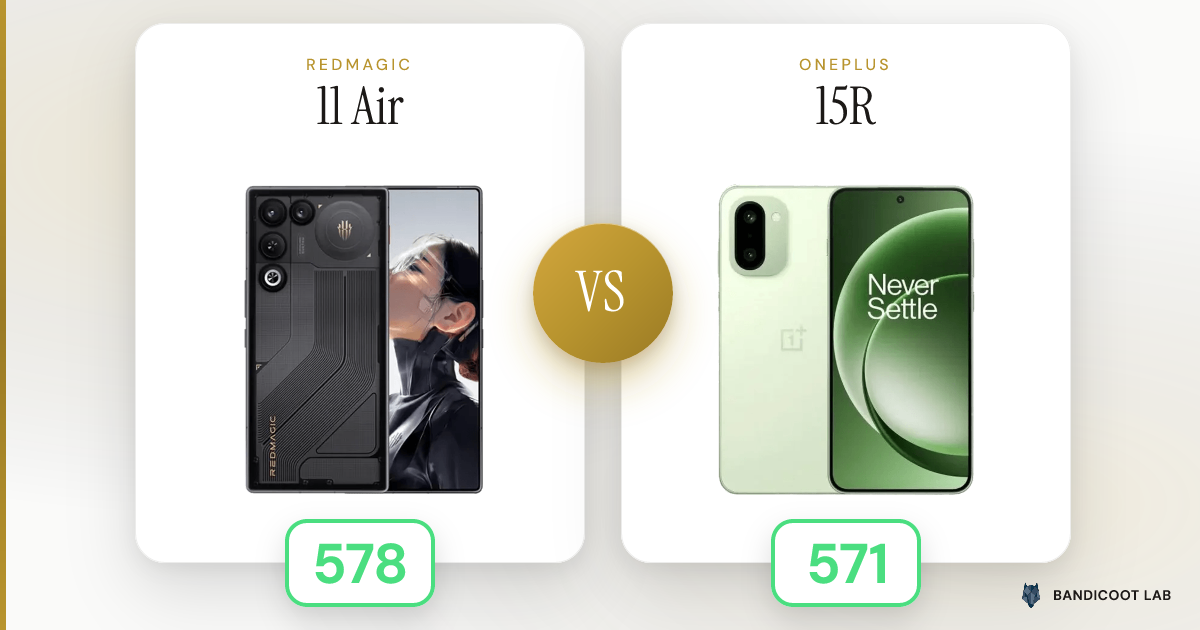
The RedMagic 11 Air runs the Qualcomm Snapdragon 8 Elite with 12GB or 16GB of RAM. Our 16GB unit scored 3,147 single-core and 9,961 multi-core in Geekbench 6. The OnePlus 15R, running the Snapdragon 8 Gen 5, scored 2,862 single-core and 9,555 multi-core. The iPhone 17e's Apple A19 leads in single-core at 3,669 but is behind in multi-core at 9,152.
GPU performance is a strength. In the 3DMark Wild Life Extreme stress test, it peaked at 6,932 with 79.5% stability, substantially higher than the OnePlus 15R's 5,079 and nearly double the iPhone 17e's 3,884. In the Solar Bay benchmark, the RedMagic peaked at 12,053 with 78.9% stability. Thermals run warm under sustained load. The stability figures suggest the phone manages throttling reasonably well, thanks, of course, to its built-in fan. Gaming drain during the stress test was 15% of battery (Solar Bay) and 37% (Wild Life Extreme).
Browser performance via Speedometer is weak at 9.12. The iPhone 17e scored 35.8 and the OnePlus 15R scored 18. This likely reflects software optimization rather than hardware capability, and everyday web browsing may feel less snappy than the raw silicon would suggest.
Camera
The RedMagic 11 Air has a 50-megapixel main camera, an 8-megapixel ultrawide, and a 16-megapixel front camera. There is no telephoto lens — digital zoom extends to 10x only.
The camera system is a weak point. Overall camera performance lags behind the Google Pixel 10a and the iPhone 17e, both of which cost roughly the same or slightly more. Sharpness on the main lens is below average and degrades quickly at higher zoom levels. At even moderate levels of zoom, the phone resolves limited detail. The lack of a telephoto lens means all zoom is digital crop, and the results reflect that limitation clearly.
The ultrawide is a better performer relative to its class. The front camera produces acceptable results in good light but struggles in low light.
Main
At 1x in bright light, the main sensor resolves well, but results drop meaningfully in mid and dark conditions. Color accuracy in auto mode shows heavy saturation boosting of around 125% in bright light, which pushes reds and skin tones noticeably warmer and more vivid than reality. Skin tone rendering is particularly affected.
Hue accuracy is decent in bright light but worsens as light drops. In dark conditions, the auto mode shifts colors slightly toward warmer tones, which is primarily a white balance issue rather than a sensor limitation. The underlying sensor data in raw mode remains relatively neutral across conditions.
Dynamic range on the main lens is strong. The auto mode captures a wide range from shadows to highlights, preserving detail in high-contrast scenes effectively. Highlights do clip in very bright areas, but the overall tonal range is broad.
Ultrawide
The ultrawide resolves detail well for an 8-megapixel sensor. Color behavior mirrors the main camera's tendency to oversaturate in auto mode, with about 126% saturation in bright light. Skin tones are pushed hard.
Dynamic range is narrower than the main lens. In high-contrast scenes, bright areas lose detail while shadows are reasonably preserved. Video stabilization on the ultrawide is average.
Front
The 16-megapixel front camera produces decent sharpness in bright and mid-light conditions. In dark conditions, processing creates visible halos around edges and an artificial look. Color accuracy in auto mode shows a notable cool/blue shift in bright light, while dark conditions swing to a warm/yellow cast, pointing to inconsistent white balance correction.
Dynamic range from the front camera is a strength, capturing a broad tonal range in auto mode. Video stabilization is moderate.
Battery
The RedMagic 11 Air packs a 7,000mAh battery, which is quite large. In our video playback test at 200 nits, it lasted 29 hours and 20 minutes. At maximum brightness, it still managed 24 hours and 16 minutes. The OnePlus 15R, with its 7,400mAh cell, pushed further at 44 hours and 13 minutes at 200 nits, but the RedMagic still significantly outlasts the Google Pixel 10a (25 hours 57 minutes) and the iPhone 17e (18 hours 27 minutes). For typical mixed use, the RedMagic should comfortably last two full days between charges.
Web browsing drain over five hours was 21%, which is solid. The Pixel 10a drained 19% and the OnePlus 15R 22% in the same test. Gaming drain during the Wild Life Extreme stress test was 37%, which is high, though this partly reflects the phone's willingness to sustain higher GPU performance with its fan, rather than throttle aggressively. Standby drain was just 1% over eight hours, which is excellent.
Charging
The RedMagic 11 Air supports 80W wired charging with no wireless charging option. From empty, the phone reaches 25% in 10 minutes and 52% in 30 minutes. Given the 7,000mAh capacity, these are modest speeds. The OnePlus 15R, also rated at 80W with a larger 7,400mAh battery, reaches 26% in 10 minutes and 63% in 30 minutes, making it noticeably faster. A full charge takes a while. The lack of wireless charging is a notable omission, though it's consistent with RedMagic's focus on keeping costs down.
Speaker
The speaker system gets loud, peaking at 79.2 dBA, which is higher than the Pixel 10a (75.4 dBA) and the OnePlus 15R (71.5 dBA). Volume is not the issue.
Sound quality is. Total harmonic distortion averages 9.7%, which is high. Distortion becomes audible at higher volumes, particularly in music with dense mixes. Bass response is thin, and the high-frequency range lacks clarity. The iPhone 17e, for comparison, manages 4.5% average distortion with much fuller bass and cleaner treble. The RedMagic's speakers are functional for game audio and casual listening but fall short for music or media consumption.
Microphone
Microphone quality is below average, with a frequency response standard deviation of 5.77. This suggests an uneven pickup across the frequency range. Voice calls will be intelligible, but recordings may sound inconsistent, with some frequencies emphasized more than others.
Other
Measurements
Specifications
The optical fingerprint sensor unlocks in an average of 261 milliseconds. This is slower than the OnePlus 15R's ultrasonic sensor at 158ms but comparable to the Google Pixel 10a at 265ms. There is no hardware-based face unlock.
Data transfer over USB-C 2.0 is slow. Large file reads max out at about 42 MB/s and writes at about 37 MB/s. The Pixel 10a's USB-C 3.2 connection is roughly four times faster for large file transfers. If you regularly move large files between your phone and computer, this is a real limitation.
Storage configurations are 256GB and 512GB.
Conclusion
The RedMagic 11 Air delivers exactly what its positioning suggests — strong GPU and CPU performance, excellent battery life, and a responsive high-refresh-rate display. It outperforms the OnePlus 15R in raw GPU benchmarks despite costing less, and its battery comfortably outlasts the iPhone 17e and Pixel 10a.
The compromises are in the camera system, which trails every competitor in this price range, with weak zoom performance and oversaturated color processing. The speaker produces high volume but poor fidelity. Charging is slower than similarly priced 80W competitors. Display brightness is limited for outdoor use. IP54 water resistance is a step below what's typical at this price. If gaming performance and battery life are your primary concerns and you can accept a below-average camera, the RedMagic 11 Air is a competitive option. If you need a more balanced phone, the Google Pixel 10a or OnePlus 15R offer better-rounded packages.
Related
Best Phones For Any Budget
RedMagic 11 Air vs OnePlus 15R
RedMagic 11 Air vs OnePlus 15
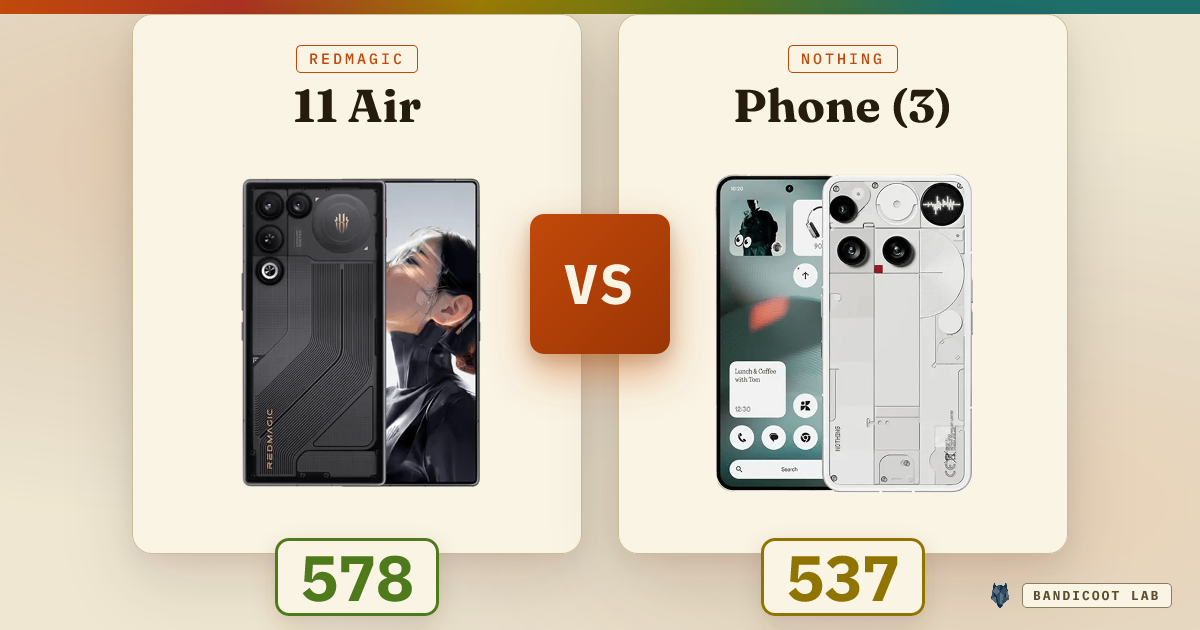
RedMagic 11 Air vs Nothing Phone (3)

RedMagic
11S Pro
Apple
iPhone 17e
Apple
iPhone 16e
Honor
600
Nothing
Phone (4a) Pro
Pixel 9a
Pixel 10a
Nothing