Samsung Galaxy S26 Ultra

Samsung
Galaxy S26 Ultra
Ranked #7 of 61 devices tested
Score Overview
The Samsung Galaxy S26 Ultra is a $1,300 flagship built around a 6.9-inch Dynamic LTPO AMOLED 2X display, the Qualcomm Snapdragon 8 Elite Gen 5 chipset, and a five-camera system anchored by a 200-megapixel main sensor. It carries over the same 5,000mAh battery and 60W wired charging as prior Ultra models, pairs two telephoto lenses with a 50-megapixel ultrawide, and keeps the IP68 rating, S Pen support, and USB-C 3.2 port. It's slightly lighter and thinner than the Galaxy S25 Ultra, but generally a similar size — even if it has a design that more closely resembles the other devices in the Galaxy S26 lineup.
The S26 Ultra's strengths cluster around performance, speaker quality, connectivity, and biometrics. Its camera system produces strong sharpness from the main lens and good color from the telephoto lenses, though overall camera results are a step behind the Xiaomi 17 Ultra. The display is competent but not class-leading, held back by color accuracy. Battery life is middling for a phone at this price, too. Charging is faster than Samsung's typical pace, though still slower than competitors from Honor and Xiaomi.
Design
Specifications
The Galaxy S26 Ultra measures 163.6 x 78.1 x 7.9mm and weighs 214 grams. It uses an aluminum frame with Gorilla Armor 2 on the front and Gorilla Glass Victus 2 on the back. The 6.9-inch display has a 19.5:9 aspect ratio and a 91.5% screen-to-body ratio. An IP68 rating covers full dust ingress and fresh-water submersion beyond 1 meter, with depth and duration set by Samsung. Bandicoot Lab does not formally test design or durability, so this section is descriptive rather than scored.
The S26 Ultra is a notable lightweight move for Samsung's Ultra line. The previous-generation Galaxy S25 Ultra weighed 218 grams with a titanium frame; the S26 Ultra drops back to aluminum and shaves 4 grams. It's also thinner at 7.9mm versus 8.2mm. Against same-price rivals the iPhone 17 Pro Max at $1,199 is noticeably heavier at 233 grams and thicker at 8.8mm despite sharing the 6.9-inch display size. The Pixel 10 Pro XL at $1,199 is 232 grams and 8.5mm thick with a smaller 6.8-inch display.
Display
The Galaxy S26 Ultra's 6.9-inch panel runs at 1440 x 3120 resolution (500 PPI), with a 120Hz adaptive refresh rate that drops to 1Hz for static content. It uses Samsung's Dynamic LTPO AMOLED 2X technology.
Peak HDR brightness measured 3,022.7 nits, which is strong — close to the iPhone 17 Pro Max's 2,975.8 nits and in the same neighborhood as the Pixel 10 Pro XL's 3,405.1 nits. HDR brightness stability was 48.8%, meaning the display dims noticeably when there’s more bright content on the screen. Maximum manual brightness reached 975.6 nits, a substantial jump from the Galaxy S25 Ultra's 717.8 nits. Minimum brightness drops to 1.21 nits, which is fine for dark room use. Brightness stability under sustained load was 98.61%, so the screen holds its brightness well over time.
Color accuracy is where the display falters. In Vivid mode, the lowest average Delta E was 3.9. Colors rendered in Vivid mode target the wider Display P3 gamut and cover 83.11% of it. Switching to Natural mode improves accuracy to an average Delta E of 2.75, which is passable but still behind the Honor Magic8 Pro's 0.82 or the Pixel 10 Pro XL's 1.32 in their respective accurate modes. The Galaxy S25 Ultra had similar accuracy issues, so this isn't a regression — but Samsung's color tuning continues to lag behind the competition in sRGB-targeted modes.
Touch latency averaged 21ms, on par with the Galaxy S25 Ultra's 20.6ms. The Pixel 10 Pro XL measured 15.7ms and the Galaxy S26+ came in at 15.9ms. The difference between 15 and 21ms is unlikely to be perceptible in daily use.
Performance
The Snapdragon 8 Elite Gen 5 powering the Galaxy S26 Ultra is paired with 12GB of RAM. It posts a Geekbench 6 single-core score of 3,685 and a multi-core score of 11,198 — a meaningful generational jump from the Galaxy S25 Ultra on the previous-generation Snapdragon 8 Elite. The iPhone 17 Pro Max's A19 Pro beats it in single-core at 3,852 but trails in multi-core at 9,872.
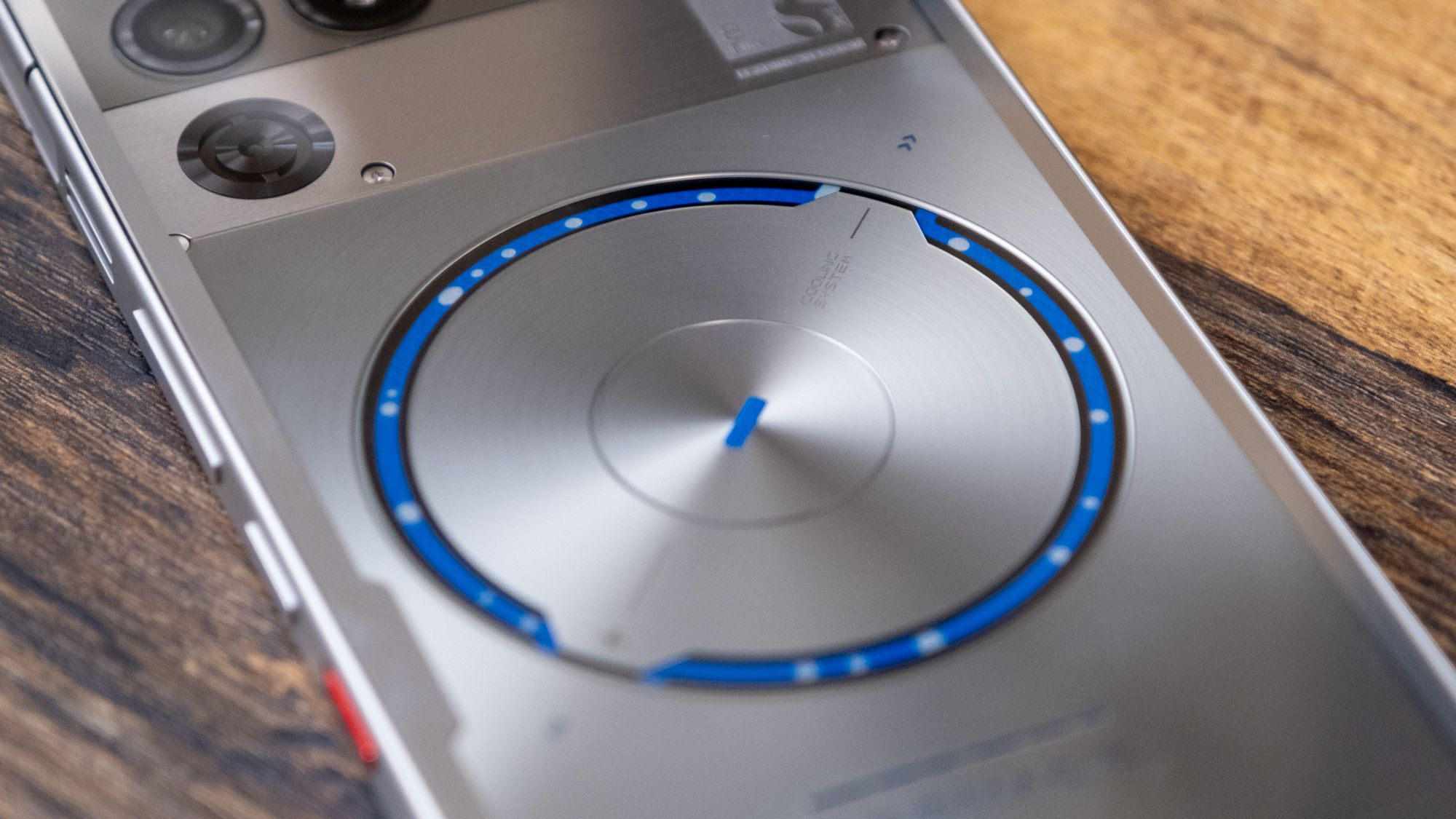
GPU performance is strong. The 3DMark Wild Life Extreme stress test returned a peak loop score of 7,802, up from the S25 Ultra's 6,911. It does heavily throttle over the test though — stability dropped to 49.8%, meaning sustained gaming performance falls to roughly half of the initial peak. The iPhone 17 Pro Max's peak of 5,828 is lower, but its 73.1% stability means it sustains performance more consistently. The Honor Magic8 Pro, running the same Snapdragon 8 Elite Gen 5, hit 6,963 peak with 64.1% stability — better thermal management despite similar silicon.
In the Solar Bay ray tracing benchmark, the S26 Ultra scored 13,861 at its best loop with 56.2% stability.
Browser performance came in at 46 on the Speedometer benchmark, which is very strong — ahead of the Honor Magic8 Pro's 44.7 and the Galaxy S25 Ultra's 32.4. This translates to noticeably snappier web page interactions.
Camera
The Galaxy S26 Ultra carries a five-camera system: a 200-megapixel f/1.4 main sensor (1/1.3-inch, 23mm), a 50-megapixel f/1.9 ultrawide (1/2.5-inch, 14mm), a 10-megapixel f/2.4 short telephoto at 3x (1/3.94-inch, 67mm), a 50-megapixel f/2.9 long telephoto at 5x (1/2.52-inch, 111mm), and a 12-megapixel f/2.2 front camera. The main sensor's f/1.4 aperture is wider than the S25 Ultra's f/1.7.
Overall camera performance is solid, with particular strength in main lens sharpness and telephoto color accuracy. The system scores behind the Xiaomi 17 Ultra, which benefits from a 1-inch main sensor and a larger telephoto sensor, and falls slightly behind the iPhone 17 Pro Max in the aggregate. Samsung's processing tends toward vivid, punchy color — saturation is boosted in auto mode across most lenses, which is a stylistic choice rather than an accuracy problem. The deeper concerns are with hue accuracy, which degrades in lower light conditions.
Sharpness is one of the S26 Ultra's clear strengths. The main lens at 1x in bright light produces excellent resolved detail. At the 5x native telephoto, bright-light sharpness is also very high. Results hold up well in mid-light and degrade gradually in dark conditions. The deep zoom range (beyond 10x) shows steady dropoff.
Main
The 200-megapixel main sensor resolves high detail in bright light, and retains strong sharpness in mid and dark conditions. Sharpening artifacts are minimal, with overshoot staying low across lighting levels.
Color accuracy in auto mode reflects Samsung's characteristic saturation boost. In bright light (1000 lux, 5500K), saturation is relatively high, pushing skin tones noticeably warmer and more vivid than they appeared in person. Hue accuracy is reasonable in bright light, with moderate hue shift. In mid-light (100 lux, 4000K), saturation drops closer to neutral but hue shift increases. Looking at the bias data, we can see that the sensor is struggling with hue resolution at lower light levels rather than failing to correct for the warmer ambient illuminant. In dark conditions (10 lux, 3000K), hue shift increases further with the same pattern — this is primarily a sensor-level limitation at higher ISO settings.
Dynamic range in auto mode is strong. It’s in the same ballpark as the Galaxy S25 Ultra and ahead of the iPhone 17 Pro Max's main lens auto result.
Ultrawide
The 50-megapixel ultrawide covers a 0.6x field of view (14mm equivalent). Sharpness is good in bright conditions and holds up reasonably well in mid-light, though it falls behind the Xiaomi 17 Ultra's ultrawide, which scored notably higher.
Color processing follows the same saturation-forward approach as the main lens. In bright light, saturation is boosted to about 115% with moderate hue shift. In dark light, color accuracy improves somewhat in auto mode compared to mid-light, with lower overall Delta E — the processing pulls back on saturation and the lens handles hue reasonably well.
Dynamic range from the ultrawide is narrower than the main lens, as expected from the smaller 1/2.5-inch sensor.
Telephoto Short
The 3x telephoto uses a 10-megapixel f/2.4 sensor — the same small 1/3.94-inch unit carried over from the Galaxy S25 Ultra. This is the weakest sensor in the system on paper.
Sharpness at native 3x is moderate in bright conditions and drops in mid and dark light. The small sensor and low resolution limit how much detail this lens can resolve, and it falls behind the main lens crop and the 5x telephoto in resolved detail at equivalent fields of view.
Color accuracy is one of this lens's relative strengths though. In bright light, Samsung's processing applies noticeable saturation boost but keeps hue errors under control. The mid-light white balance correction is adequate — the increase in hue shift in dark conditions is driven more by sensor noise and hue confusion from the small sensor at high ISO. In low lighting, skin tones drift further and noise is heavily smoothed by processing.
Dynamic range in auto mode is good for a telephoto of this sensor size. Stabilization performed well, too.
Telephoto Long
The 5x telephoto uses a 50-megapixel f/2.9 sensor (1/2.52-inch, 111mm equivalent). This is the more capable of the two telephoto lenses.
Sharpness at native 5x is high in bright light and holds up well in mid-light. The larger sensor and higher resolution give it a meaningful advantage over the 3x telephoto. In dark conditions, resolved detail drops but remains usable.
Color is a strong point. In bright light auto mode, overall Delta E is moderate and skin tone accuracy is good — better than most other lenses on this phone. In mid-light, hue shift increases modestly. Dark-light auto mode shows a large jump in Delta E with notably high skin tone error and elevated hue shift — the processing pipeline appears to struggle with the noisy low-light signal from this sensor.
Dynamic range in auto mode is moderate — narrower than the main lens but expected given the smaller sensor and longer focal length.
Front
The 12-megapixel f/2.2 front camera uses a 1/3.2-inch sensor at 23mm equivalent. It's unchanged from the Galaxy S25 Ultra.
Sharpness is adequate in bright light and drops in darker conditions. The front camera resolves less detail than the main or telephoto lenses, which is typical for a selfie sensor. The iPhone 17 Pro Max's 18-megapixel front camera produces sharper results across all lighting levels.
Color accuracy in auto mode is reasonable. Bright-light output shows moderate saturation boost and controlled hue shift. In mid-light, hue errors increase notably. Dark-light hue shift is substantial.
Dynamic range is limited — the weakest of any lens on the phone, with only moderate usable range in auto mode. The front camera also clips highlights early, which can affect outdoor selfies with bright skies.
Stabilization on the front camera was the weakest among all lenses, though the impact depends on whether video selfies are a priority.
Battery
The Galaxy S26 Ultra retains the same 5,000mAh battery as its predecessor. Video playback at 200 nits ran for 31 hours and 34 minutes — marginally better than the Galaxy S25 Ultra's 30 hours and 59 minutes. At maximum brightness, playback lasted 29 hours and 17 minutes. These are solid endurance numbers for video consumption; two days of moderate use between charges is realistic.
Web browsing drain was 24% over our five-hour test, identical to the Galaxy S25 Ultra. This translates to roughly 21 hours of continuous browsing at 200 nits — adequate but unremarkable.
Gaming drain measured 24% during the 3DMark stress test, slightly better than the S25 Ultra's 26% and the iPhone 17 Pro Max's 25%. The Honor Magic8 Pro matched at 25% but has a 7,100mAh battery, meaning it has substantially more total gaming time available.
Standby drain was 10% over eight hours, which is unusually high. The Galaxy S25 Ultra and iPhone 17 Pro Max both lost only 2% over the same period. The Honor Magic8 Pro lost 7%. This elevated idle drain will eat into real-world battery life, particularly overnight, however it’s also likely an optimization issue that could be fixed with updates.
Overall, the S26 Ultra's battery performance is solid. The strong video playback number is offset by average web browsing efficiency and notably poor standby drain.
Charging
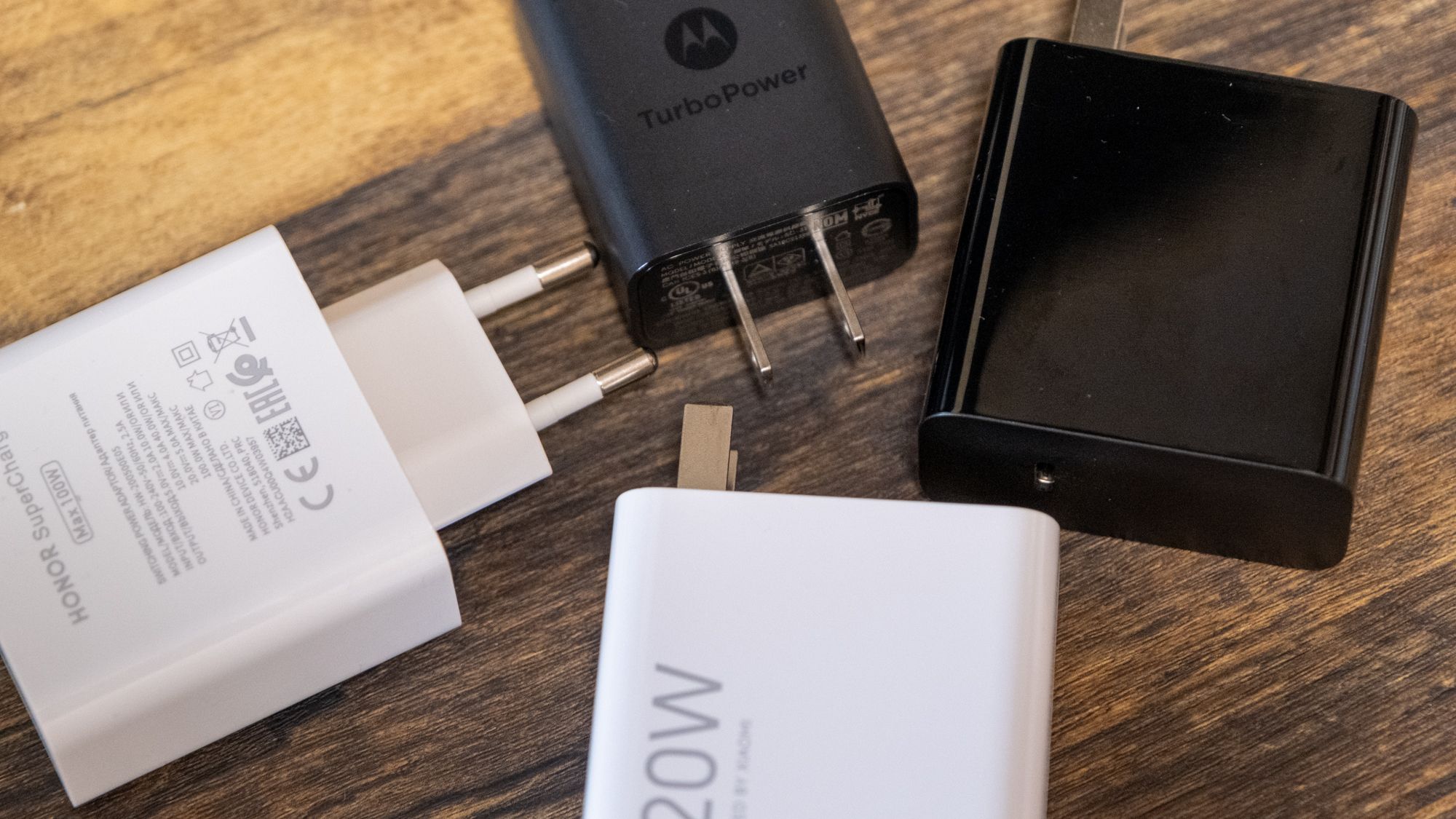
The Galaxy S26 Ultra supports 60W wired charging and 25W wireless charging. Wired charging reached 34% in 10 minutes and 79% in 30 minutes — a clear improvement over the Galaxy S25 Ultra's 29% and 74% at the same intervals, reflecting the jump from 45W to 60W charging. The iPhone 17 Pro Max, limited to 40W wired charging, managed only 29% and 67% at those same marks.
The Honor Magic8 Pro's 120W charging hit 30% in 10 minutes and 81% in 30 minutes on a much larger 7,100mAh battery, so despite the higher wattage it fills proportionally faster.
Wireless charging at 25W reached 18% in 10 minutes and 44% in 30 minutes. The iPhone 17 Pro Max, also rated at 25W wireless, did slightly better at 20% and 47%. Samsung's wireless charging is functional but not a standout. Magnetic alignment might help with this a little.
Speaker
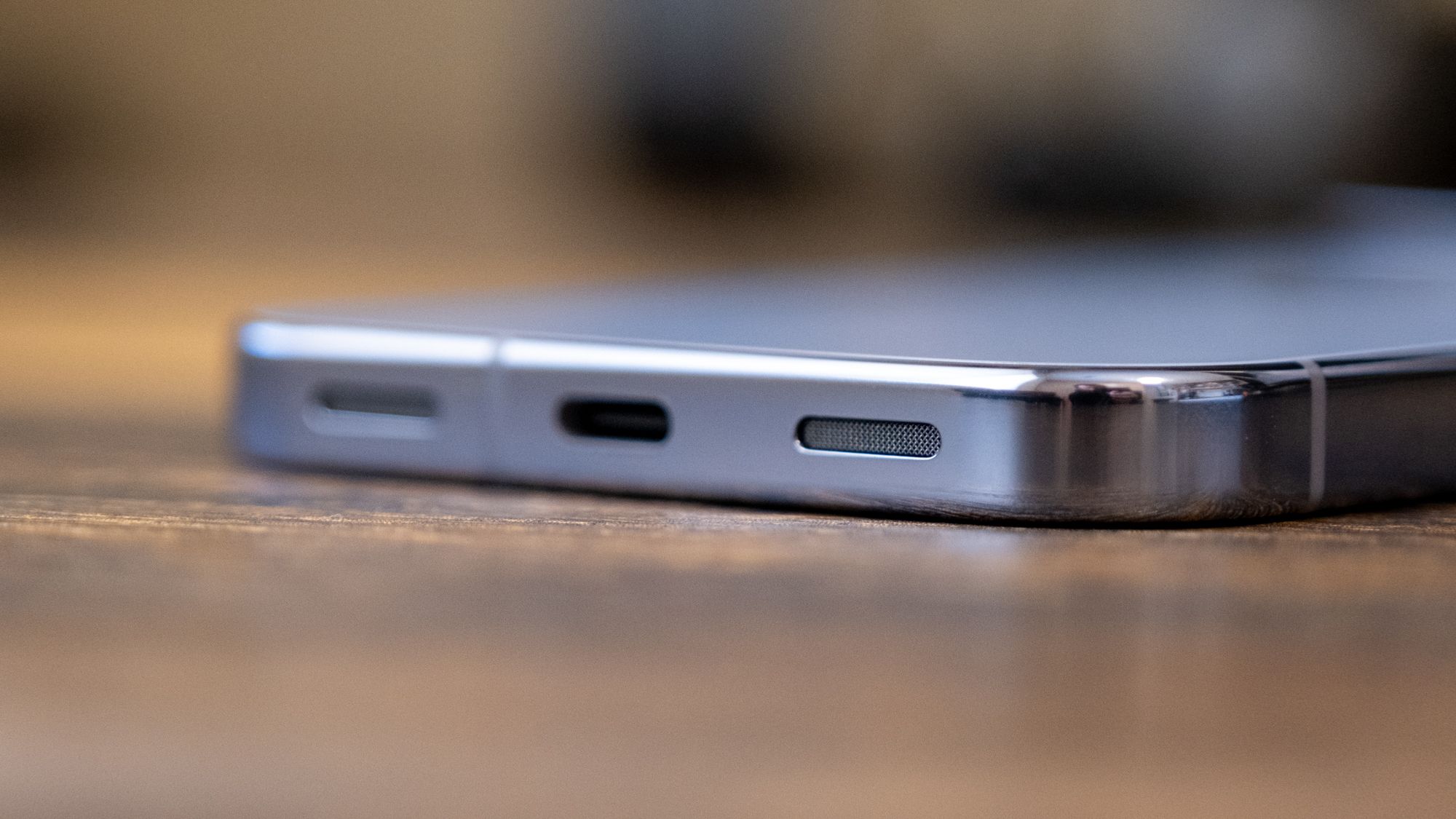
The Galaxy S26 Ultra's speaker was a step up from its predecessor in several ways. Bass extension improved to 18.4 dB of decay from the mids, better than the Galaxy S25 Ultra's 21.8 dB. The high end was clear and well-extended at 8 dB above the mids. Loudness of 75.3 dBA was lower than the Galaxy S25 Ultra's 78.6 dBA — a slight regression. Distortion was the best result in its price bracket at 3.3%, cleaner than the Pixel 10 Pro XL's 10.1% and iPhone 17 Pro Max's 8.9%.
Microphone
The Galaxy S26 Ultra's microphone performance fell below the database average. Frequency response standard deviation was higher than some othets. The Galaxy S25 Ultra, iPhone 17 Pro Max, and Honor Magic8 Pro all produced flatter responses. Voice calls and basic recordings will be fine, but for any recording-sensitive use, this is a weak point for a $1,300 phone.
Other
Measurements
Specifications
The ultrasonic fingerprint sensor unlocked in an average of 137.5ms — fast, and a noticeable improvement over the Galaxy S25 Ultra's 208.3ms. The Pixel 10 Pro XL's ultrasonic sensor measured 213.9ms.
Data transfer over USB-C 3.2 is fast too. Large file reads hit 331.57MB/s and writes reached 274.26MB/s, comparable to the Galaxy S25 Ultra and Honor Magic8 Pro. Small file transfer speeds were also strong. The Xiaomi 17 Ultra's USB-C 3.2 Gen 2 port pulled ahead in large file reads at 440MB/s, but the S26 Ultra's transfer speeds are more than adequate for backing up photos or moving large files.
Conclusion
The Galaxy S26 Ultra delivers strong performance, fast biometrics, clean speaker output, and a capable multi-lens camera system — the core features that matter in daily use are well-executed. The Snapdragon 8 Elite Gen 5 provides a meaningful generational jump in CPU and browser speed over the Galaxy S25 Ultra, and the faster fingerprint sensor and improved wired charging address longstanding complaints.
The weaknesses are specific and measurable. Display color accuracy in both Vivid and Natural modes trails behind the Honor Magic8 Pro and Pixel 10 Pro XL. The 3x telephoto lens, still using a small 10-megapixel sensor, is the weakest link in an otherwise capable camera array. And while 60W charging is faster than Samsung's previous 45W standard, it still falls short of what Honor and Xiaomi offer at similar price points. For buyers prioritizing camera versatility with dual telephoto lenses and Samsung's software ecosystem, the S26 Ultra is a well-rounded choice.
Related

Poco F9 Ultra vs Samsung Galaxy S26 Ultra
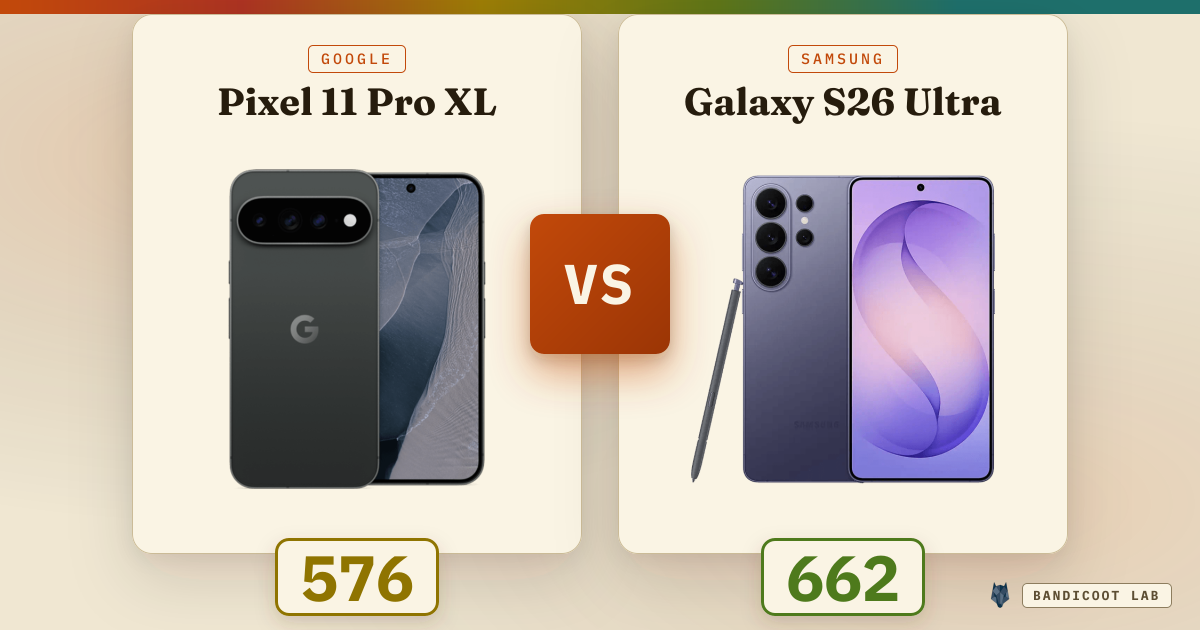
Google Pixel 11 Pro XL vs Samsung Galaxy S26 Ultra
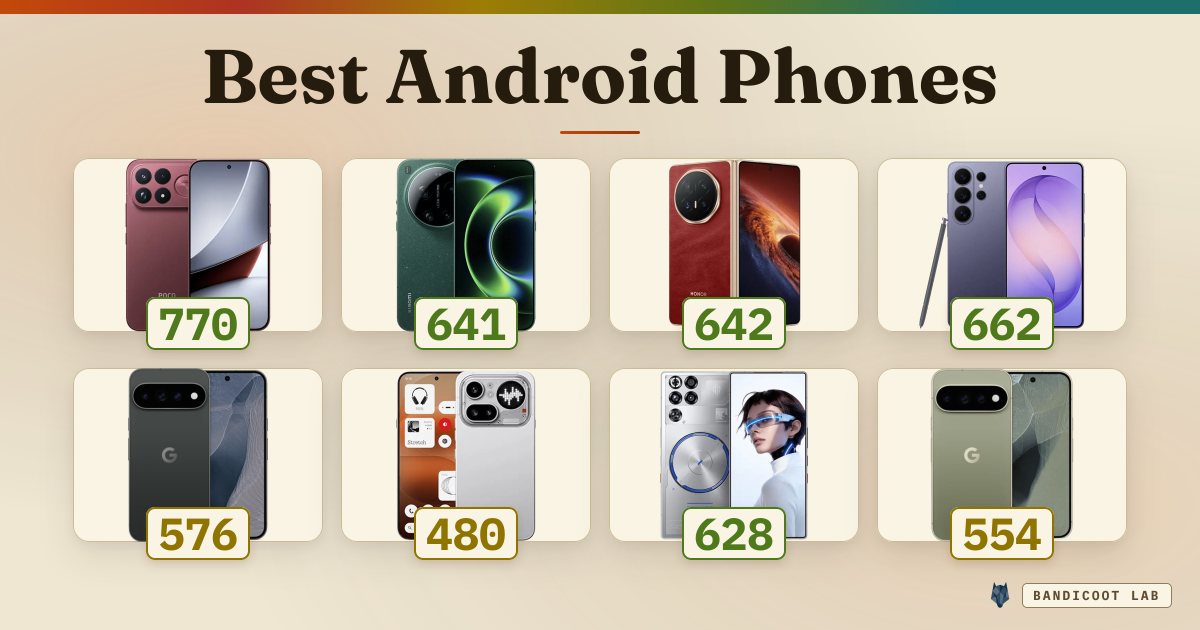
Best Android Phones
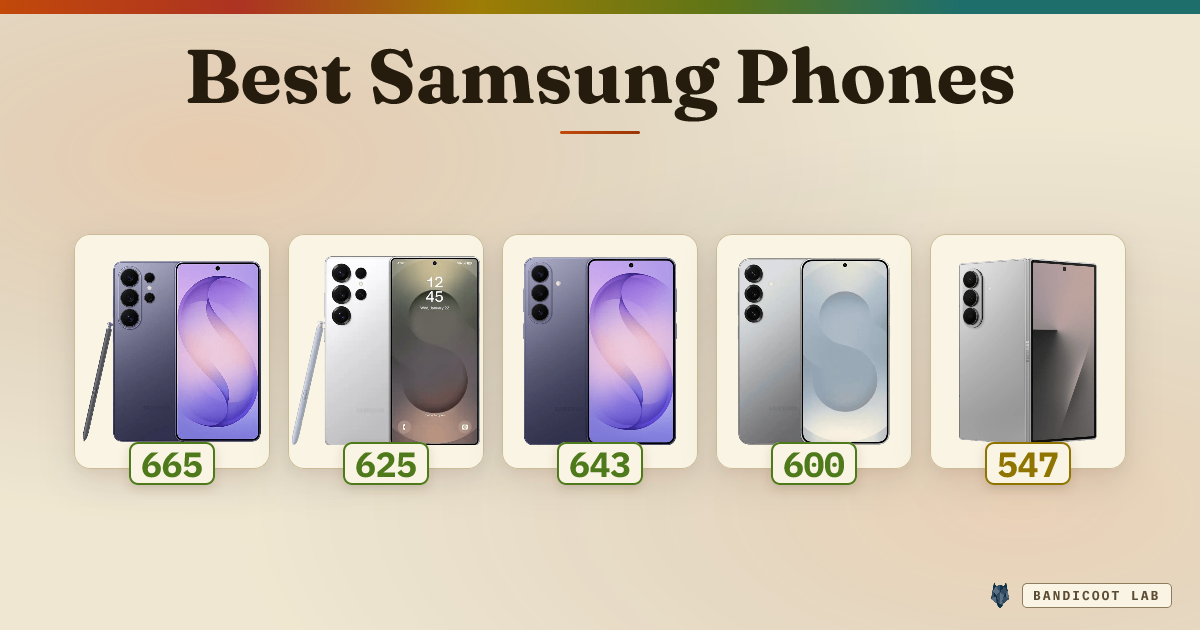
Best Samsung Phones

Samsung Galaxy S26 Series vs Galaxy S25 Series
The house look: How phone brands tune camera color
How we test speakers and microphones

Samsung Galaxy S26 Series vs Xiaomi 17 Series
How we test charging

Samsung Galaxy S26 vs Galaxy S26+ vs Galaxy S26 Ultra
How we test performance
Samsung Galaxy S26 Series vs Google Pixel 10 Series
How we test batteries

Apple iPhone 17 Series vs Samsung Galaxy S26 Series
Sensor size vs dynamic range: Does a bigger sensor capture more?
How we test cameras
Best Phones for Selfies
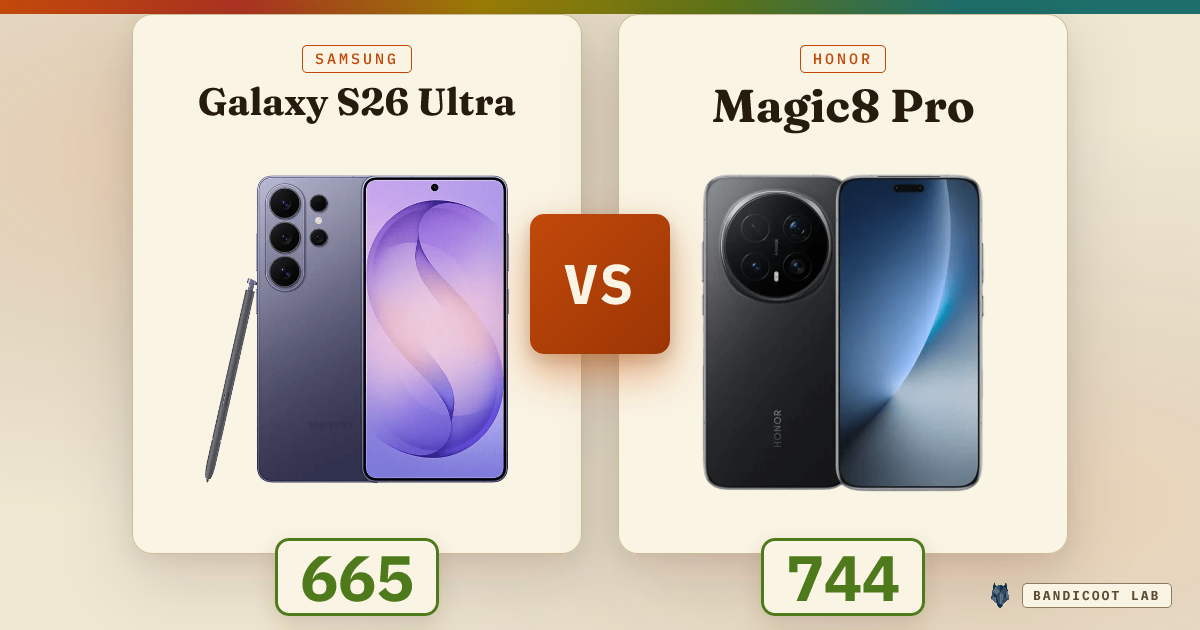
Samsung Galaxy S26 Ultra vs Honor Magic8 Pro

Samsung Galaxy S26 Ultra vs Xiaomi 17 Ultra
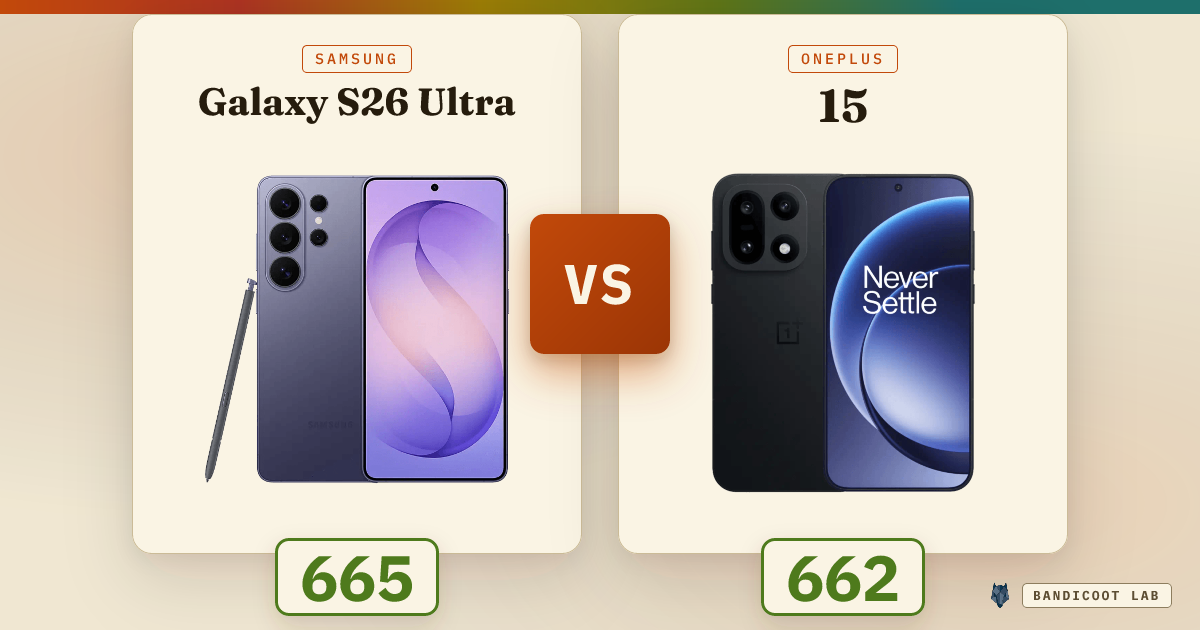
Samsung Galaxy S26 Ultra vs OnePlus 15

Samsung Galaxy S26 Ultra vs Galaxy S25 Ultra
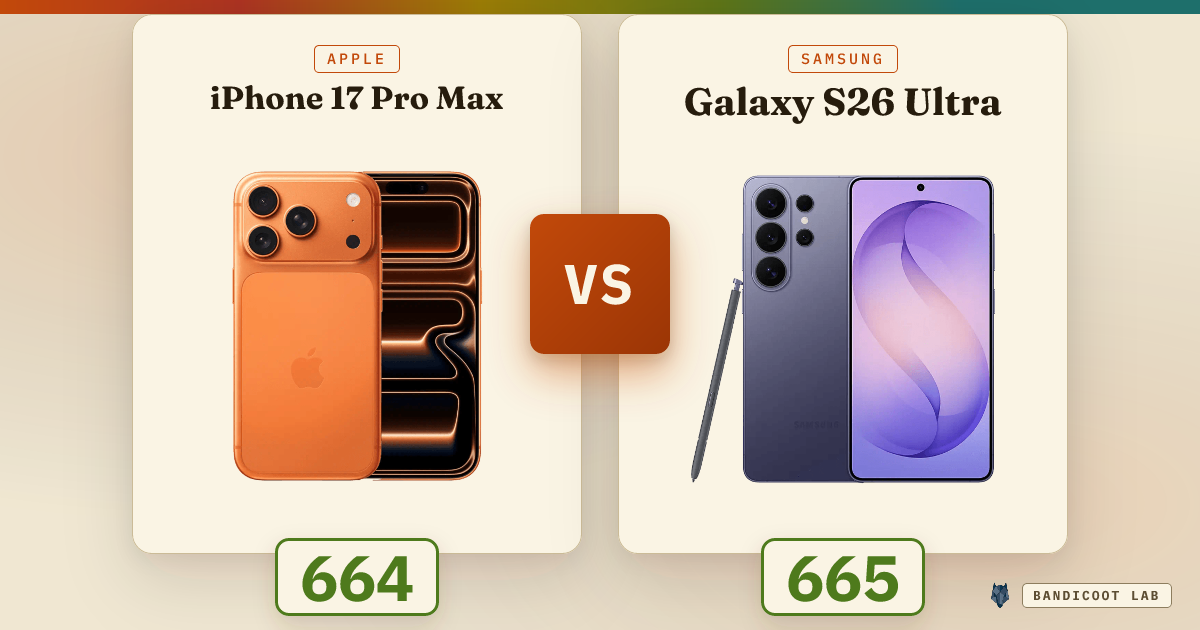
Apple iPhone 17 Pro Max vs Samsung Galaxy S26 Ultra
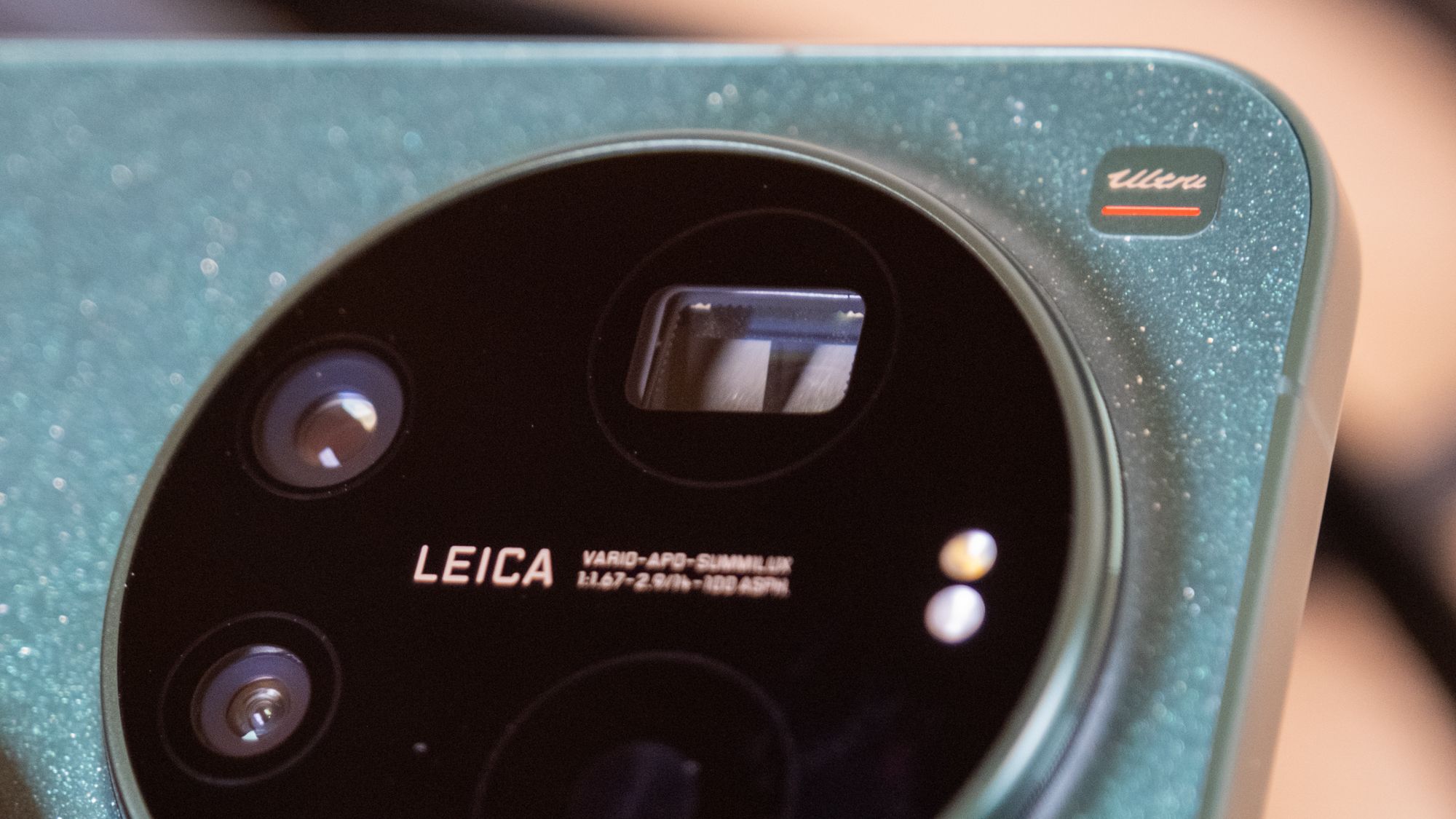
Megapixels vs sharpness: Does resolution buy sharper photos?

Samsung Galaxy S26 vs S26+ vs S26 Ultra

Samsung Galaxy S26 Ultra vs Google Pixel 10 Pro XL
Samsung