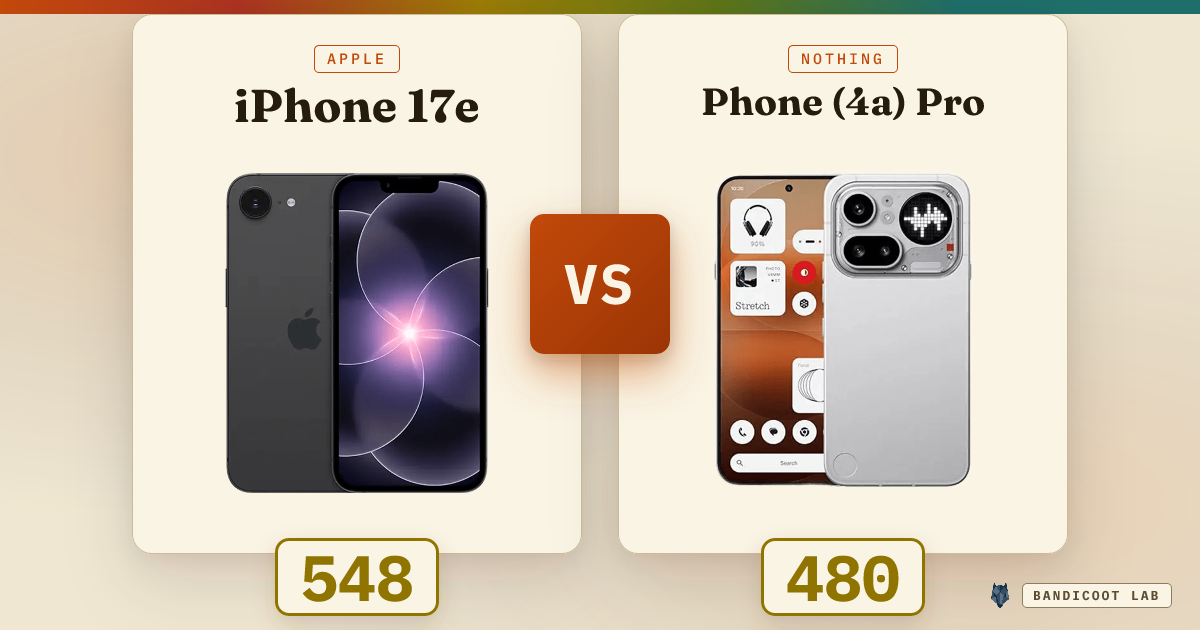
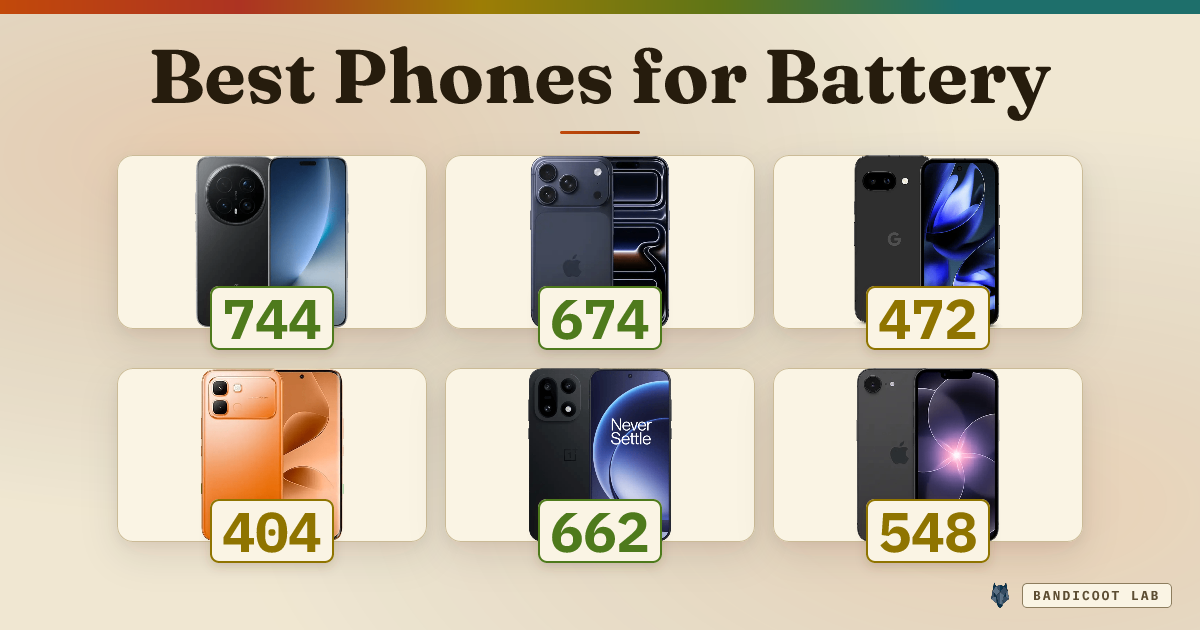
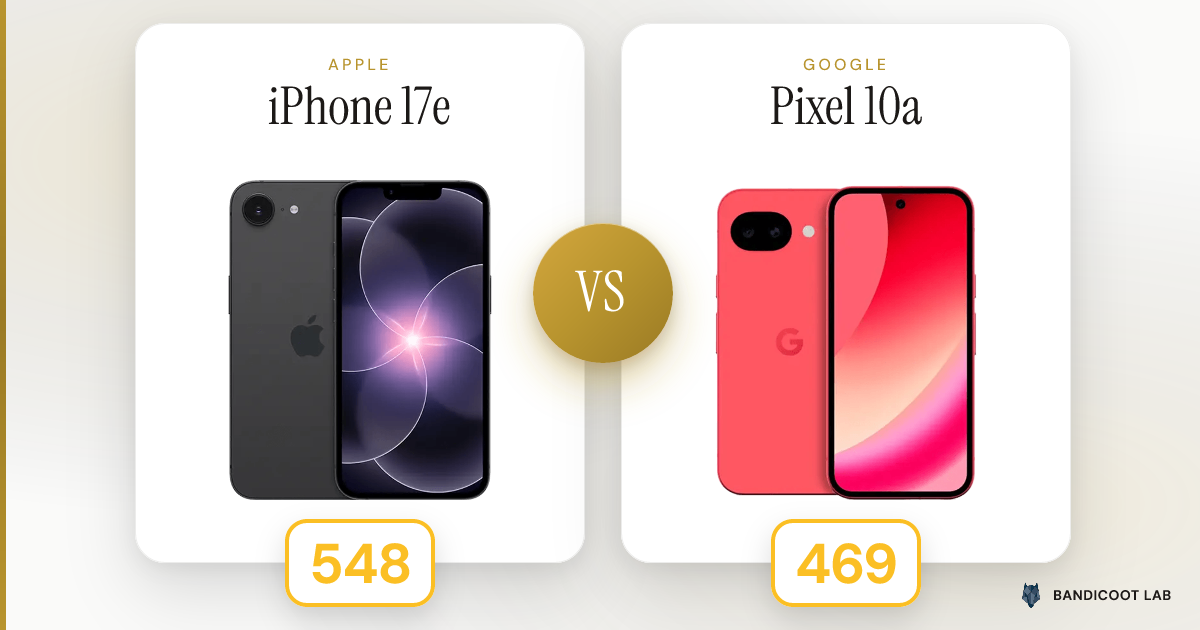
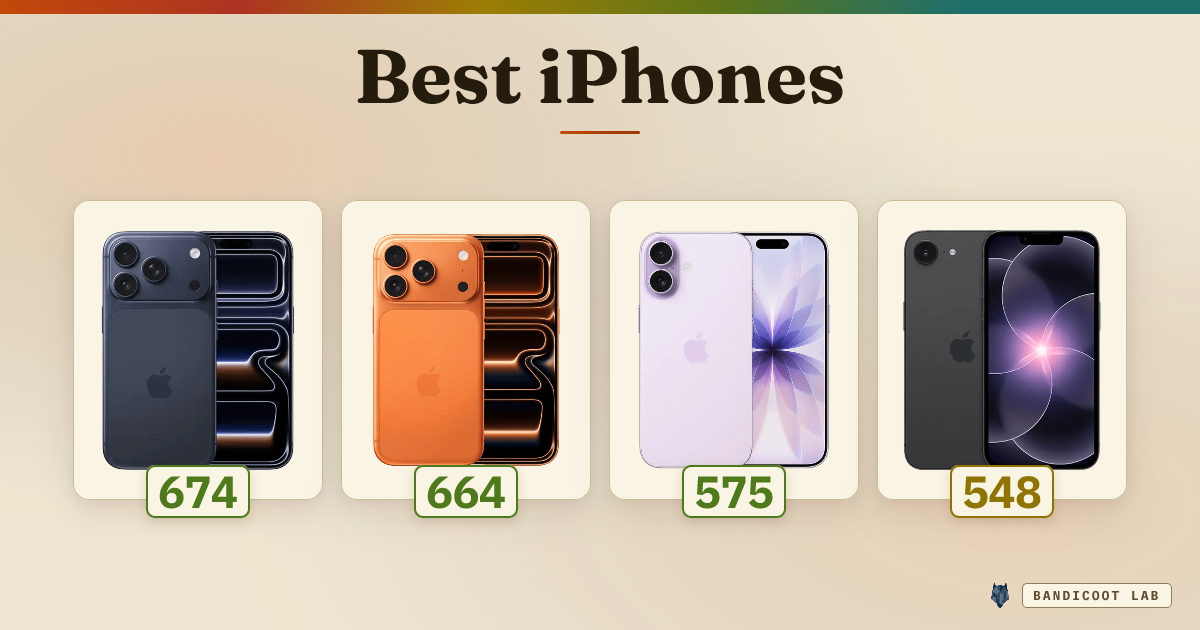
Apple iPhone 17e vs iPhone 16e
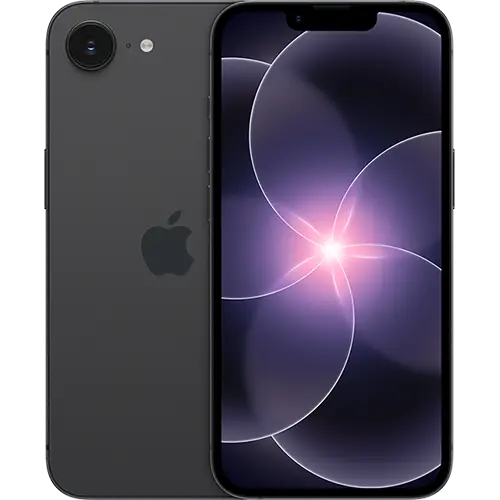
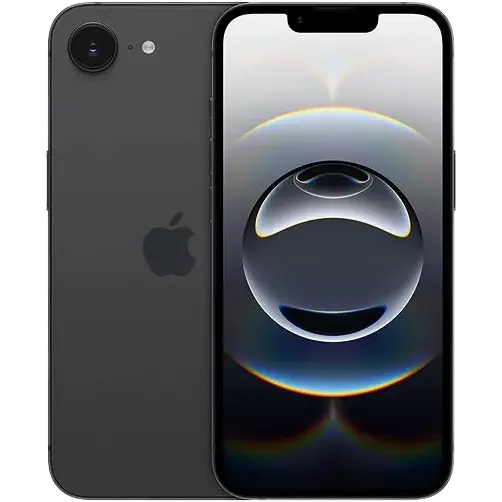
Apple
Apple
iPhone 17e
iPhone 16e
Ranked #33 of 60
Ranked #42 of 60
Overall
Overall
The iPhone 17e is Apple’s so-called “budget” phone, coming in at $599 and replacing the iPhone 16e, which came at the same price. The 16e was Apple's first attempt at merging the SE line into a more modern shell, and the 17e is a direct successor built on the same physical template. Both are single-camera phones aimed at people who want iOS without paying flagship prices. Neither has an ultrawide or telephoto lens, and both top out at a 60Hz display.
The iPhone 17e beats its predecessor in some predictable ways, like in processing power and graphics performance. It also has a meaningful advantage in wireless charging speed. The iPhone 16e, however, still beats the iPhone 17e in a few ways.
Here’s how the iPhone 17e really competes with the iPhone 16e, and where they’re the same, based on our lab testing.
Design
| Apple iPhone 17e | Apple iPhone 16e | |
|---|---|---|
| Specifications | ||
| Dimensions | 146.7 x 71.5 x 7.8 mm | 146.7 x 71.5 x 7.8 mm |
| Weight | 169g | 167g |
| IP Rating | IP68 | IP68 |
| Frame | Aluminum | Aluminum |
| Front | Ceramic Shield 2 | Ceramic Shield |
| Back | Glass | Glass |
| Screen-to-body ratio | 87.1% | 87.1% |
These two phones are physically identical in almost every measurable way. Both use aluminum frames, glass backs, and 6.1-inch displays at an 87.1% screen-to-body ratio with a 19.5:9 aspect ratio. Dimensions are the same: 146.7 x 71.5 x 7.8mm. Weight differs by 2 grams — 169g for the 17e, 167g for the 16e. Both carry an IP68 rating, meaning submersion in fresh water to a rated depth.
The one spec-sheet difference in materials is the front glass: the 17e uses Ceramic Shield 2, while the 16e uses the first-generation Ceramic Shield. Apple claims improved drop resistance for the newer version, but Bandicoot Lab doesn't formally test design or durability, so we can't verify that in practice. On paper, these are the same phone with a slightly updated front panel material.
Display
| Apple iPhone 17e | Apple iPhone 16e | |
|---|---|---|
541/ 881 | 524/ 881 | |
Both phones use 6.1-inch OLED panels at 1170 x 2532 resolution, giving each 460 pixels per inch. Refresh rate is 30–60Hz on both. You won't find any difference in sharpness or smoothness between them.
Brightness is also nearly matched. Manual brightness tops out at 850 nits on the 17e and 848 nits on the 16e. Peak HDR brightness is 1,163 nits on both. HDR brightness stability across window sizes is a perfect 100% for each, and sustained brightness over a 30-minute HDR test holds at 97.4% on the 17e and 97.3% on the 16e. These are functionally the same panel in terms of output.
Color accuracy gives the 17e a small edge. In its best display mode, colors stay closer to reference across the board, with neutral tones reading more accurately. The 16e is still good — colors don't drift enough to bother most people — but in a side-by-side comparison, the 17e renders more faithfully. Both panels cover about 75% of the P3 gamut and nearly 100% of sRGB.
HDR tone mapping behavior is similar on both too. Each display lifts highlights slightly above what the content was mastered at and begins clipping at the same input level. Neither follows the HDR reference curve precisely, but the deviation is comparable. You'd struggle to see a difference in HDR content between them.
Performance
| Apple iPhone 17e | Apple iPhone 16e | |
|---|---|---|
764/ 1012 | 655/ 1012 | |
Perhaps one of the biggest differences between the phones is that the iPhone 17e has a new chip. The iPhone 17e runs Apple's A19 chip with 8GB of RAM. The iPhone 16e uses the A18, also with 8GB.
In CPU benchmarks, the 17e scores 3,669 single-core and 9,152 multi-core in GeekBench 6, compared to 3,338 and 8,308 for the 16e. That's roughly a 10% gain in both. For everyday tasks, like app launches, multitasking, general responsiveness, a 10% CPU bump is hard to perceive. It'll show up in sustained workloads like video export or complex Shortcuts automations, but not in how fast Messages opens.
GPU performance is where the gap widens. The 17e's peak Wild Life Extreme score of 3,884 is only slightly above the 16e's 3,739, but stability under sustained load differs more: 76.4% versus 66.2%. The 16e throttles harder over time, which means extended gaming sessions will see more frame drops. In the Solar Bay ray-tracing test, the 17e pulls further ahead with a peak score of 8,123 versus 4,821, though stability is similar at 77.5% and 81.2% respectively. The A19's GPU is meaningfully stronger for graphically demanding tasks.
Browser performance is close — 35.8 versus 34.3 on Speedometer.
Camera
| Apple iPhone 17e (Overall) | Apple iPhone 16e (Overall) | |
|---|---|---|
| Specifications | ||
| Main | 48MP, f/1.6, 26mm, 1/2.55" | 48MP, f/1.6, 26mm, 1/2.55" |
| Front | 12MP, f/1.9, 23mm, 1/3.6" | 12MP, f/1.9, 23mm, 1/3.6" |
Both phones share identical camera hardware on paper, made up of a 48-megapixel f/1.6 main sensor at 26mm with a 1/2.55-inch sensor size, and a 12-megapixel f/1.9 front camera at 23mm. No ultrawide, and no telephoto. Digital zoom maxes out at 10x on both. The differences come entirely from processing and software tuning.
Overall, neither phone's camera system is strong by the standards of phones at this price. Main camera sharpness is adequate but unremarkable on both, and both clip highlights in high-contrast scenes. The 17e has better color accuracy from its main lens, especially in mid-brightness environments. The 16e resolves slightly more fine detail from its main camera in bright light. Deeper zoom is poor on both — heavy digital cropping from a single lens doesn't produce usable results at the long end, and the 17e is only marginally better.
Main
| Apple iPhone 17e (Main) | Apple iPhone 16e (Main) | |
|---|---|---|
571/ 722 | 517/ 722 | |
In bright light, the 16e's main camera captures a bit more resolved detail than the 17e. As light drops to moderate indoor levels, the 17e catches up and the two are close. In low light, the gap narrows further, with neither holding a clear advantage in sharpness.
Color character diverges more. The 16e pushes saturation noticeably higher across all lighting conditions. In bright light it renders colors vivid — almost punchy — while the 17e keeps things closer to life. This extends to skin tones — the 16e shifts skin tones significantly from reference in bright light, pushing them warmer and more saturated. The 17e renders skin much more accurately in the same conditions. In mid-light at warmer color temperatures, the 17e's colors drift, with a strong warm yellow cast creeping in. This looks like a white balance overcorrection issue rather than a sensor limitation, since hue errors also climb in that lighting. The 16e shows the same warm drift pattern in mid-light, though less severe. In low light, both phones push colors warmer, which is typical white balance behavior under dim tungsten-like sources. Neither handles it gracefully.
Dynamic range is similar between the two, and they’re actually both quite good. The 17e maintains slightly more tonal separation, but the practical difference is small. High-contrast outdoor shots will lose detail in bright skies on either phone.
Video stabilization from the main camera is noticeably better on the 17e. Handheld footage shows less residual motion, making it more usable for walking or moving shots. The 16e's stabilization is looser, with more visible shake.
Front
| Apple iPhone 17e (Front) | Apple iPhone 16e (Front) | |
|---|---|---|
549/ 722 | 568/ 722 | |
Front camera sharpness is close between the two phones. Both capture good detail in bright light that drops off gradually as conditions dim. The 16e has a slight edge across all lighting levels, but it's the kind of difference you'd only spot in a direct comparison.
Color behavior from the front camera follows a similar pattern to the main lens. Both phones keep hue accuracy reasonable in bright light. In mid-light, the 16e's front camera shifts significantly toward warm magenta-pink tones — a more aggressive cast than the 17e shows, though the 17e also drifts warm. Skin tones are inaccurate on both phones from the front camera across all lighting; neither produces faces that look true to life, with the 17e doing slightly better in bright and mid conditions and the 16e doing better in the dark.
Dynamic range is where the 16e's front camera has a clear advantage. It retains more usable detail in both shadows and highlights, making it more forgiving of backlit selfies or mixed lighting. The 17e clips more aggressively. Stabilization on front-facing video is weak on both, with the 16e slightly worse. Neither is great for handheld video calls in motion.
Battery
| Apple iPhone 17e | Apple iPhone 16e | |
|---|---|---|
498/ 836 | 496/ 836 | |
Both phones have the same 4,005mAh battery. Video playback longevity is essentially identical: 18.46 hours on the 17e and 18.65 hours on the 16e. That's enough for roughly a full day and a half of continuous video, or about two days of mixed typical use for either phone.
Where they differ is in active and idle efficiency. Over a five-hour web browsing test, the 17e lost 33% of its charge while the 16e lost 29%. Standby drain is similar: 3% overnight for the 17e versus 2% for the 16e over eight hours.
The 17e fights back in gaming efficiency. During the GPU stress test, the 17e drained only 17% compared to 19% for the 16e. The A19 chip appears to handle sustained GPU workloads more efficiently, which tracks with its better thermal management and higher GPU stability scores. If gaming is a significant part of your usage, the 17e stretches the battery further.
Charging
| Apple iPhone 17e | Apple iPhone 16e | |
|---|---|---|
281/ 837 | 220/ 837 | |
Both phones support 20W wired charging and reach 25% in 10 minutes, 61% in 30 minutes over USB-C. Wired charging is identical.
Wireless charging is the real differentiator. The iPhone 17e supports 15W MagSafe/Qi2 magnetic wireless charging, while the iPhone 16e tops out at 7.5W and doesn’t have any MagSafe support. The 17e reaches 17% in 10 minutes and 38% in 30 minutes wirelessly, compared to 11% and 23% for the 16e. If you charge on a nightstand pad or in a car mount, the 17e will be meaningfully faster — a 65% improvement at the half-hour mark. For anyone who relies on wireless charging as their primary method, this is one of the most tangible upgrades.
Speaker
| Apple iPhone 17e | Apple iPhone 16e | |
|---|---|---|
821/ 897 | 817/ 897 | |
Speaker performance is close. The 16e is slightly louder at 70.5 dBA versus 69.1 dBA, though that difference is barely perceptible without direct comparison. Distortion is similarly low on both — neither speaker breaks up at high volumes.
Both phones produce clear, detailed sound with an emphasis on mids and highs over bass. The 17e has a slight edge in low-end presence, giving music and video audio a touch more body. High-frequency clarity is nearly identical. The 17e also has marginally less variation across the frequency range, producing a slightly more even sound overall. These are small differences. Both are good speakers for phones in this category, and you'd be happy with either for podcast listening or casual video.
Microphone
| Apple iPhone 17e | Apple iPhone 16e | |
|---|---|---|
665/ 1220 | 632/ 1220 |
The iPhone 17e's microphone produces slightly more consistent frequency response than the 16e's, resulting in more natural-sounding voice capture, at least in our testing. Both are solidly average — adequate for calls and voice memos, neither exceptional nor problematic. You won't notice a difference between them in normal use.
Other
| Apple iPhone 17e | Apple iPhone 16e | |
|---|---|---|
| Biometrics | 229/ 1181 | 220/ 1181 |
| Data Transfer | 90/ 943 | 104/ 943 |
| Specifications | ||
| Biometric type | Face Recognition | Face Recognition |
| Ports | USB-C 2.0 | USB-C 2.0 |
| Storage | 256GB, 512GB | 128GB, 256GB, 512GB |
Both phones use hardware-based face unlock with no fingerprint sensor. The iPhone 17e unlocks in an average of 458ms, the 16e in 476ms. That 18ms gap isn't something you'd perceive.
Data transfer speeds are identical: 39 MB/s read and 38 MB/s write on both, over USB-C 2.0. These are slow by modern standards — large file transfers to a computer will take a while. Storage options differ slightly: the 17e starts at 256GB and goes to 512GB, while the 16e offers 128GB, 256GB, and 512GB. The 17e's higher base storage is a consideration if you're comparing at the entry price.
Conclusion
The iPhone 17e and 16e are very similar phones. They share the same body, the same screen resolution and refresh rate, the same battery capacity, and the same camera hardware. The differences are in the silicon and software tuning, and they cut in different directions depending on what you care about.
The 17e is the better pick if you prioritize GPU performance, wireless charging speed, video stabilization, or main camera color accuracy. The A19 chip handles sustained gaming loads with less throttling, and 15W MagSafe charging is a genuine quality-of-life improvement over 7.5W. Its main camera also renders skin tones and colors more faithfully in good light. You also get a higher minimum storage tier at 256GB.