Motorola Razr (2025) vs Motorola Razr Ultra (2025)

Motorola
Motorola
Razr (2025)
Razr Ultra (2025)
Ranked #57 of 60
Ranked #32 of 60
Overall
Overall
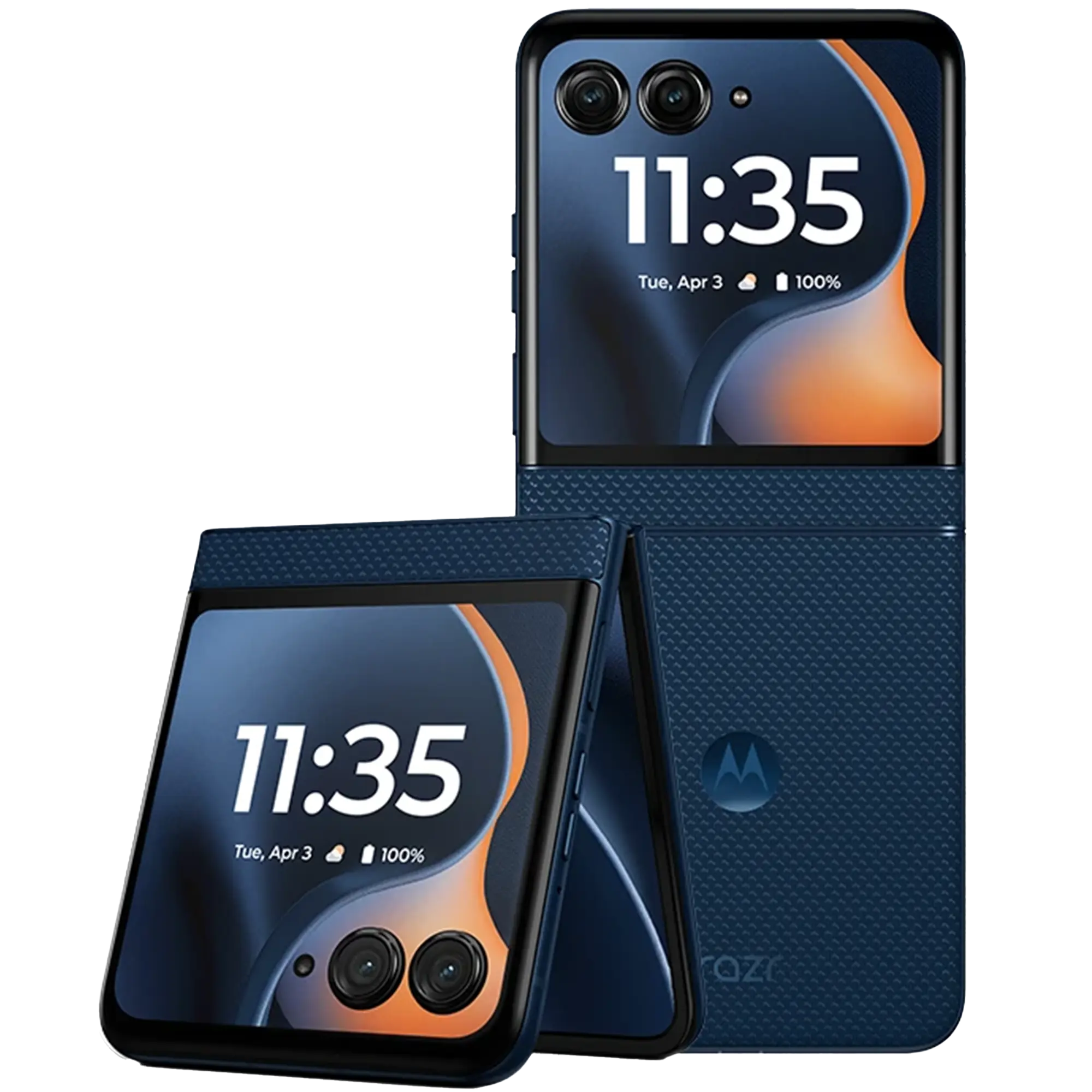
The Motorola Razr (2025) is Motorola's mid-range flip foldable, priced at $599.99 and aimed at people who want the foldable form factor without paying flagship prices. The Razr Ultra (2025), at $1,299.99, is the full-featured version — offering more power, more camera hardware, a larger cover display, and faster charging. They share the same basic shape and folding design, but the Ultra costs more than double.
The Ultra pulls ahead in performance, battery life, biometrics, and microphone quality. It also has a substantially better cover display and faster charging. The standard Razr has a louder speaker and competitive camera results in some conditions. Both phones share identical web browsing battery drain, the same IP rating, and similar wired data transfer speeds. The standard Razr's inner display is brighter in HDR than the Ultra's, though the Ultra's cover screen is far more usable.
Here’s how the two phones compare in our lab testing.
Design
| Motorola Razr (2025) | Motorola Razr Ultra (2025) | |
|---|---|---|
| Specifications | ||
| Dimensions (folded) | 88.1 x 74 x 15.9 mm | 88.1 x 74 x 15.7 mm |
| Dimensions (unfolded) | 171.3 x 74.0 x 7.3 mm | 171.5 x 74.0 x 7.2 mm |
| Weight | 188g | 199g |
| IP Rating | IP48 | IP48 |
| Frame | Aluminum | Aluminum |
| Front | Gorilla Glass Victus | Gorilla Glass Ceramic |
| Back | Vegan leather | Vegan leather / Alcantara / Wood |
| Screen-to-body ratio (inner) | 84.9% | 87.3% |
| Screen-to-body ratio (outer) | 64.1% | 78.1% |
Both phones fold to nearly identical dimensions. The Razr (2025) measures 88.1 x 74 x 15.9mm folded and 171.3 x 74.0 x 7.3mm unfolded. The Ultra comes in at 88.1 x 74 x 15.7mm folded and 171.5 x 74.0 x 7.2mm unfolded. The difference is fractions of a millimeter.
Both use aluminum frames. The standard Razr has Gorilla Glass Victus on the front and vegan leather on the back. The Ultra upgrades to Gorilla Glass Ceramic on the front and offers vegan leather, Alcantara, or wood back options. Both carry an IP48 rating, which means protection against objects larger than 1mm and submersion in freshwater. It's a lower water resistance rating than the IP68 you'd find on most flagship slabs.
The inner displays differ in size: 6.9 inches on the Razr versus 7.0 inches on the Ultra, with the Ultra achieving an 87.3% screen-to-body ratio compared to the Razr's 84.9%. The bigger difference is in the cover screens. The Razr has a 3.6-inch 1:1 square display at 64.1% screen-to-body ratio. The Ultra has a 4-inch panel in a 10.6:9 aspect at 78.1% screen-to-body ratio. That's a meaningful jump in usable cover screen real estate.
Bandicoot Lab doesn't formally test design or durability.
Display
Inner
| Motorola Razr (2025) (Inner) | Motorola Razr Ultra (2025) (Inner) | |
|---|---|---|
569/ 881 | 605/ 881 | |
Both inner panels run at 1080 x 2640 resolution with a 22:9 aspect ratio. The Ultra's slightly larger 7-inch panel gives it a higher pixel density at 464 pixels per inch versus the Razr's 413 PPI on its 6.9-inch screen.
Manual brightness is close: the Razr reaches 525 nits and the Ultra hits 501 nits. For dark-room use, the Ultra goes dimmer, bottoming out at 0.58 nits versus 2.56 nits on the Razr. HDR peak brightness is better on the standard Razr — 3,221 nits versus 2,850 nits on the Ultra. The Ultra holds that brightness more consistently across different HDR window sizes at 57.3% stability compared to the Razr's 48.3%. Both hold brightness well over sustained 30-minute HDR playback, with the Razr at 99.5% stability and the Ultra at 99.1%.
Color accuracy is a near-tie. In their best modes, the Razr's inner display achieves a lowest average Delta E (a measure of color error, where lower is more accurate) of 2.24, and the Ultra lands at 2.25. Both cover 99%+ of the sRGB gamut and over 96% of Display P3. Colors look accurate and natural on either phone's inner screen.
The Ultra's inner display tracks the HDR reference curve more faithfully, with minimal brightness boosting and highlights clipping at 85% of the range. The Razr's inner panel pushes highlights noticeably brighter than mastered and starts clipping earlier at 80%. If you watch a lot of HDR content, the Ultra renders it more accurately.
Touch latency is 19.1ms on the Razr and 19.9ms on the Ultra. That's close enough to be indistinguishable in use.
Outer
| Motorola Razr (2025) (Outer) | Motorola Razr Ultra (2025) (Outer) | |
|---|---|---|
391/ 881 | 560/ 881 | |
The cover screens diverge more sharply. The Ultra's 4-inch outer display runs at 1080 x 1272 resolution (417 PPI) with a 1–165Hz adaptive refresh rate. The Razr's 3.6-inch cover display is 1056 x 1056 (413 PPI) and tops out at 90Hz with a 60–90Hz range. The Ultra's cover screen is meaningfully smoother for scrolling and interactions.
The Ultra's outer display, in its best mode, achieves colors very close to reference. Neutral tones look clean and whites are accurate. The Razr's outer panel drifts more from reference; colors are slightly less precise, though not dramatically off for a cover screen.
HDR brightness on the outer displays — the Razr's cover screen peaks at 1,782 nits with 89.9% stability across window sizes. For the Razr's outer display, tone mapping is less faithful than its inner panel but starts clipping later at 95%, with modest brightness boosting.
Touch latency on the cover screens shows a gap: the Razr's outer display measures 46.7ms while the Ultra's registers lower. The Razr's cover screen latency is noticeably higher than its inner panel, which could affect responsiveness for quick interactions on the front screen.
Performance
| Motorola Razr (2025) | Motorola Razr Ultra (2025) | |
|---|---|---|
196/ 1012 | 740/ 1012 | |
The Razr runs a MediaTek Dimensity 7400X with 8GB of RAM. The Ultra uses a Qualcomm Snapdragon 8 Elite with 16GB. This is a wide gap in silicon.
CPU benchmarks reflect it. The Ultra scores 2,917 single-core and 8,917 multi-core in GeekBench 6. The Razr manages 1,081 single-core and 3,077 multi-core. That's roughly 2.7x the single-core performance and 2.9x multi-core. You'll feel this in app launch times, multitasking, and anything computationally heavy.
GPU performance is pretty different too. The Ultra peaks at 6,375 in Wild Life Extreme compared to the Razr's 1,028. The Razr maintains 99.6% stability across stress test loops, meaning it throttles almost not at all — but that’s because it doesn’t perform well enough to need to. The Ultra drops to 68.1% stability, hitting 50°C during sustained GPU load. For short gaming bursts the Ultra is dramatically faster; over extended sessions it heats up and throttles significantly. The Razr starts from a much lower baseline but won't heat up.
Browser performance shows a similar spread: the Ultra's Speedometer score of 19.4 doubles the Razr's 9.4. Web pages with complex JavaScript will load faster on the Ultra.
For everyday use like messaging, social media, and light apps, both phones are fine. The moment you push into gaming, multitasking, or AI-powered features, the Ultra is in a different class.
Camera
| Motorola Razr (2025) (Overall) | Motorola Razr Ultra (2025) (Overall) | |
|---|---|---|
| Specifications | ||
| Main | 50MP, f/1.7, 25mm, 1/1.95" | 50MP, f/1.8, 24mm, 1/1.56" |
| Ultrawide | 13MP, f/2.2, 1/3.0" | 50MP, f/2, 12mm |
| Front | 32MP, f/2.4, 25mm, 1/3.14" | 50MP, f/2, 22mm |
Both phones lack a dedicated telephoto lens, relying on digital zoom from their main cameras. The Ultra has a higher-resolution ultrawide (50 megapixels versus 13 megapixels) and a higher-resolution front camera (50 megapixels versus 32 megapixels). The main cameras differ in sensor size: the Razr uses a larger 1/1.95-inch sensor at f/1.7, while the Ultra has a 1/1.56-inch sensor at f/1.8.
Overall camera scores are close, with neither phone standing out as a strong camera performer. Both sit in the lower third of tested devices. The Ultra edges ahead on the main lens and shows stronger sharpness at zoom, but the Razr holds its own with its ultrawide and front camera.
At deep zoom levels, the Ultra maintains much higher sharpness through the digital crop range. At 8x, the Ultra retains strong detail while the Razr's output degrades substantially. The Ultra can push to 20x and 30x digital zoom, though detail drops off considerably at those extremes.
Main
| Motorola Razr (2025) (Main) | Motorola Razr Ultra (2025) (Main) | |
|---|---|---|
339/ 722 | 451/ 722 | |
In bright light, both main cameras deliver similar sharpness at 1x. The Razr edges ahead slightly in dark conditions at 1x, while the Ultra is sharper in mid-light. The Ultra pulls away at higher zoom levels. At 4x, the Ultra captures roughly double the detail of the Razr. At 8x, the gap grows even wider. If you crop or zoom frequently, the Ultra is clearly better.
The Razr's main camera pushes saturation noticeably in all lighting conditions, producing punchy, vivid images. The Ultra is more restrained in bright and mid light, with saturation close to neutral. Both phones add a warm yellow cast in processing, but the Razr leans into it harder. In bright light, both shift skin tones away from reference; faces look warmer and more saturated than they should. The Ultra's skin tone accuracy is better in bright light, though both struggle.
In low light, both cameras have problems. The Razr's hue accuracy degrades with a strong warm-magenta cast as the white balance system overcorrects. The Ultra develops a similar but more extreme magenta cast in dark conditions. Hue errors spike on both, but the Ultra's are worse in low light. This appears to be primarily a white balance correction issue on both phones, since the warm bias increases as the ambient light gets warmer.
Both main cameras retain decent shadow detail and handle highlights reasonably in processed shots. Neither produces particularly deep or layered high-contrast images, but they're adequate for the segment.
Ultrawide
| Motorola Razr (2025) (Ultrawide) | Motorola Razr Ultra (2025) (Ultrawide) | |
|---|---|---|
444/ 722 | 447/ 722 | |
The Razr's 13-megapixel ultrawide and the Ultra's 50-megapixel ultrawide produce different results. In bright light, the Razr's ultrawide is sharper, which is surprising given the resolution gap. Its processing aggressively enhances detail. In mid-light, both are close. In dark conditions, both drop to similar sharpness levels.
The Razr's ultrawide oversaturates similarly to its main camera and carries the same warm cast. The Ultra's ultrawide is more neutral, with minimal color bias in bright and mid light. In low light, the Razr's ultrawide develops a strong warm-magenta shift while the Ultra's stays relatively controlled. Hue accuracy on the Ultra's ultrawide holds up much better across all lighting conditions. The Razr's ultrawide hue accuracy collapses in low light.
Skin tones on the ultrawide are off on both phones in bright light, with both pushing faces warmer and more saturated than reference. The Ultra does moderately better in mid and dark conditions.
The Razr's ultrawide retains slightly more shadow detail in processed shots than the Ultra's.
Front
| Motorola Razr (2025) (Front) | Motorola Razr Ultra (2025) (Front) | |
|---|---|---|
485/ 722 | 495/ 722 | |
The Ultra's 50-megapixel front camera is sharper than the Razr's 32-megapixel selfie camera in bright and dark light. In mid-light, both are close. The Ultra's front camera maintains more detail in low light.
Both front cameras are heavily processed. In bright light, both push skin tones significantly away from reference: faces look warmer and more saturated than natural. The Razr oversaturates more, with a slight warm-magenta push. The Ultra desaturates slightly in mid and dark conditions, giving selfies a slightly muted look compared to the Razr's punchy approach.
Front camera stabilization is better on the Razr, which keeps video steady during handheld use. The Ultra's front camera shows more motion in handheld video. Both shoot at 1080p 30fps from the front camera.
Both front cameras pull similar detail from highlights and shadows in processed shots, with the Ultra drawing slightly more.
Battery
| Motorola Razr (2025) | Motorola Razr Ultra (2025) | |
|---|---|---|
497/ 836 | 532/ 836 | |
The Razr has a 4,500mAh battery and the Ultra has a 4,700mAh cell. Both are compact for their capacity given the folding design.
Video playback at 200 nits on the inner display gives 23.9 hours for the Razr and 29.7 hours for the Ultra. On the cover screen, the Razr lasts 26.3 hours and the Ultra stretches to 32.8 hours. The Ultra's nearly six extra hours of inner-display video playback is a meaningful gap. At 29.7 hours of video, the Ultra can comfortably get through two full days of moderate use between charges.
Web browsing drain is identical: both phones lose 22% over the five-hour test. If your usage is mostly browsing and messaging, battery life is effectively the same.
Gaming is where the story inverts. The Razr loses just 11% during the one-hour stress test, while the Ultra burns through 43%. The Ultra's Snapdragon 8 Elite GPU is far more powerful but draws far more power under sustained load. If you game frequently, the Razr's battery will survive the session much more easily.
Standby drain is identical at 3% over eight hours. Neither phone has a background drain problem.
Charging
| Motorola Razr (2025) | Motorola Razr Ultra (2025) | |
|---|---|---|
306/ 837 | 355/ 837 | |
The Ultra charges at 68W wired and 30W wireless. The Razr charges at 30W wired and 15W wireless. The wired speed gap is substantial.
At 10 minutes on a wire, the Ultra reaches 30% and the Razr hits 27%. That's closer than you'd expect given the wattage difference, partly because the Ultra has a larger battery. At 30 minutes, the Ultra reaches 75% and the Razr hits 71%. Both phones charge quickly for their class, and the gap between them is smaller than the spec sheets suggest.
Wireless charging is identical in practice: both reach 12% at 10 minutes and 29% at 30 minutes, despite the Ultra's higher 30W wireless rating versus the Razr's 15W. On wireless, you won't notice any difference between the two.
Speaker
| Motorola Razr (2025) | Motorola Razr Ultra (2025) | |
|---|---|---|
595/ 897 | 540/ 897 | |
The Razr is louder at 75.1 dBA maximum versus the Ultra's 72.8 dBA. That's an audible difference, and the Razr will fill a room more easily.
The Ultra has lower distortion at 10.0% THD compared to the Razr's 13.7%. At higher volumes, the Ultra sounds cleaner. The Razr pushes fuller bass and has more presence in the high end, giving it a richer overall character. The Ultra leans toward a smoother, more balanced output with less emphasis at the extremes but better control.
Neither phone is a strong performer for speakers overall. Both sit in the lower portion of tested devices. If speaker quality matters to you, neither foldable will compete with the best slab phones, which have more room for driver hardware.
Microphone
| Motorola Razr (2025) | Motorola Razr Ultra (2025) | |
|---|---|---|
472/ 1220 | 683/ 1220 |
The Ultra's microphone is more consistent across the frequency range, producing more natural-sounding voice recordings. The Razr's microphone shows more variation, which can make voice capture sound slightly uneven. Both are adequate for calls, but the Ultra is the better pick for voice notes or video recordings where audio quality matters. The Razr falls below average; the Ultra is solidly mid-range.
Other
| Motorola Razr (2025) | Motorola Razr Ultra (2025) | |
|---|---|---|
| Biometrics | 357/ 1181 | 635/ 1181 |
| Data Transfer | 103/ 943 | 101/ 943 |
| Specifications | ||
| Biometric type | Fingerprint | Fingerprint |
| Ports | USB-C 2.0 | USB-C 2.0 |
| Storage | 256GB | 512GB, 1TB |
Fingerprint unlock is noticeably faster on the Ultra at 165ms versus the Razr's 294ms. Both use capacitive sensors. The Ultra's unlock feels near-instant; the Razr's has a perceptible delay. Neither phone has hardware-based face unlock.
Data transfer speeds are similar and slow on both: the Razr reads at 41 MB/s and writes at 37 MB/s, while the Ultra reads at 39 MB/s and writes at 36 MB/s. Both use USB-C 2.0, which limits wired transfer speeds. Moving large files to either phone will take patience.
The Razr comes in one configuration: 8GB RAM with 256GB storage. The Ultra offers 16GB RAM with 512GB or 1TB storage options.
Conclusion
The Razr Ultra (2025) is the stronger phone in most measurable areas. It has a much faster processor, nearly six more hours of video playback, a larger and smoother cover display, better color accuracy on that cover screen, faster fingerprint unlock, a better microphone, and substantially higher sharpness at zoom. Its inner display tracks HDR content more faithfully, and it comes with double the RAM and up to four times the storage.
The standard Razr (2025) has some advantages. Its speaker has more character. Its inner display peaks brighter in HDR. Its ultrawide camera is sharp in good light. Wired charging speeds are closer than the spec gap implies.
The core question is whether the Ultra's advantages are worth $700. If you use your cover screen frequently, game or multitask heavily, need more storage, or want the best zoom performance between the two, the Ultra justifies itself. If you want a foldable phone for basic use, don't care much about the cover screen, and would rather put that $700 toward something else, the Razr (2025) handles the fundamentals well enough at less than half the price.
Related
Motorola
Razr Ultra (2025)
Motorola
Razr (2025)
Motorola
Razr Ultra (2026)

Motorola
Razr Fold
Motorola
Razr+ (2026)
Motorola
Razr (2026)

Motorola
Moto G Power (2026)

Motorola Razr (2026) vs Motorola Razr (2025)

Samsung Galaxy Z Flip 7 vs Motorola Razr (2025)

Samsung Galaxy Z Flip 7 vs Motorola Razr Ultra (2025)