Motorola Razr Fold

Motorola
Razr Fold
Ranked #26 of 60 devices tested
Score Overview
The Motorola Razr Fold is Motorola's book-style foldable, pitched at the same audience as the Samsung Galaxy Z Fold 7 and Google Pixel 10 Pro Fold. It's a large-screen productivity device that unfolds into a near-square 8.1-inch tablet, with a 6.6-inch outer display for one-handed use, a triple rear camera system including a 3x telephoto, and a Snapdragon 8 Gen 5 chipset. At $1,899.99, it sits in the center of foldable pricing.
The Razr Fold's strengths are its displays, particularly the outer screen's brightness and color accuracy, and its wired charging speed, which outpaces plenty of foldable rivals. Camera color accuracy on the main and telephoto lenses is strong compared to competing foldables, and the 6,000mAh battery delivers long video playback on the outer screen. Weaknesses include low manual brightness on both displays, web browsing that drains the battery faster than expected, poor microphone performance, and deep zoom image quality that falls off more quickly than the 100x maximum suggests.
Here’s how the Motorola Razr Fold performed in our thorough testing.
Design
Specifications
The Razr Fold measures 160.05 × 73.6 × 9.89mm folded and 160.05 × 144.46 × 4.55mm unfolded, weighing 243g. It has an aluminum frame and Gorilla Glass Ceramic 3 on the front. The port is USB-C 3.2. It carries an IP48/IP49 rating, meaning it's protected against objects larger than 1mm and rated against both low-pressure and high-pressure water jets, though it isn't rated for full submersion the way an IP68 device like the Pixel 10 Pro Fold is.
At 243g, it's heavier than the Samsung Galaxy Z Fold 7 (215g) and the Honor Magic V5 (217g), but lighter than the Pixel 10 Pro Fold (258g). The folded thickness of 9.89mm is comparable to the Z Fold 7's 8.9mm and the Magic V5's 8.8mm. Unfolded at 4.55mm, it's slightly thicker than the Magic V5 (4.1mm) but thinner than the Pixel 10 Pro Fold (5.2mm). The 8.1-inch inner display is the largest among these foldables, paired with an 8:7.2 aspect ratio that's close to square.
Bandicoot Lab does not formally test design or durability, so we can't speak to in-hand feel, hinge longevity, or perceived build quality.
Display
Inner
The inner display is an 8.1-inch AMOLED panel at 2484 × 2232, yielding 412 pixels per inch. It supports 1–120Hz adaptive refresh. Manual brightness tops out at about 543 nits, which is low compared to the Pixel 10 Pro Fold's 1,288 nits and the Galaxy Z Fold 7's 734 nits. For HDR content in auto brightness, the inner panel peaks at 4,142 nits, the highest peak among these foldables. Brightness drops significantly across larger HDR window sizes, though: stability is 41.6%, meaning a full-screen bright scene won't sustain anywhere near that peak. Over a 30-minute sustained test, brightness holds steady at 97.9%.
Color accuracy is good. In Radiant Mode, the inner display targets Display P3 with an average color error of 1.37 and covers 97.67% of the Display P3 gamut. That's tighter than the Samsung Galaxy Z Fold 7's best mode and close to the Pixel 10 Pro Fold's Natural Mode accuracy. Vivid Mode covers nearly 90% of Rec. 2020 with 99.9% Display P3 coverage, at the cost of higher color deviation.
HDR tone mapping on the inner display slightly boosts highlights above mastered levels, with clipping starting at about the 80% input level. This means the very brightest highlights in HDR content get crushed together rather than being rendered distinctly. The Pixel 10 Pro Fold clips later (at 100%) but renders HDR less accurately overall.
Touch latency averages 15.1ms, which is low and shouldn't be perceptible for most tasks.
Outer
The 6.6-inch outer display is an LTPO P-OLED at 2520 × 1080 (415 PPI) with a 21:9 aspect ratio and a 30–165Hz refresh rate. The higher refresh ceiling gives it a smoother feel for scrolling and animations than the 120Hz inner display.
Manual brightness is limited to about 502 nits, similar to the inner panel. HDR peak brightness reaches 3,164 nits, and HDR stability across window sizes is 50.2%, meaningfully better than the inner display's 41.6%. Sustained brightness over time is excellent at 99.3%. The minimum brightness drops to 2.49 nits, fine for nighttime use.
Color accuracy in Radiant Mode averages a very low error, closely tracking Display P3 with 99.23% gamut coverage. The outer display also offers Vivid Mode at full Display P3 coverage. Natural Mode targets sRGB accurately, though it has a single high-error outlier that pushes the maximum deviation up despite the low average.
Tone mapping on the outer panel tracks the HDR reference curve closely without boosting highlights. Clipping starts at the 75% input level, so the brightest highlights still lose some distinction, but mid-range HDR content is rendered accurately.
Touch latency averages 14.7ms, essentially identical to the inner screen.
Performance
The Razr Fold runs the Qualcomm Snapdragon 8 Gen 5 with 16GB of RAM. GeekBench 6 scores of 2,628 (single-core) and 9,178 (multi-core) put it behind the Samsung Galaxy Z Fold 7 (3,006 / 9,818) but ahead of the Google Pixel 10 Pro Fold (2,268 / 5,986). In daily use, the gap between the Razr Fold and the Z Fold 7 is unlikely to be noticeable in app launches or multitasking. The gap over the Pixel 10 Pro Fold, especially in multi-core, is more meaningful for sustained workloads.
GPU performance is solid. The Wild Life Extreme stress test peaked at 5,401 with 68.6% stability, and Solar Bay peaked at 9,631 with 68.9% stability. Both tests showed the device holding close to 69% of its peak under sustained load at 37°C, which is better thermal management than the Z Fold 7 (48.1% stability, 44.7°C) or the Honor Magic V5 (58.6% stability, 47.3°C). You'll get more consistent frame rates during extended gaming sessions.
Browser performance via Speedometer scored 16.9, which is low. The Z Fold 7 scored 32.3, and even the Pixel 10 Pro Fold managed 20.3. Web-heavy users will notice slower page interactions.
Camera
The Razr Fold has a 50-megapixel main camera (f/1.6, 24mm, 1/1.28" sensor), a 50-megapixel ultrawide (f/2.0, 12mm), a 50-megapixel 3x telephoto (f/2.4, 71mm, 1/1.95" sensor), a 32-megapixel inner front camera (f/2.4, 22mm), and a 20-megapixel outer front camera (f/2.4, 22mm). The system maxes out at 100x digital zoom.
Sharpness across the main, ultrawide, and telephoto lenses is consistent. All three hold up well through bright and mid lighting, and the telephoto reaches its highest sharpness in dark conditions. The main camera's 1/1.28" sensor gives it an advantage in light gathering. At zoom levels from 2x through about 10x, detail is high. Beyond 20x, detail drops, and by 50x, you're looking at modest but usable detail. At 80x and beyond, sharpness falls off substantially, with 100x delivering soft images that are only useful for identifying distant subjects. The Honor Magic V5 produces significantly less detail at these extreme zoom levels.
Main
The main lens is sharp across all lighting. It delivers high detail in bright and mid conditions and holds up well in low light. Color tuning is close to neutral in saturation, hovering right around 100% in bright light and pulling back slightly in darker conditions. This is notably restrained compared to the Honor Magic V5 and Samsung Galaxy Z Fold 7. Hue accuracy is good across all three lighting conditions. Skin tones show moderate error in bright light, improving in mid and dark conditions. The processing pulls slightly warm in lower light.
Dynamic range is modest. Highlights clip in bright scenes, and shadow detail is limited compared to the Honor Magic V5's main camera, which preserves more range.
Ultrawide
The ultrawide delivers strong sharpness in bright and mid light, though it drops in dark conditions. It's competitive with or better than the ultrawides on competing foldables in terms of detail.
Saturation stays close to natural, but skin tone error is severe in bright and mid lighting. Faces look noticeably off-reference under good light, improving substantially only in darker conditions. Hue errors also increase in mid and low light. The white balance shifts with lighting temperature rather than being a fixed sensor issue.
Dynamic range is good, preserving more shadow and highlight information than the main lens.
Telephoto
The 3x telephoto at 50 megapixels on a 1/1.95" sensor is sharp across all lighting conditions, with its best sharpness coming in low light. This lens holds detail better than the Pixel 10 Pro Fold's 5x telephoto and is competitive with the Honor Magic V5's 3x.
Color character leans slightly vivid in bright light and shifts toward muted in darker conditions. White balance handling shifts progressively warmer as lighting gets dimmer. Hue accuracy degrades noticeably in mid and dark light, though skin tones remain more consistent than on competing foldables' telephoto lenses.
Dynamic range is limited, especially compared to the main and ultrawide. Highlights clip, and shadow detail is compressed.
Front Inner
The 32-megapixel inner front camera is sharp in bright and mid light, with a drop in dark conditions. Color rendering is muted overall. In bright light, skin tones show large errors. This improves substantially in mid and dark conditions, where skin tone accuracy is reasonable.
Dynamic range is strong, with good detail in both highlights and shadows.
Front Outer
The 20-megapixel outer front camera is softer than the inner camera across all conditions. Detail in dark conditions drops more noticeably.
Color is pushed slightly vivid in bright light and pulls back to muted in dark. Skin tones are consistently off-reference across all lighting. The bright-light processing applies a cool bias that shifts toward warm in dimmer conditions.
Dynamic range is the strongest of any lens on the device, with good highlight and shadow retention. Video stabilization on the outer front camera shows visible jitter during handheld recording.
Battery
The Razr Fold has a 6,000mAh battery, which is larger than most other modern foldable phones. Video playback on the outer screen lasted 39 hours and 41 minutes, and on the inner screen, 26 hours and 13 minutes. The outer screen result is exceptional, nearly 12 hours longer than the Samsung Galaxy Z Fold 7's outer screen (28 hours 7 minutes) and roughly 8 hours longer than the Honor Magic V5's (31 hours 46 minutes). For video-heavy use, you're looking at a comfortable full day on the inner display and potentially close to two on the outer.
Web browsing drained 32% over the five-hour test, which is average for foldables. The Z Fold 7 lost 34% and the Magic V5 lost 35% in the same test, so the Razr Fold is slightly more efficient. Gaming drained 29% during the one-hour stress test, worse than the Z Fold 7 (23%) and Magic V5 (23%). The larger battery helps compensate, but GPU-heavy tasks will consume battery faster than the competition. Standby drain was 4% over eight hours, double the 2% from all three competitors.
Charging
Wired charging runs at 80W, reaching 25% in 10 minutes and 65% in 30 minutes. That's meaningfully faster than the Samsung Galaxy Z Fold 7 (19% / 53% at 25W) and the Pixel 10 Pro Fold (19% / 52% at 30W). The Honor Magic V5 at 66W is closer, hitting 31% in 10 minutes and 79% in 30 minutes.
Wireless charging at 15W is slow: 11% in 10 minutes and 26% in 30 minutes. This matches the Pixel 10 Pro Fold's 15W wireless performance and is well behind the Honor Magic V5's 50W wireless charging (18% / 48%). If you rely on wireless charging overnight, 15W is adequate. For quick top-ups, it isn't.
Speaker
The Razr Fold reaches 74.5 dBA maximum volume, louder than the Honor Magic V5 (70.1 dBA) and the Pixel 10 Pro Fold (72.8 dBA), though not quite as loud as the Galaxy Z Fold 7 (76.6 dBA). Average total harmonic distortion is 3.19%, low for a phone speaker and better than all three competitors. The sound stays clean even at higher volumes.
The frequency character leans toward fuller low-end presence with adequate high-frequency clarity. Bass response is decent for a foldable, and the overall sound is balanced without the tinny quality that some thinner devices exhibit.
Microphone
The microphone's frequency response showed high variability, indicating uneven capture across the frequency range. This is a weak result, well below the performance of the Galaxy Z Fold 7, Honor Magic V5, and Pixel 10 Pro Fold. Voice calls and recordings may sound inconsistent, particularly in the frequencies that matter most for speech clarity.
Other
Measurements
Specifications
The Razr Fold uses a capacitive fingerprint sensor averaging 164ms unlock speed, fast enough to feel instant in practice and quicker than the Pixel 10 Pro Fold's 297ms, though not quite as snappy as the Galaxy Z Fold 7's 111ms or the Honor Magic V5's 117ms. There is no hardware-based face unlock.
Data transfer over USB-C 3.2 is fast, with read speeds of 273 MB/s and write speeds of 249 MB/s. That's comparable to the Galaxy Z Fold 7 and Honor Magic V5, and roughly triple the Pixel 10 Pro Fold's transfer speeds. Storage comes in a single 512GB configuration.
Conclusion
The Motorola Razr Fold is a capable foldable that carves out its own space through a very bright inner display, strong battery endurance on the outer screen, and the fastest wired charging in this foldable class. Its camera system is competitive, with particularly good color accuracy on the main and telephoto lenses compared to foldable rivals that tend to oversaturate. GPU thermal management is also better than the competition, delivering more consistent sustained performance.
The tradeoffs are low manual brightness on both displays, weak browser performance, poor microphone quality, and standby drain that's double what competitors achieve. The camera system is solid but not exceptional, landing in the middle of the pack overall, with the ultrawide's skin tone problems and the outer front camera's stabilization being the most noticeable weaknesses. At $1,899.99, it's $100 cheaper than both the Galaxy Z Fold 7 and Honor Magic V5, which makes its strengths in battery life, charging, and display peak brightness a reasonable value proposition if you can live with the weaker points.
Related

Motorola Razr Ultra (2026) vs Motorola Razr Fold

Motorola Razr+ (2026) vs Motorola Razr Fold
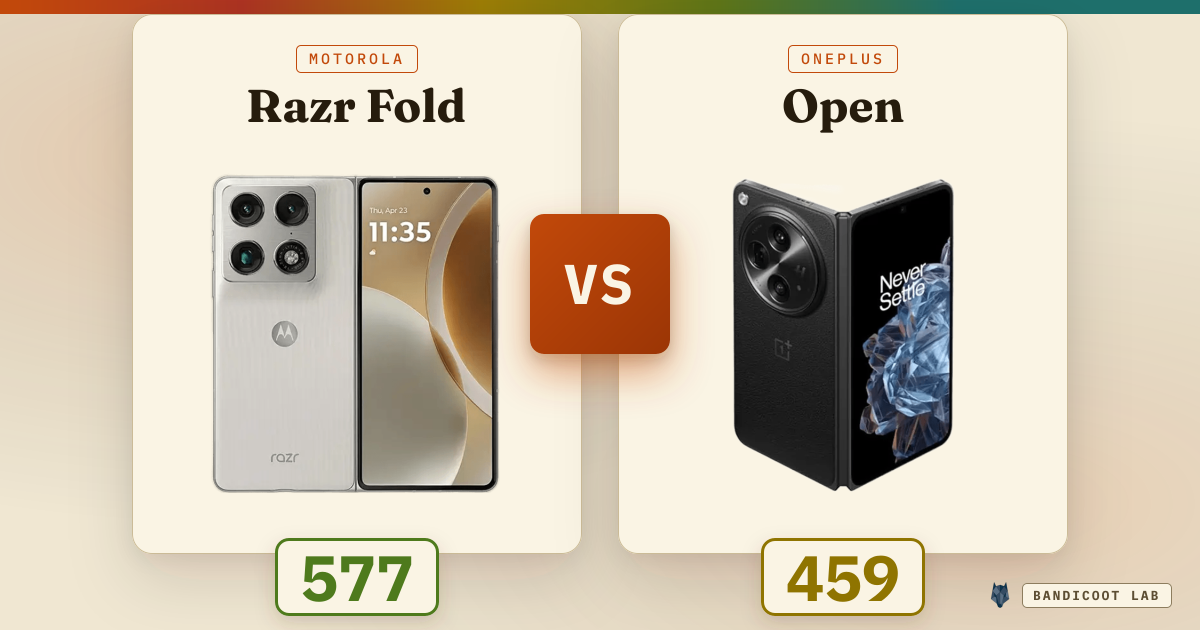
Motorola Razr Fold vs OnePlus Open

Motorola Razr (2026) vs Motorola Razr Fold

Motorola Razr Fold vs Samsung Galaxy Z Fold 7
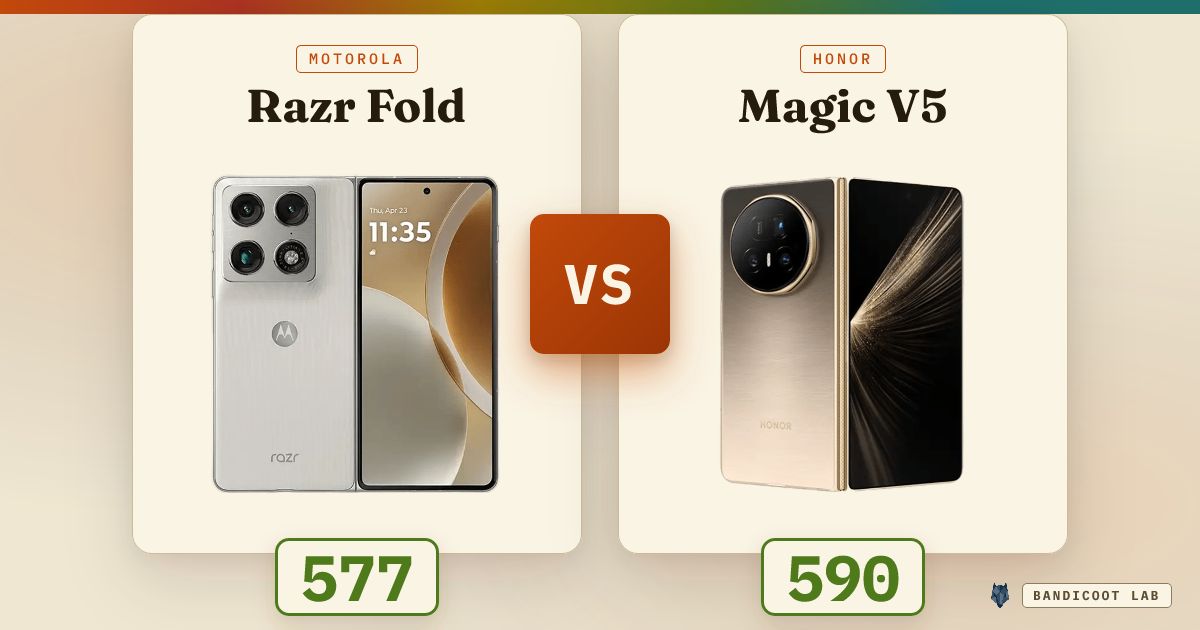
Motorola Razr Fold vs Honor Magic V5

Motorola Razr Fold vs Google Pixel 10 Pro Fold
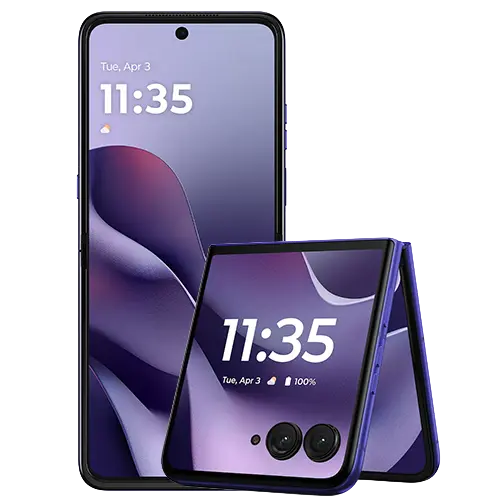
Motorola
Razr Ultra (2026)
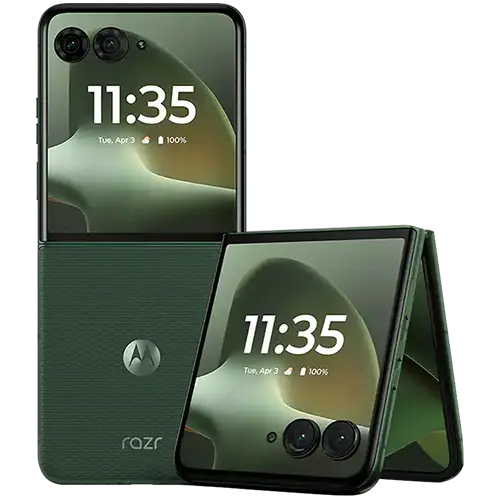
Motorola
Razr+ (2026)
Motorola
Razr (2026)

Motorola
Moto G Power (2026)
Honor