Motorola Razr+ (2026) vs Samsung Galaxy Z Flip 7
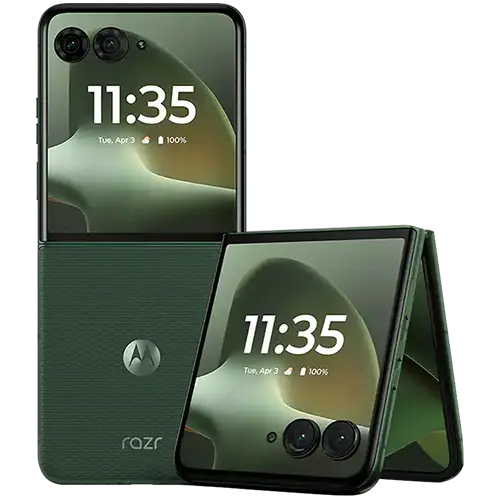

Motorola
Samsung
Razr+ (2026)
Galaxy Z Flip 7
Ranked #47 of 59
Ranked #40 of 59
Overall
Overall
The Motorola Razr+ and Samsung Galaxy Z Flip 7 are two clamshell foldables at exactly the same price, $1,099.99 each. The Motorola Razr+ (2026) and Samsung Galaxy Z Flip 7 are built for someone who wants a full-size phone that folds down to fit a small pocket or bag, and who's willing to accept the compromises that come with a folding screen. Both run a large inner display, a usable cover screen, and a dual-camera system with no telephoto. The differences are in how each company spent its budget.
Motorola leans on its cover screen and charging speed. Samsung leans on raw processing power, camera stabilization, and a more refined speaker. The Razr+ charges meaningfully faster and has a brighter, more useful outer display. The Z Flip 7 is the stronger performer by a wide margin, holds onto detail better in dim light, and lasts longer on a charge. Neither has a standout camera system, and both make real concessions to fit the folding form factor.
Here’s how the Motorola Razr+ (2026) and Samsung Galaxy Z Flip 7 compare in our lab testing.
Design
| Motorola Razr+ (2026) | Samsung Galaxy Z Flip 7 | |
|---|---|---|
| Specifications | ||
| Dimensions (folded) | 88.1 x 74 x 15.3 mm | 85.5 x 75.2 x 13.7 mm |
| Dimensions (unfolded) | 171.4 x 74.0 x 7.1 mm | 166.7 x 75.2 x 6.5 mm |
| Weight | 189g | 188g |
| IP Rating | IP48 | IP48 |
| Frame | Aluminum | Aluminum |
| Front | Gorilla Glass Victus | Plastic (inner) / Gorilla Glass Victus 2 (outer) |
| Back | Vegan leather | Gorilla Glass Victus 2 |
| Screen-to-body ratio (inner) | 85.1% | 86.2% |
| Screen-to-body ratio (outer) | 78.1% | 83.9% |
Both phones use an aluminum frame, and both carry an IP48 rating. That covers dust larger than 1mm and brief immersion, but not the full submersion protection of an IP68 phone. Keep both away from sustained water exposure.
Folded, the Razr+ measures 88.1 x 74 x 15.3mm and weighs 189g. The Z Flip 7 is slightly smaller and thinner folded at 85.5 x 75.2 x 13.7mm, and a gram lighter at 188g. Unfolded, the gap holds: the Z Flip 7 is 6.5mm thick versus the Razr+ at 7.1mm. The Samsung is the more compact package in the hand, folded and open.
Materials differ on the back and front. The Razr+ uses a vegan leather back, which resists fingerprints and adds grip. The Z Flip 7 uses Gorilla Glass Victus 2 front and back, with the inner folding panel covered by plastic as all folding screens are. Screen-to-body ratios land close on the inner display, 85.1% for the Razr+ and 86.2% for the Z Flip 7, so bezels are thin on both.
Bandicoot Lab doesn't formally test design or durability.
Display
Inner
| Motorola Razr+ (2026) (Inner) | Samsung Galaxy Z Flip 7 (Inner) | |
|---|---|---|
652/ 881 | 540/ 881 | |
The Razr+ runs a 6.9-inch LTPO AMOLED at 1084 x 2640 (414 pixels per inch) with a 1–165Hz refresh range. The Z Flip 7 uses a 6.8-inch LTPO AMOLED at 1080 x 2520 (397 PPI) and tops out at 120Hz. The Razr+ has the sharper, faster panel on paper, and its higher refresh ceiling means scrolling and animation can run smoother.
The Z Flip 7 is brighter in manual mode, reaching 690 nits against the Razr+ at 483 nits. That's the brightness you get dragging the slider up in daylight, and it's a real advantage outdoors. For HDR content, the Razr+ pushes higher peaks, around 3,236 nits versus 2,785 on the Z Flip 7, and it holds brightness more consistently across different window sizes. The Z Flip 7's HDR brightness varies depending on how much of the screen is lit. Over a sustained 30-minute HDR clip, both panels hold near their peak.
Color accuracy on the inner panels is close, and both land in the same range — accurate enough that most people won't notice drift in normal use. Touch latency is the one clear gap. The Razr+ averages 6.8ms, the Z Flip 7 18.6ms. That's a difference you might feel in fast games or drawing apps, where the Razr+ tracks your finger more tightly.
The Razr+ follows the HDR reference curve closely and pushes highlights only modestly, clipping the brightest detail near the top of the range. The Z Flip 7 lifts highlights more aggressively and clips a bit earlier. Neither is a problem in practice; the Razr+ is the more faithful of the two.
Outer
| Motorola Razr+ (2026) (Outer) | Samsung Galaxy Z Flip 7 (Outer) | |
|---|---|---|
592/ 881 | 474/ 881 | |
The cover screens are where these phones diverge most. The Razr+ has a 4-inch LTPS AMOLED at 1272 x 1080 (417 PPI), running 30–165Hz. The Z Flip 7's cover screen is 4.1 inches at 948 x 1048 (342 PPI), 60–120Hz. The Razr+ cover screen is sharper and faster.
Brightness flips the other way. The Z Flip 7's cover screen is brighter, which helps when you're using it as a viewfinder or glancing at notifications in sunlight. Color accuracy on both outer panels drifts a bit more than their inner displays, with neutral tones reading slightly off, but neither is bad for a secondary screen. The Razr+ cover screen is also far more responsive to touch, which matters if you run full apps on it rather than just widgets.
Performance
| Motorola Razr+ (2026) | Samsung Galaxy Z Flip 7 | |
|---|---|---|
377/ 1012 | 578/ 1012 | |
The Razr+ runs a Qualcomm Snapdragon 8s Gen 3 with 12GB of RAM. The Z Flip 7 uses Samsung's own Exynos 2500, also with 12GB. On benchmarks, the gap is wide.
In CPU tests, the Z Flip 7 scores 2,322 single-core and 8,162 multi-core on GeekBench 6, against the Razr+ at 1,940 and 4,905. The multi-core gap is large enough to show up in heavy multitasking and demanding apps. Browser performance follows the same pattern: the Z Flip 7 more than doubles the Razr+ on Speedometer, 26.5 to 12.3, which you'll feel as faster page loads and smoother web apps.
Graphics tell a similar story for peak output. The Z Flip 7 hits a much higher peak in the Wild Life Extreme GPU stress test, 5,387 to 3,149. Sustained performance is closer: under load both throttle, with the Razr+ holding 52.8% of its peak over 20 loops and the Z Flip 7 holding 44%. The Z Flip 7 starts higher and stays higher even after throttling, so it's still the stronger gaming phone, but it runs warmer relative to its own ceiling.
For everyday use, the Razr+ is perfectly fluid for messaging, browsing, and camera work. The difference shows up in sustained heavy tasks and gaming, where the Z Flip 7 has clear headroom the Razr+ doesn't.
Camera
| Motorola Razr+ (2026) | Samsung Galaxy Z Flip 7 | |
|---|---|---|
468/ 587 | 456/ 587 | |
Neither phone is a camera-first device, and both skip a telephoto lens entirely. Each pairs a 50-megapixel main camera with an ultrawide, and relies on digital cropping for zoom up to 10x. Against dedicated camera phones, both fall short, but they trade strengths between themselves.
Main camera sharpness is close at 1x in good light. The Z Flip 7 keeps detail steadier in dim light, where the Razr+ softens more. As you crop toward 2x and beyond, both lose resolution, and past 10x neither produces usable detail. The Z Flip 7 holds a slight edge at the long end, but at that range results are poor on both.
Main
| Motorola Razr+ (2026) (Main) | Samsung Galaxy Z Flip 7 (Main) | |
|---|---|---|
501/ 722 | 566/ 722 | |
The Razr+ main is a 50-megapixel f/1.8 26mm sensor. The Z Flip 7 uses a 50-megapixel f/1.8 23mm with a notably larger 1/1.57-inch sensor against the Razr+ at 1/1.95 inches. That larger sensor helps the Z Flip 7 gather light, which shows in low-light detail retention.
In bright light, both resolve similar fine detail at 1x. The Razr+ holds up slightly better in moderate light, while the Z Flip 7 pulls ahead in the dark. Cropping to 2x, both stay reasonable but soften; the Razr+ degrades a touch faster as you push past that.
Color from the Razr+ main stays close to neutral and accurate across lighting conditions. The Z Flip 7 renders punchier colors but introduces more hue error as light warms, and its skin tones run further from accurate, particularly in bright light where faces pick up a noticeable shift.
Ultrawide
| Motorola Razr+ (2026) (Ultrawide) | Samsung Galaxy Z Flip 7 (Ultrawide) | |
|---|---|---|
426/ 722 | 596/ 722 | |
The Razr+ ultrawide is a 50-megapixel f/2 sensor; the Z Flip 7 uses a 12-megapixel f/2.2. The Razr+ ultrawide resolves more detail and stays closer to its main camera in quality. Color from the Razr+ ultrawide leans a bit cool but holds hue reasonably.
The Z Flip 7 ultrawide struggles with color as light dims. Hue accuracy falls apart in warm, low light, with a strong blue-yellow shift that signals white balance correction failing. Skin tones in particular drift badly. The Z Flip 7 ultrawide holds highlight and shadow detail better than the Razr+ ultrawide, which clips brighter areas earlier.
Front
| Motorola Razr+ (2026) (Front) | Samsung Galaxy Z Flip 7 (Front) | |
|---|---|---|
583/ 722 | 303/ 722 | |
The Razr+ front camera is a 32-megapixel f/2.4 sensor; the Z Flip 7 uses a 10-megapixel f/2.2. The Razr+ front camera holds sharpness better as light drops, while the Z Flip 7 falls off sharply in the dark.
Color is the bigger story. The Razr+ front camera keeps skin tones close to accurate across lighting, the strongest part of its camera system. The Z Flip 7 front camera drifts noticeably, with skin tones reading well off reference in every condition and getting worse in warm, dim light. Both front cameras clip and flatten high-contrast scenes; the Z Flip 7 introduces more tonal artifacts. For video, the Z Flip 7 front camera stabilizes handheld footage better, but the Razr+ produces the more accurate-looking selfie. On both foldables you can also shoot selfies with the main camera using the cover screen, which is the better option on both.
Battery
| Motorola Razr+ (2026) | Samsung Galaxy Z Flip 7 | |
|---|---|---|
445/ 799 | 516/ 799 | |
The Razr+ carries a 4,500mAh battery, the Z Flip 7 a slightly smaller 4,300mAh. The Z Flip 7 lasts longer despite the smaller cell.
In video playback on the inner screen, the Z Flip 7 ran 28.4 hours to the Razr+ at 25 hours. That's a full day of heavy use plus a comfortable buffer on the Samsung; the Razr+ gets you through a day but with less margin. Web browsing drain over five hours was lighter on the Z Flip 7 as well, 23% versus 25%. The gaming test, measured during a sustained GPU stress run, drained the Z Flip 7 21% against the Razr+ at 26%, meaning the Razr+ runs its battery down faster under heavy load. Standby drain over eight hours of idle was identical at 3%, so neither bleeds charge overnight.
The Z Flip 7 is the longer-lasting phone across the board. The Razr+ is a solid all-day device, but with heavy use you're more likely to reach for a charger by evening.
Charging
| Motorola Razr+ (2026) | Samsung Galaxy Z Flip 7 | |
|---|---|---|
300/ 837 | 211/ 837 | |
The Razr+ charges at 45W wired and 15W wireless. The Z Flip 7 is slower at 25W wired, with the same 15W wireless.
The wired charging speed gap is real. In 10 minutes, the Razr+ reaches 27% against the Z Flip 7's 20%. At 30 minutes, the Razr+ is at 70% while the Z Flip 7 sits at 55%. The Razr+ tops up meaningfully faster, which is the more useful trait on a phone you might charge in short bursts. Wireless charging is slow on both, with the Razr+ slightly ahead at 30 minutes. If quick top-ups matter to you, the Razr+ is the clear pick here.
Speaker
| Motorola Razr+ (2026) | Samsung Galaxy Z Flip 7 | |
|---|---|---|
488/ 897 | 704/ 897 | |
Both phones top out at nearly the same volume, 77.8 dBA for the Razr+ and 77.2 dBA for the Z Flip 7. The dividing line is cleanliness.
The Z Flip 7 runs much lower distortion, around 5.4% total harmonic distortion against the Razr+ at 9.1%. Its frequency response is also far more even, so audio sounds more balanced and controlled. The Z Flip 7 has fuller bass and clearer high-end. The Razr+ sounds thinner and gets harsher at volume. For music, podcasts, and video, the Z Flip 7 is the better-sounding phone by a clear margin.
Microphone
| Motorola Razr+ (2026) | Samsung Galaxy Z Flip 7 | |
|---|---|---|
699/ 1220 | 789/ 1220 |
Both phones record above-average audio. The Z Flip 7 edges ahead with a slightly more even frequency response, but both capture clean, usable voice for calls and video. This isn't a meaningful differentiator between them.
Other
| Motorola Razr+ (2026) | Samsung Galaxy Z Flip 7 | |
|---|---|---|
| Biometrics | 556/ 1181 | 869/ 1181 |
| Data Transfer | 114/ 877 | 389/ 877 |
| Specifications | ||
| Biometric type | Fingerprint | Fingerprint |
| Ports | USB-C 2.0 | USB-C 3.2 |
| Storage | 256GB | 256GB, 512GB |
Both use a capacitive fingerprint sensor, and the Z Flip 7 is the faster of the two, unlocking in 121ms against the Razr+ at 189ms. Both are quick enough that you won't be waiting, but the Z Flip 7 feels snappier. Neither phone has hardware-based face unlock, so any face unlock relies on the camera and isn't as secure.
Data transfer is where the ports diverge. The Razr+ uses USB-C 2.0, capping out around 42 MB/s read and 36 MB/s write. The Z Flip 7 uses USB-C 3.2 and moves data far faster, around 173 MB/s read and 171 MB/s write. If you regularly transfer large files over cable, the Z Flip 7 is dramatically quicker. Storage is 256GB on the Razr+, with the Z Flip 7 offering 256GB or 512GB options.
Conclusion
These two phones split cleanly. The Z Flip 7 wins on the things that touch most of your day: it's much faster in CPU and browsing, lasts longer on a charge, sounds better through its speaker, unlocks quicker, and transfers files far faster over USB. Its main and ultrawide cameras handle dynamic range and low light better, though it pays for that with vivid, less accurate color and weak skin tones. It also has the brighter manual display for outdoor use.
The Razr+ counters with a better cover screen experience — sharper, more responsive, and well suited to running apps on the front. It charges much faster wired, holds HDR brightness more steadily, has lower touch latency on the inner panel, and produces more accurate color across its cameras, especially in selfies where its front camera is the standout. Its main camera also holds up slightly better in bright and moderate light at 1x.
Pick the Z Flip 7 if you want the stronger all-around phone: more performance, longer battery, better sound, and the more capable rear cameras in difficult light. Pick the Razr+ if you live on the cover screen, value fast charging, or shoot a lot of selfies and want accurate color. At the same price, the Z Flip 7 covers more of what most people use a phone for, while the Razr+ makes a focused case around its outer display and charging speed.
FAQ
Does the Razr+ (2026) or Galaxy Z Flip 7 have better battery life?
The Z Flip 7 lasts longer despite carrying a smaller battery. In video playback it ran 28.4 hours to the Razr+'s 25 hours, and it drains more slowly during web browsing and gaming as well. The Razr+ gets through a full day, but under heavy use you're more likely to need a charge before the day ends.
Which foldable charges faster, the Motorola Razr+ or the Z Flip 7?
The Razr+ charges significantly faster wired at 45W versus the Z Flip 7's 25W. After 30 minutes the Razr+ is at 70% while the Z Flip 7 sits at 55%, making the Razr+ the better pick if you rely on short top-up charges throughout the day. Wireless charging is 15W on both.
Which phone takes better selfies, the Razr+ or the Z Flip 7?
The Razr+ produces more accurate selfies. Its 32-megapixel front camera keeps skin tones close to reference across lighting conditions, and it holds sharpness better as light drops. The Z Flip 7's front camera drifts noticeably from accurate skin tones in most conditions and worsens in warm, dim light. Both phones let you shoot selfies with the main camera using the cover screen, which is the better option on either device.
Should I pick the Z Flip 7 or the Razr+ for shooting in low light?
The Z Flip 7 holds detail better as light drops, helped by its larger main camera sensor. The Razr+ softens sooner in dim conditions. The Z Flip 7's ultrawide also retains highlight and shadow detail better, though its color accuracy in warm, low light is a weakness on both lenses. For low-light shooting the Z Flip 7 is the safer choice, with the caveat that neither phone competes with a dedicated camera-first device.
Related
Motorola
Razr+ (2026)
Samsung
Galaxy Z Flip 7

Samsung
Galaxy S26 Ultra
Samsung
Galaxy S26+
Samsung
Galaxy Z Fold 8 Ultra
Samsung
Galaxy Z Fold 8
Samsung
Galaxy S26
Motorola
Razr Ultra (2026)

Motorola
Razr Fold
Motorola
Razr (2026)

Motorola
Moto G Power (2026)

Samsung Galaxy Z Fold 7 vs Galaxy Z Flip 7