Nothing Phone (4b) vs Apple iPhone 17e
Nothing
Apple
Phone (4b)
iPhone 17e
Ranked #59 of 61
Ranked #34 of 61
Overall
Overall
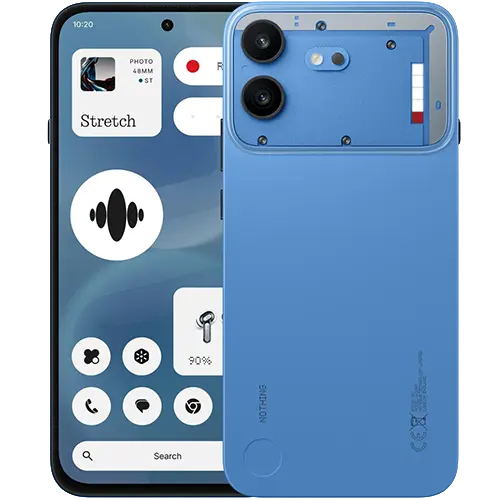
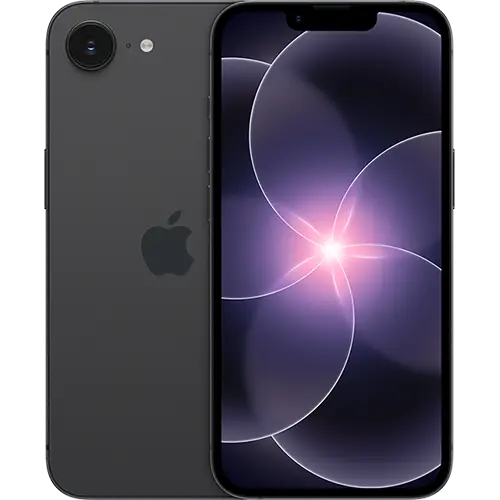
The Nothing Phone (4b) is Nothing's $399 entry, aimed at buyers who want a big battery and bold design without a steep price. The iPhone 17e is Apple's $599 starting point for the iPhone lineup, a compact phone built around Apple's silicon and its ecosystem of services. A $200 gap separates them. That's enough to make a budget-conscious buyer think carefully about what the premium actually buys.
The iPhone 17e has the stronger camera, faster processor, better speaker, and more durable build. Display quality splits between them: the iPhone is brighter and more color-accurate, while the Nothing is smoother and more responsive. The Nothing Phone (4b) lasts considerably longer on a charge and includes an ultrawide camera the iPhone doesn't have.
Design
| Nothing Phone (4b) | Apple iPhone 17e | |
|---|---|---|
| Specifications | ||
| Dimensions | 164.4 x 78.2 x 8.6 mm | 146.7 x 71.5 x 7.8 mm |
| Weight | 210g | 169g |
| IP Rating | IP64 | IP68 |
| Frame | Plastic | Aluminum |
| Front | Dragontrail glass | Ceramic Shield 2 |
| Back | Plastic | Glass |
| Screen-to-body ratio | 87.4% | 87.1% |
The iPhone 17e is noticeably smaller and lighter: 146.7 x 71.5 x 7.8mm and 169g, compared to the Nothing's 164.4 x 78.2 x 8.6mm and 210g. The Nothing is taller, wider, and 41g heavier.
Materials favor the iPhone. It uses an aluminum frame, Ceramic Shield 2 front glass, and a glass back. The Nothing has a plastic frame, Dragontrail glass front, and plastic back. The iPhone's IP68 rating means it's rated for submersion in water. The Nothing's IP64 covers splashes but not submersion.
Screen-to-body ratios are nearly identical at 87.4% for the Nothing and 87.1% for the iPhone. Both use a 19.5:9 aspect ratio. The Nothing's larger body houses a 6.77-inch display versus the iPhone's 6.1-inch panel.
Bandicoot Lab doesn't formally test design or durability. Everything in this section is based on published specs.
Display
| Nothing Phone (4b) | Apple iPhone 17e | |
|---|---|---|
467/ 881 | 541/ 881 | |
The Nothing Phone (4b) has a 6.77-inch AMOLED at 1080 x 2344 (381 pixels per inch) with a 120Hz refresh rate. The iPhone 17e has a 6.1-inch OLED at 1170 x 2532 (460 PPI) capped at 60Hz. The iPhone's higher pixel density means tighter text and finer detail at close range. The Nothing's 120Hz refresh makes scrolling and animations visibly smoother.
Manual brightness reaches 850 nits on the iPhone and 582 nits on the Nothing, a meaningful gap outdoors. HDR peak brightness is nearly identical: 1,163 nits for the iPhone and 1,147 nits for the Nothing. Both maintain full brightness stability across HDR window sizes, and both sustain that brightness well over a 30-minute test. Color accuracy in the best display mode is good on both panels. Colors stay close to reference and neutral tones look clean on each. The iPhone is slightly more precise, but the difference is small enough that most people won't notice. Both cover sRGB nearly completely (99.7% and 99.3%) and about 75% of DCI-P3.
The two panels handle HDR tone mapping differently. The Nothing follows the reference curve closely, with minimal highlight boosting and clipping that begins only at the 90% input level. The iPhone pushes highlights well above reference and clips earlier, at 75%. The iPhone's HDR looks punchier. The Nothing's is more faithful to how content was mastered.
Touch latency is where these two diverge sharply. The Nothing measures 21.4ms; the iPhone measures 62.3ms. Combined with 120Hz, the Nothing feels meaningfully more responsive under the finger. You'll notice the difference most in fast scrolling and tap-heavy interactions.
Performance
| Nothing Phone (4b) | Apple iPhone 17e | |
|---|---|---|
202/ 1012 | 764/ 1012 | |
The Nothing Phone (4b) runs a Qualcomm Snapdragon 6 Gen 4 with 8GB of RAM. The iPhone 17e runs an Apple A19, also with 8GB. These aren't close.
The iPhone scores 3,669 single-core and 9,152 multi-core in GeekBench 6, versus 1,096 and 3,158 for the Nothing. That's roughly a 3x gap in both tests. In Speedometer, which reflects browser and general responsiveness, the iPhone scores 35.8 to the Nothing's 11.1. GPU performance is even more lopsided: the iPhone peaks at 3,884 in Wild Life Extreme versus 966 for the Nothing. The Nothing holds steadier under sustained GPU load (99.5% stability versus 76.4%), but even at its throttled floor the iPhone delivers far more graphics output.
In daily use, the iPhone will feel snappier across the board: app launches, web browsing, and multitasking. The Nothing handles everyday tasks and light gaming fine, but complex workloads expose the gap quickly.
Camera
| Nothing Phone (4b) | Apple iPhone 17e | |
|---|---|---|
330/ 587 | 430/ 587 | |
Neither phone targets camera enthusiasts. The iPhone 17e has a 48-megapixel main camera (f/1.6, 26mm, 1/2.55-inch sensor) and a 12-megapixel front camera. The Nothing Phone (4b) has a 50-megapixel main (f/1.8, 29mm, 1/2.76-inch sensor), an 8-megapixel ultrawide, and a 16-megapixel front camera. No telephoto on either side. Both max out at 10x digital zoom.
Sharpness is one of the biggest separators. Both main cameras capture similar detail in bright and mid light. In low light, the iPhone holds roughly twice the detail of the Nothing, thanks to its larger sensor and wider aperture. At 10x digital zoom, both phones are cropping heavily from the main sensor. The iPhone retains noticeably more detail at this range, though neither produces results you'd want to rely on. The iPhone's front camera is also substantially sharper across all lighting conditions.
The Nothing's main camera renders gently vivid colors in bright light, settling closer to neutral as light drops. The iPhone leans slightly muted in bright conditions but pushes saturation harder in mid light. Both struggle with white balance under warmer lighting. The iPhone overcorrects aggressively in mid light, introducing a heavy warm cast. The Nothing drifts warm too, but more gradually. Skin tone accuracy follows a similar pattern: the iPhone is accurate in bright light and drifts in warmer conditions, while the Nothing is inaccurate in bright light but improves in dimmer settings. For both phones, white balance handling is the primary cause of color degradation as lighting gets warmer.
Dynamic range clearly favors the iPhone's main camera. It retains more shadow detail, controls highlights better, and produces smoother tonal transitions. The Nothing clips highlights and occasionally inverts tones in high-contrast scenes, giving some images an unnatural look.
Main
| Nothing Phone (4b) (Main) | Apple iPhone 17e (Main) | |
|---|---|---|
358/ 722 | 571/ 722 | |
In bright and mid light, main camera sharpness at 1x is comparable. As you crop in digitally, the iPhone holds usable detail further into the range. The gap widens dramatically in low light, where the iPhone captures roughly double the detail. The Nothing's smaller sensor and slower lens are the limiting factors.
Dynamic range is a significant iPhone advantage. High-contrast scenes retain depth through shadows and highlights. The Nothing's more limited range clips highlights and can produce tonal inconsistencies where darker areas render lighter than they should.
Color handling is mixed across lighting. In bright daylight at 5500K, the iPhone produces accurate skin tones and well-controlled hues. The Nothing oversaturates slightly and produces significant skin tone errors in the same conditions. Under warmer mid-range lighting at 4000K, the situation reverses. The iPhone's white balance pushes a strong warm cast that inflates saturation and throws skin tones off. The Nothing's white balance drifts warm too, but to a much lesser degree, and its skin tones are more controlled. In low light at 3000K, both phones drift: the Nothing shows a mild warm-pink cast, and the iPhone shifts warm with improved skin rendering.
Ultrawide
| Nothing Phone (4b) (Ultrawide) | Apple iPhone 17e (Ultrawide) | |
|---|---|---|
375/ 722 | — | |
The Nothing Phone (4b) has an 8-megapixel ultrawide (f/2.2, 16mm). The iPhone 17e has no ultrawide. If wider framing matters, the Nothing is the only option here.
The Nothing's ultrawide is a basic unit. Sharpness is reasonable in bright and mid light and drops in low light. It's a clear step down from the Nothing's own main camera, which is typical for a small 1/4.0-inch sensor. Dynamic range is better controlled than the Nothing's main lens, with smoother tonal handling and no inversions. Colors are slightly muted across conditions, with hue accuracy degrading under warmer light in the same white-balance-driven pattern as the main camera.
Front
| Nothing Phone (4b) (Front) | Apple iPhone 17e (Front) | |
|---|---|---|
363/ 722 | 549/ 722 | |
The iPhone 17e's front camera is substantially sharper than the Nothing's in every lighting condition, capturing about twice the detail in low light. The Nothing's higher megapixel count doesn't help when the lens is slower and the pixels are smaller.
Color accuracy degrades on both phones under warmer light, in opposite directions. The Nothing's processing overcorrects toward cool tones, giving faces a slightly cold look in dimmer conditions. The iPhone shifts warm and pink, which is more flattering but still inaccurate. Skin tones are mediocre on both. The Nothing is off in bright light; the iPhone falls apart in low light, where it also desaturates colors heavily, leaving faces looking washed out. Video stabilization favors the Nothing, which keeps handheld footage more controlled than the iPhone's front camera.
Battery
| Nothing Phone (4b) | Apple iPhone 17e | |
|---|---|---|
547/ 836 | 498/ 836 | |
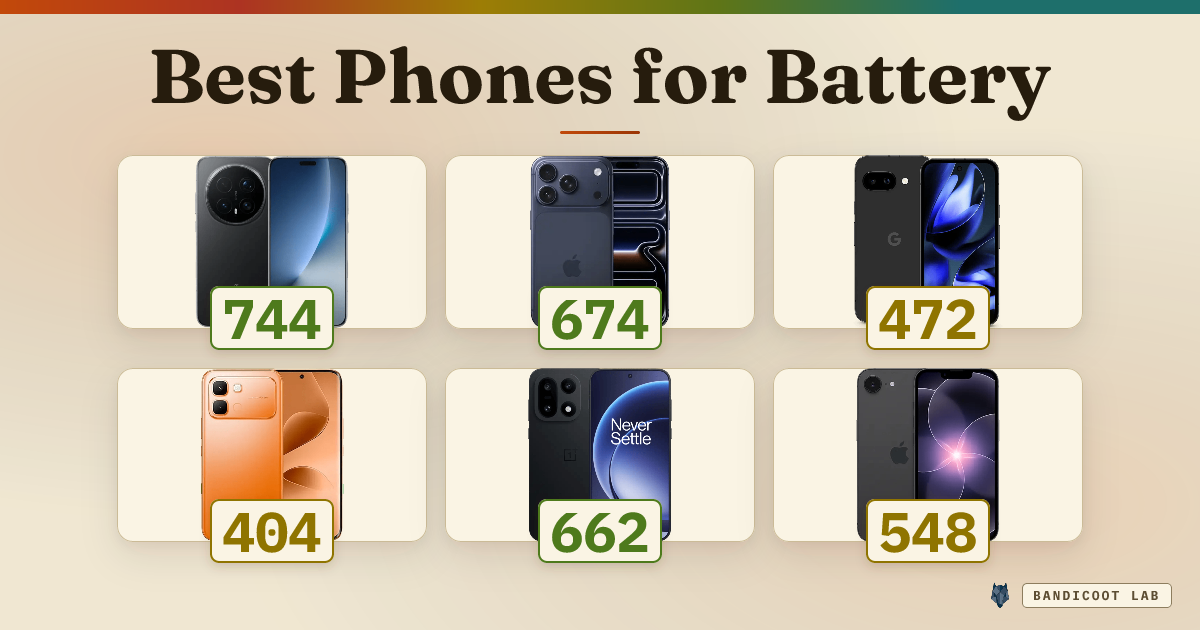
The Nothing Phone (4b) has a 5200mAh battery. The iPhone 17e has a 4005mAh cell. That 30% capacity advantage shows up in every test.
In video playback, which runs continuously until the phone dies, the Nothing lasts 28 hours. The iPhone lasts 18.5 hours. The Nothing could get you through a long weekend trip on a single charge with moderate use. Over a five-hour web browsing session, the Nothing drains 22% versus 33% for the iPhone. Eight hours of overnight standby costs 2% on the Nothing and 3% on the iPhone.
During the 3DMark Wild Life Extreme stress test (20 loops), the Nothing drains 10% and the iPhone drains 17%. The iPhone's GPU is doing roughly four times the graphical work during this test, so the higher drain isn't disproportionate. For raw stamina during a gaming session, the Nothing's larger battery still wins.
Battery life is the Nothing's clearest advantage. The gap in video playback alone is nine and a half hours. That changes how often you reach for a charger.
Charging
| Nothing Phone (4b) | Apple iPhone 17e | |
|---|---|---|
178/ 837 | 281/ 837 | |
The Nothing Phone (4b) charges at up to 33W wired. The iPhone 17e supports up to 20W wired and 15W wireless via MagSafe/Qi2 magnetic alignment. The Nothing has no wireless charging.
On wired charging, the iPhone reaches 25% in 10 minutes and 61% in 30 minutes. The Nothing reaches 19% and 50%. The iPhone fills to a higher percentage faster, partly because its battery is 23% smaller. In absolute energy delivered, the Nothing pushes a similar amount of charge into its larger battery over 30 minutes. It just has more to fill.
The iPhone's wireless charging reaches 17% in 10 minutes and 38% in 30 minutes. It's slower than wired, but the convenience of dropping the phone on any MagSafe or Qi2 charger is something the Nothing can't match.
Speaker
| Nothing Phone (4b) | Apple iPhone 17e | |
|---|---|---|
590/ 897 | 821/ 897 | |
The iPhone 17e has the better speaker by a wide margin. It produces full, extended bass that reaches well below what the Nothing can manage. Its frequency response is more balanced and distortion stays lower, at 4.45% total harmonic distortion compared to 7.61% for the Nothing. High-end clarity is strong on the iPhone, with cleaner separation across the range.
The Nothing is louder, peaking at 73.4 dBA versus the iPhone's 69.1 dBA. Loudness is the only speaker metric where it leads. The Nothing sounds thinner and more uneven, with minimal bass presence.
If you use your phone's speaker for anything beyond calls and notifications, you'll hear the difference. The iPhone sounds significantly richer and more complete.
Microphone
| Nothing Phone (4b) | Apple iPhone 17e | |
|---|---|---|
310/ 1220 | 665/ 1220 |
The iPhone 17e's microphone is above average, with even frequency response that captures voice cleanly. The Nothing Phone (4b) is well below average, with noticeably uneven output. For calls, video recording, and voice memos, the iPhone produces clearer, more consistent audio.
Other
| Nothing Phone (4b) | Apple iPhone 17e | |
|---|---|---|
| Biometrics | 360/ 1181 | 229/ 1181 |
| Data Transfer | 99/ 943 | 90/ 943 |
| Specifications | ||
| Biometric type | Fingerprint | Face Recognition |
| Ports | USB-C 2.0 | USB-C 2.0 |
| Storage | 128GB, 256GB | 256GB, 512GB |
The Nothing Phone (4b) uses an optical fingerprint sensor that unlocks in 292ms. The iPhone 17e uses hardware-based face unlock at 458ms. The Nothing is quicker to authenticate, though both are responsive enough for daily use. The Nothing has no hardware-based face unlock; the iPhone has no fingerprint sensor.
Data transfer speeds are similar and slow on both. The Nothing reads at 37 MB/s and writes at 36 MB/s; the iPhone reads at 39 MB/s and writes at 38 MB/s. Both use USB-C 2.0. The Nothing starts at 128GB of storage with a 256GB option. The iPhone starts at 256GB with a 512GB option.
Conclusion
The $200 gap between these phones buys a lot. The iPhone 17e is faster, takes better photos in most conditions, sounds better through its speaker, and comes in a smaller, more durable body with IP68 water resistance. Its A19 chip is in a different class than the Snapdragon 6 Gen 4, and the camera advantages in low light and dynamic range are clear. For someone who values performance, camera quality, and build materials, the iPhone earns its premium.
The Nothing Phone (4b) at $399 has clear strengths of its own. Its battery lasts nine and a half hours longer in video playback, its 120Hz display is noticeably smoother and more responsive, and it includes an ultrawide camera the iPhone lacks. If you spend more time consuming content than creating it, and you'd rather charge less often than have the fastest chip, the Nothing delivers on the things that shape daily experience.
The cameras are the starkest dividing line beyond performance. If you shoot in low light, need reliable skin tones across conditions, or crop in regularly, the iPhone is clearly ahead. If you mostly shoot in decent light and want the option of a wider angle, the Nothing covers different ground. Everything else — speaker, microphone, build quality — favors the iPhone, but those are the kind of advantages some buyers will happily trade for $200 back in their pocket.
FAQ
Does the Nothing Phone (4b) or iPhone 17e have better battery life?
The Nothing Phone (4b) lasts considerably longer. It runs 28 hours of video playback versus 18.5 hours for the iPhone 17e. Over a five-hour web browsing test it drains 22% against the iPhone's 33%. Its 5200mAh battery is about 30% larger than the iPhone's 4005mAh cell.
Is the iPhone 17e worth $200 more than the Nothing Phone (4b)?
The extra money buys a much faster chip, a stronger camera in low light and high-contrast scenes, a better speaker and microphone, and a smaller body with an aluminum frame and IP68 water resistance. The Nothing Phone (4b) costs $399 and offers longer battery life, a smoother 120Hz display, and an ultrawide camera. Performance, camera quality, and build favor the iPhone. Battery life and display smoothness favor the Nothing.
Which has the better low-light camera, the iPhone 17e or the Nothing Phone (4b)?
The iPhone 17e. Its main camera captures roughly twice the detail of the Nothing's in low light, and its larger sensor and wider f/1.6 aperture are the main reasons. The iPhone also retains more shadow and highlight detail in high-contrast scenes. In bright and mid light the two main cameras are much closer in sharpness.
Is the Nothing Phone (4b) screen better than the iPhone 17e's?
It depends on what you value. The Nothing's 6.77-inch panel runs at 120Hz with 21.4ms average touch latency, so scrolling and taps feel much more responsive than on the iPhone's 60Hz screen at 62.3ms. The iPhone 17e is brighter outdoors, with 850 nits of manual brightness versus 582 nits. It also has sharper text at 460 PPI versus 381 PPI and slightly more precise color. HDR peak brightness is nearly identical on both.
Which is better for gaming, the iPhone 17e or the Nothing Phone (4b)?
The iPhone 17e is far ahead on graphics power. It peaks at 3,884 in Wild Life Extreme versus 966 for the Nothing, and even its throttled performance exceeds what the Nothing delivers. The Nothing holds its output more steadily under sustained load, at 99.5% stability versus 76.4%, and drains less battery during the stress test (10% versus 17%). The Nothing handles light gaming, but demanding games run better on the iPhone.
Does the iPhone 17e or Nothing Phone (4b) charge faster?
The iPhone 17e fills faster in practice, reaching 25% in 10 minutes and 61% in 30 minutes on wired charging. The Nothing Phone (4b) reaches 19% and 50% despite its higher 33W rating, partly because its battery is larger. The iPhone also supports 15W wireless charging through MagSafe/Qi2, which the Nothing doesn't offer.
Related
Apple
iPhone 17e
Nothing
Phone (4b)
Nothing
Phone (4a) Pro
Nothing
Phone (4a)
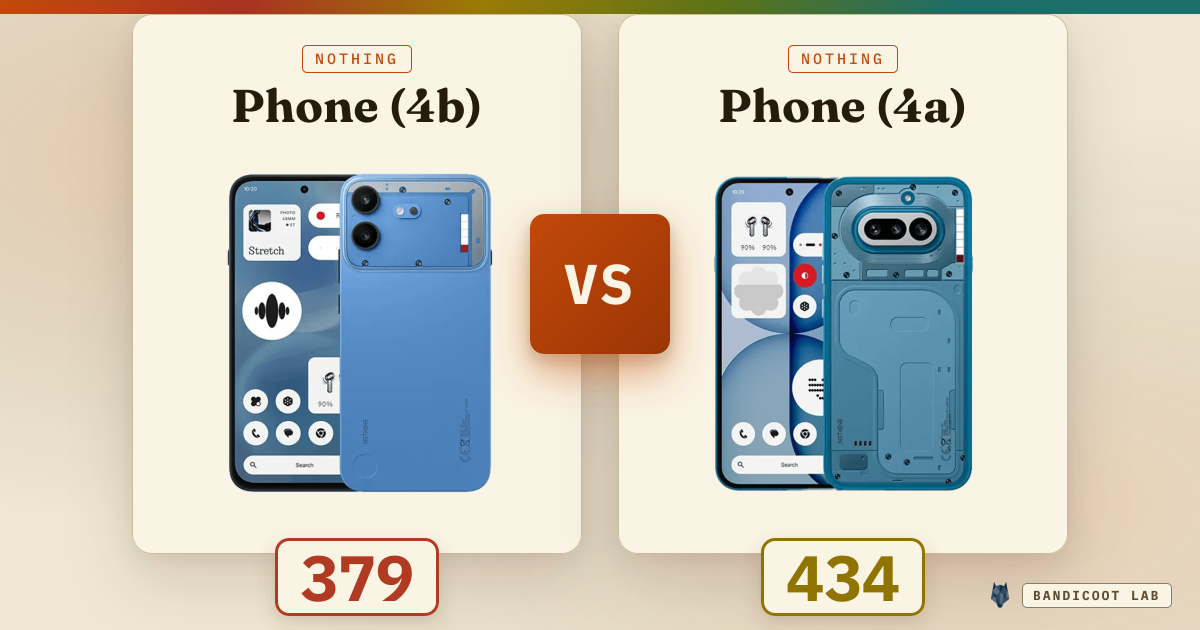
Nothing Phone (4b) vs Nothing Phone (4a)
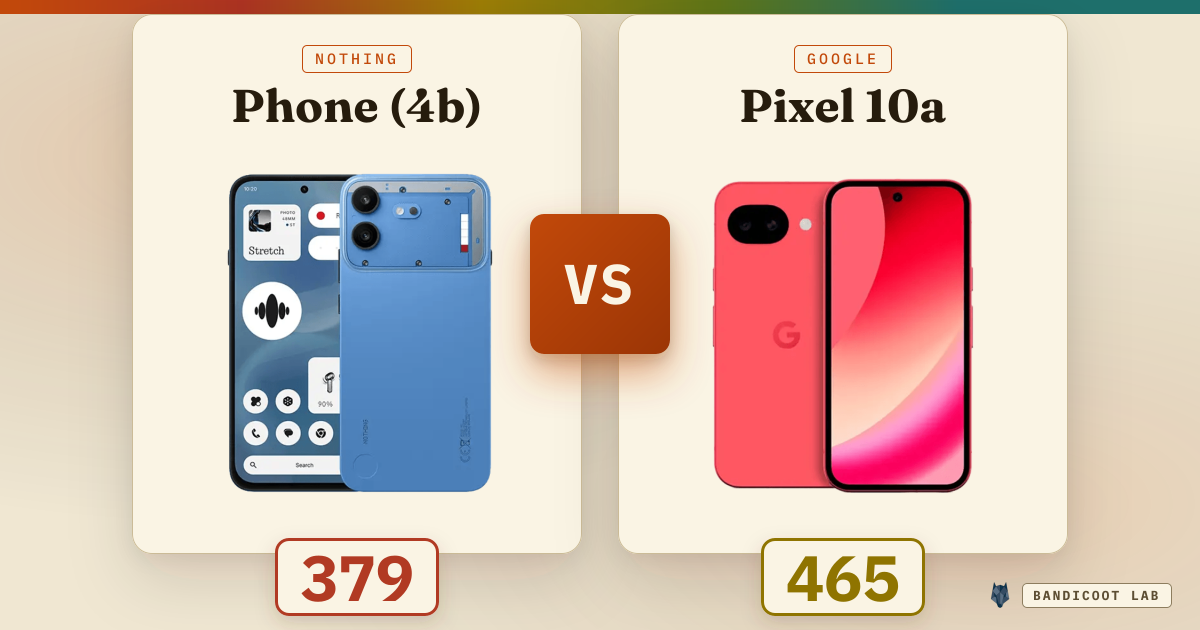
Nothing Phone (4b) vs Google Pixel 10a

Nothing Phone (4b) vs Motorola Moto G Power (2026)
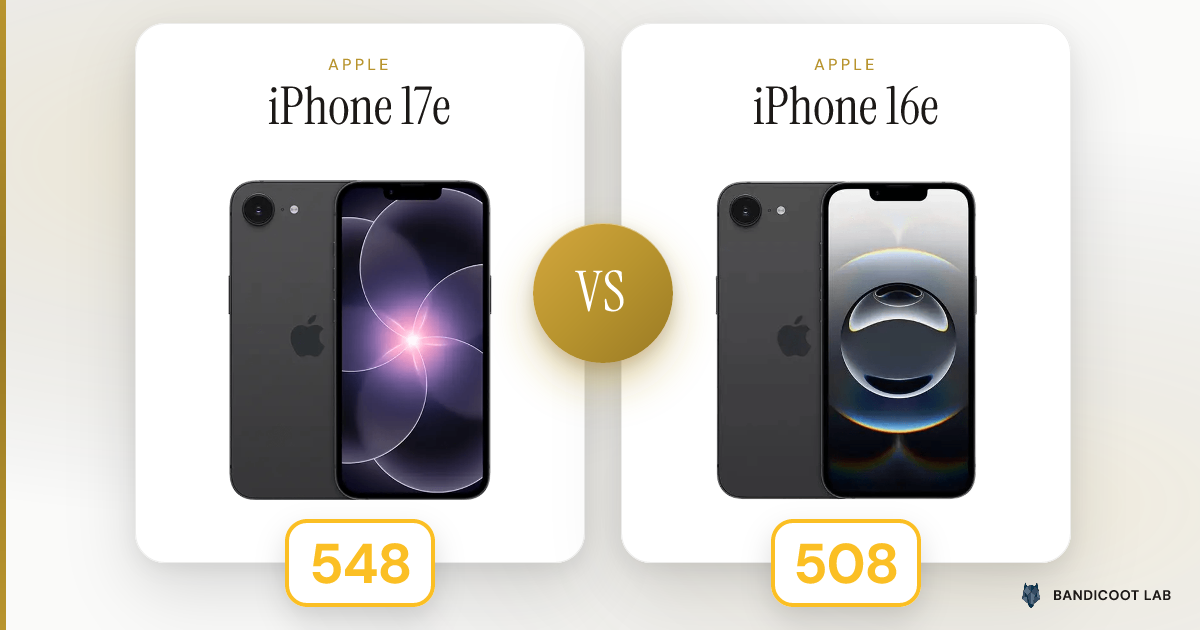
Apple iPhone 17e vs iPhone 16e
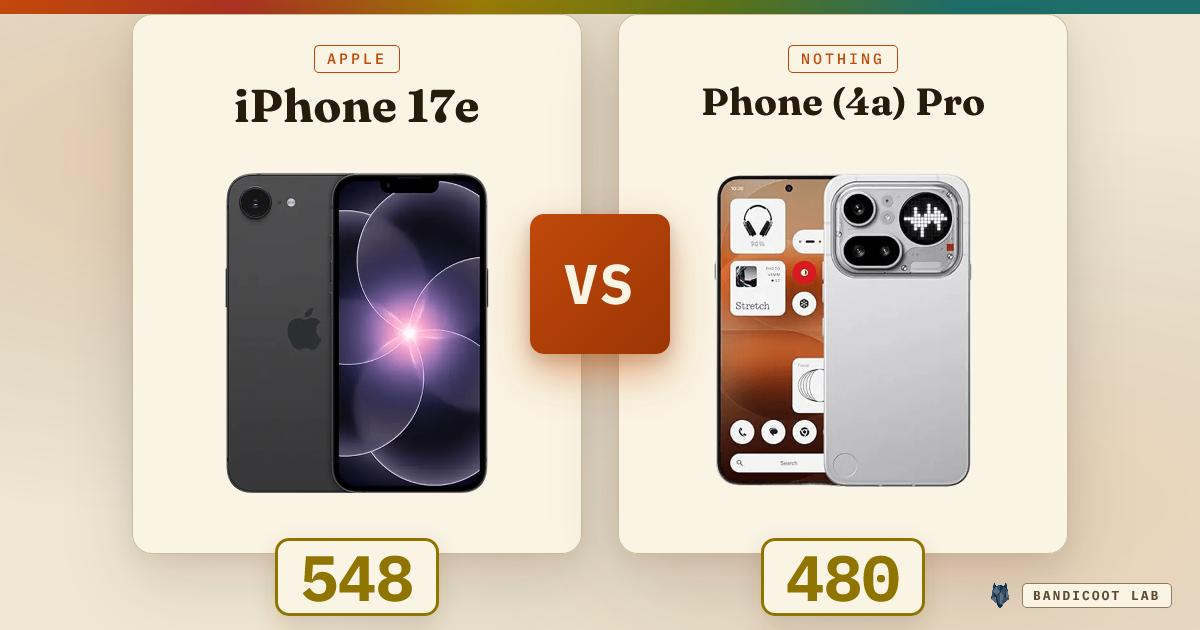
Apple iPhone 17e vs Nothing Phone (4a) Pro
Best Phones for Battery
Apple iPhone 17e vs Google Pixel 10a
Best iPhones