Nothing Phone (4b) vs Motorola Moto G Power (2026)
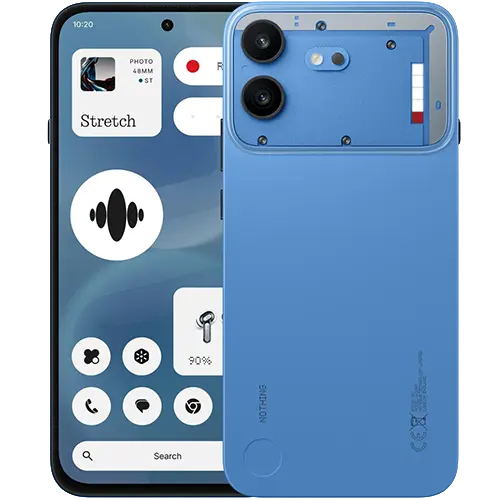

Nothing
Motorola
Phone (4b)
Moto G Power (2026)
Ranked #59 of 61
Ranked #61 of 61
Overall
Overall
The Moto G Power at $299.99 is built to the formula Motorola has used for this line for years: big battery, low price, enough phone for people who aren't chasing flagships. The Nothing Phone (4b) at $399 targets a step above, offering a better screen and faster internals for buyers who want more but aren't ready to spend $600. A hundred dollars separates them.
The Nothing Phone (4b) earns that premium in the areas most people feel daily: it has the better display, significantly longer battery life, considerably more processing power, and more accurate camera color. The Moto G Power pushes back with much better water resistance, a faster fingerprint sensor, faster charging, a louder speaker, and a sharper front camera. Its microphone is also meaningfully better. The gap in battery life and performance favors the Nothing; the gap in price and durability favors the Moto.
Design
| Nothing Phone (4b) | Motorola Moto G Power (2026) | |
|---|---|---|
| Specifications | ||
| Dimensions | 164.4 x 78.2 x 8.6 mm | 166.6 x 77.1 x 8.7 mm |
| Weight | 210g | 208g |
| IP Rating | IP64 | IP68/IP69 |
| Frame | Plastic | Plastic |
| Front | Dragontrail glass | Gorilla Glass 7i |
| Back | Plastic | Vegan leather |
| Screen-to-body ratio | 87.4% | 87.2% |
Both phones are similarly sized. The Moto G Power is slightly taller at 166.6mm versus 164.4mm, while the Nothing is a touch wider at 78.2mm versus 77.1mm. Weight is nearly identical at 210g and 208g, and thickness is within a tenth of a millimeter at 8.6mm and 8.7mm. Screen-to-body ratios are effectively the same at 87.4% and 87.2%, so bezels should look comparable on both. The Nothing uses a 19.5:9 aspect ratio; the Moto is slightly taller and narrower at 19.9:9.
Build materials diverge in a few ways. Both have plastic frames. The Nothing pairs a Dragontrail glass front with a plastic back. The Moto uses Gorilla Glass 7i up front and a vegan leather back. The Gorilla Glass 7i should offer better scratch resistance than Dragontrail, and the leather back is less likely to show fingerprints or pick up scuffs than bare plastic.
The biggest practical gap is water resistance. The Moto G Power carries an IP68/IP69 rating, meaning it's rated for submersion in fresh water up to 1.5 meters and can handle high-pressure water jets. The Nothing Phone (4b) is IP64: protected from dust and splashes, but not submersion. For anyone who regularly uses their phone near water or in rough conditions, the Moto has a genuine advantage here. Bandicoot Lab doesn't formally test design or durability, so this section describes what's on the spec sheet.
Display
| Nothing Phone (4b) | Motorola Moto G Power (2026) | |
|---|---|---|
467/ 881 | 387/ 881 | |
The fundamental split here is panel technology. The Nothing Phone (4b) uses a 6.77-inch AMOLED display; the Moto G Power has a 6.8-inch LCD. Both are 1080p with very similar pixel density: 381 pixels per inch on the Nothing, 387 PPI on the Moto. Both max out at 120Hz, though the Nothing can drop as low as 30Hz for static content while the Moto's floor is 60Hz.
Brightness favors the Nothing across the board. In manual mode, the Nothing peaks at 582 nits versus the Moto's 547 nits. Displaying HDR content in auto brightness, the Nothing reaches 1,147 nits while the Moto hits 1,021 nits. Both hold brightness evenly across HDR window sizes, scoring 100% stability there. Over a 30-minute sustained brightness test, the Nothing barely fades at 99.1%. The Moto drops to 94.5%, a modest but measurable dip. The AMOLED panel also gives the Nothing true blacks and effectively infinite contrast, something the LCD on the Moto can't match.
Color accuracy is another win for the Nothing. In its best display mode, colors stay close to reference with minimal visible drift. The Moto shows more noticeable deviation; some tones land far enough off that you could spot it without a reference screen next to it. Both panels cover 99.3% of the sRGB gamut and roughly 75% of DCI-P3, so they can display a similar range of colors. The difference is in how accurately they render within that range.
For HDR tone mapping, the Nothing tracks the reference curve fairly closely, with only minimal brightening of highlights. It clips the signal at about 90% input level. The Moto takes a more aggressive approach, intentionally pushing highlights well above the mastered signal and clipping earlier at 85%. HDR content on the Moto looks brighter in the highlights but loses subtlety in near-white tones. Touch latency is 21.4ms on the Nothing and 28ms on the Moto. That 6.6ms gap is unlikely to register in everyday scrolling but could be perceptible in fast-paced games.
Performance
| Nothing Phone (4b) | Motorola Moto G Power (2026) | |
|---|---|---|
202/ 1012 | 121/ 1012 | |
The Nothing Phone (4b) runs on Qualcomm's Snapdragon 6 Gen 4; the Moto G Power uses MediaTek's Dimensity 6300. Both have 8GB of RAM. The performance gap between them is substantial.
In GeekBench 6, the Nothing scores 1,096 single-core and 3,158 multi-core versus the Moto's 792 and 2,130. That's roughly 38% faster in single-threaded work and 48% in multi-threaded tasks. You'll feel this in app launch times, multitasking, and anything compute-heavy. The GPU gap is wider still: the Nothing peaked at 966 in Wild Life Extreme, more than two and a half times the Moto's 382. Both phones maintain excellent thermal stability under sustained GPU load, with the Nothing at 99.5% and the Moto at 99.2%. They don't throttle; the Moto just starts from a much lower ceiling.
Browser performance follows the same pattern. The Nothing scores 11.1 in Speedometer versus the Moto's 6.1, so web pages with heavy JavaScript load and respond noticeably faster. For basic browsing and social media, both phones are fine. For anything more demanding, the Snapdragon 6 Gen 4 has a comfortable margin.
Camera
| Nothing Phone (4b) | Motorola Moto G Power (2026) | |
|---|---|---|
330/ 587 | 287/ 587 | |
Neither phone is one you'd buy for its camera. Both sit near the bottom of our camera rankings, and their hardware tells you why: 50-megapixel main sensors of similar size (1/2.76-inch on the Nothing, 1/2.88-inch on the Moto), 8-megapixel ultrawides, and no telephoto lens on either. Sharpness is a mixed story. The Moto's main camera holds detail better in low light, and its ultrawide and front camera both resolve more detail than the Nothing's equivalents across all lighting. The Nothing keeps pace with the Moto's main sensor in bright and mid conditions.
Neither phone handles extreme digital zoom well. The Nothing crops up to 10x, the Moto to 8x, and detail falls off steeply past 3-4x on both. At 10x, the Nothing's output is extremely soft. These are large-crop digital zooms from smallish sensors, and the results show it.
The phones' color rendering is where they diverge most. The Moto pushes saturation aggressively across all conditions, producing vivid, punchy images with a warm cast. The Nothing renders color much closer to neutral, with only a slight vivid push in bright light. These are processing choices, and which you prefer is partly personal. Accuracy is a separate question, and the Nothing comes out ahead. Its hue rendering is moderate in good light and degrades gradually as conditions dim, mostly due to white balance correction that doesn't fully compensate for warmer lighting. The Moto's hue errors are larger overall and become severe in low light, where skin tones shift dramatically toward magenta and pink. That shift doesn't track with the change in lighting temperature, pointing to a sensor-level color separation issue rather than a white balance problem.
Main
| Nothing Phone (4b) (Main) | Motorola Moto G Power (2026) (Main) | |
|---|---|---|
358/ 722 | 309/ 722 | |
The Nothing Phone (4b) uses a 50-megapixel f/1.8 sensor at 29mm; the Moto G Power uses a 50-megapixel f/1.8 at 31mm with a slightly smaller 1/2.88-inch sensor. In bright and mid light, both main cameras resolve similar levels of detail. The Nothing has a slight edge under mid lighting. In low light, the Moto pulls ahead meaningfully, retaining substantially more sharpness while the Nothing's output softens.
Both phones rely entirely on digital crop for zoom. The Nothing covers 1x to 10x, the Moto 1x to 8x. Both hold reasonable detail at 2x. By 4x, softening is visible on both, and beyond that it degrades quickly. The Nothing's extra reach to 10x adds range on paper but not useful quality.
Color on the main camera reinforces the overall picture. The Moto's processing boosts saturation well above natural across all three test lighting conditions, giving images a vivid, warm look. Skin tones are pushed notably away from reference, most severely in bright light and only partially improving as conditions dim. The Nothing is closer to accurate, though its skin tone rendering drifts most in bright light. In mid light, the Nothing develops a noticeable warm, yellowish cast, consistent with white balance struggling to keep pace with the 4000K test illuminant. By low light, the Nothing shifts slightly toward magenta, but the drift is mild compared to the Moto's.
Dynamic range favors the Nothing's main camera. Both clip highlights, but the Nothing preserves a wider range from shadows to highlights with fewer tonal irregularities. The Moto's images tend to look flatter in high-contrast scenes, with areas that should be smoothly gradated sometimes reading unevenly. Video stabilization is noticeably better on the Nothing as well. Handheld footage stays more controlled, while the Moto shows more residual shake.
Ultrawide
| Nothing Phone (4b) (Ultrawide) | Motorola Moto G Power (2026) (Ultrawide) | |
|---|---|---|
375/ 722 | 326/ 722 | |
The Nothing Phone (4b) has an 8-megapixel f/2.2 ultrawide at 16mm; the Moto G Power has an 8-megapixel f/2.2 at a wider 13mm. Despite both being 8 megapixels, the Moto's ultrawide resolves significantly more detail across all lighting conditions. The gap is large enough to see without zooming in.
Color follows each phone's main camera tendencies. The Moto oversaturates heavily, with a warm, vivid push in bright and mid light. In low light, the Moto's ultrawide develops severe hue errors: skin tones take on a strong pink cast, with the color shift far exceeding what white balance alone would explain. The Nothing's ultrawide is close to neutral in saturation, almost slightly muted. Its color stays more consistent across lighting, with only moderate drift in dim conditions.
Dynamic range is the Nothing's clear advantage here. Its ultrawide captures a noticeably wider tonal range with cleaner shadow-to-highlight transitions. The Moto's ultrawide loses dynamic range significantly, with multiple tonal irregularities that reduce depth in high-contrast scenes. Both ultrawides clip highlights.
Front
| Nothing Phone (4b) (Front) | Motorola Moto G Power (2026) (Front) | |
|---|---|---|
363/ 722 | 334/ 722 | |
The Moto G Power's 32-megapixel f/2.2 front camera at 24mm outresolves the Nothing's 16-megapixel f/2.4 at 25mm by a wide margin. In bright light, the sharpness difference is dramatic. The Moto maintains a meaningful advantage in mid and low light as well, though both cameras soften in the dark.
Color accuracy flips the advantage. The Moto's front camera oversaturates heavily in all conditions and produces extreme hue errors in low light, with skin tones shifting dramatically toward magenta and warm yellow. The errors are severe enough to make portraits look unnatural under dim indoor lighting. The Nothing's front camera is moderately vivid in bright light and close to neutral in dim settings. It develops a cool, bluish cast in mid and low light as the processing overcompensates for warmer color temperatures. Skin tones drift in bright light but stay more controlled overall.
Dynamic range strongly favors the Nothing's front camera. It preserves a wider tonal range with more visible depth in high-contrast selfie lighting. The Moto's front camera clips more aggressively and captures a narrower range. For video selfies, the Nothing produces more stable footage with less visible shake.
Battery
| Nothing Phone (4b) | Motorola Moto G Power (2026) | |
|---|---|---|
547/ 836 | 392/ 836 | |
Both phones pack 5200mAh batteries, but they don't use that capacity equally. The Nothing Phone (4b) lasted 28 hours in video playback testing versus the Moto G Power's 17.6 hours. That's a 10-hour gap from identical capacity. The Nothing can comfortably get through two full days of moderate use on a charge. The Moto is a reliable one-day phone with some buffer.
The gap narrows in other tests but doesn't close. In five-hour web browsing, the Nothing drained 22% versus the Moto's 24%. During gaming stress testing, the Nothing lost 10% while the Moto dropped 11%. Overnight standby drew 2% from the Nothing and 3% from the Moto. The web and gaming differences are small enough that daily patterns will vary more than the test gap. The video playback advantage is the headline: 10 more hours of screen-on endurance from the same battery size.
Charging
| Nothing Phone (4b) | Motorola Moto G Power (2026) | |
|---|---|---|
178/ 837 | 224/ 837 | |
The Nothing Phone (4b) supports 33W wired charging; the Moto G Power supports 30W. Neither offers wireless charging.
Despite the lower rated wattage, the Moto charges faster in practice. At 10 minutes, they're nearly identical: the Moto reaches 20% versus the Nothing's 19%. By 30 minutes, the Moto pulls ahead at 58% versus the Nothing's 50%. That eight-percentage-point gap means the Moto picks up meaningfully more charge from a quick top-up before heading out.
Speaker
| Nothing Phone (4b) | Motorola Moto G Power (2026) | |
|---|---|---|
590/ 897 | 558/ 897 | |
The Moto G Power is significantly louder, peaking at 80.3 dBA versus the Nothing's 73.4 dBA. In a noisy room or outdoors, the Moto will be much easier to hear. The Moto also has fuller bass and a more balanced frequency spread, giving music and media a rounder, warmer character.
The Nothing has lower total harmonic distortion at 7.61% compared to the Moto's 12.48%. The Nothing's speaker leans heavily toward high-end clarity with very little bass. Music and podcasts sound thin but articulate. The Moto's sound is fuller, but its higher distortion means it gets rougher as you push volume. If you value sheer loudness, the Moto wins easily. If you want cleaner audio at moderate volume, the Nothing's speaker stays more composed.
Microphone
| Nothing Phone (4b) | Motorola Moto G Power (2026) | |
|---|---|---|
310/ 1220 | 619/ 1220 |
The Moto G Power has the better microphone, with more even frequency response that should produce clearer voice recordings and better call quality. It scores above average among the phones we've tested. The Nothing Phone (4b) falls well below average, with more uneven response that can make voices sound less natural. For phone calls and voice messages, the Moto has a tangible edge.
Other
| Nothing Phone (4b) | Motorola Moto G Power (2026) | |
|---|---|---|
| Biometrics | 360/ 1181 | 548/ 1181 |
| Data Transfer | 99/ 943 | 93/ 943 |
| Specifications | ||
| Biometric type | Fingerprint | Fingerprint |
| Ports | USB-C 2.0 | USB-C 2.0 |
| Storage | 128GB, 256GB | 128GB |
Both phones have fingerprint sensors but neither has hardware-based face unlock. The Moto's capacitive fingerprint reader averages 192ms, while the Nothing's optical sensor takes 292ms. That 100ms difference is noticeable in daily use; the Moto unlocks with a snappier, more immediate feel.
Data transfer speeds are nearly identical and uniformly slow. The Nothing reads at 37 MB/s and writes at 36 MB/s; the Moto reads at 38 MB/s and writes at 34 MB/s. Both use USB-C 2.0, which caps transfer rates. The Nothing offers 128GB or 256GB storage options, while the Moto comes in 128GB only.
Conclusion
The Nothing Phone (4b) costs a hundred dollars more and earns it in the areas most people interact with daily. Battery life is the widest gap: 10 more hours of video playback from the same capacity. The AMOLED display is brighter, more accurate, and sustains its brightness better. Processing power isn't close, with the Snapdragon 6 Gen 4 roughly 40 to 150 percent faster depending on the task. Its camera system produces more accurate color and better dynamic range, though sharpness is a split between the two.
The Moto G Power at $299.99 is substantially more water-resistant, faster to unlock, and louder. It charges more quickly, its front camera resolves more detail, and its microphone is noticeably better for calls. If durability, a lower price, and better selfie sharpness matter most to you, the Moto's strengths line up well with those priorities. Battery life, display quality, and performance favor the Nothing, and so does the hundred dollars it costs more.
FAQ
Is the Nothing Phone (4b) worth $100 more than the Moto G Power?
For most people, yes. The Nothing Phone (4b) has a brighter and more accurate AMOLED display, far longer video battery life, and much stronger processing, which are the things you notice every day. The Moto G Power is the better buy if you want the lower $299.99 price, water resistance, and a louder speaker.
Which lasts longer on a charge, the Moto G Power or the Nothing Phone (4b)?
The Nothing Phone (4b) lasts longer. Both have 5200mAh batteries, but the Nothing played video for 28 hours versus 17.6 hours for the Moto G Power. Web browsing, gaming, and standby results are much closer, so the gap is largest for video and other screen-on use.
Does the Moto G Power or Nothing Phone (4b) charge faster?
The Moto G Power charges faster despite its lower 30W rating versus the Nothing's 33W. The two are nearly even at 10 minutes, but at 30 minutes the Moto is at 58% against 50% for the Nothing. Neither phone supports wireless charging.
Which has the better camera, the Nothing Phone (4b) or Moto G Power?
The Nothing Phone (4b) has more accurate color and wider dynamic range, and its video is steadier. The Moto G Power resolves more detail on the ultrawide and front cameras and holds sharpness better in low light on the main camera. The Moto also oversaturates and shifts skin tones toward magenta in dim light, so the Nothing is the better pick for natural-looking photos.
Is the Moto G Power better for water resistance and durability?
Yes. The Moto G Power is rated IP68/IP69, so it handles submersion in fresh water and high-pressure jets. The Nothing Phone (4b) is IP64, which covers dust and splashes but not submersion. The Moto also uses Gorilla Glass 7i on the front, which should resist scratches better than the Nothing's Dragontrail glass.
Is the Nothing Phone (4b) much faster than the Moto G Power for gaming and everyday use?
Yes. The Nothing's Snapdragon 6 Gen 4 is roughly 38% faster in single-core and 48% faster in multi-core work, and its graphics performance is more than two and a half times higher. Both phones hold steady under sustained load without throttling, but the Moto G Power starts from a much lower ceiling. Basic browsing and social media run fine on either.
Related
Nothing
Phone (4b)
Motorola
Moto G Power (2026)
Motorola
Razr Ultra (2026)
Motorola
Razr Fold
Nothing
Phone (4a) Pro
Motorola
Razr+ (2026)
Nothing
Phone (4a)
Motorola
Razr (2026)
Nothing Phone (4b) vs Nothing Phone (4a)
Nothing Phone (4b) vs Google Pixel 10a
Nothing Phone (4b) vs Apple iPhone 17e
Best Phone Speakers