Nothing Phone (4b) vs Google Pixel 10a
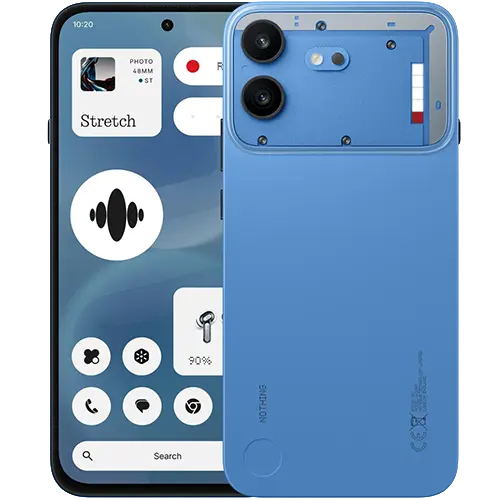
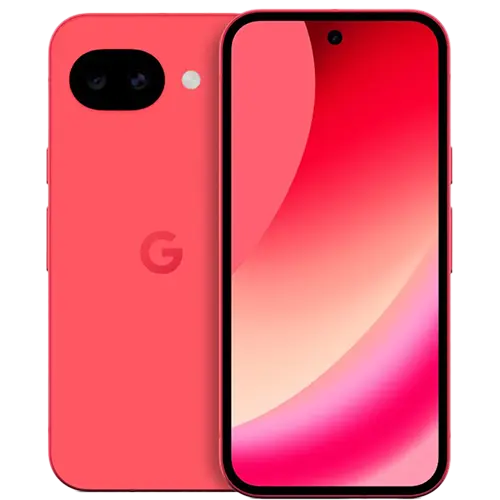
Nothing
Phone (4b)
Pixel 10a
Ranked #59 of 61
Ranked #51 of 61
Overall
Overall
A hundred dollars separates these two phones. The gap in capability is wider than that.
The Nothing Phone (4b) at $399 is Nothing's most affordable model — a big-screen budget phone from a brand built on distinctive design. The Google Pixel 10a at $499 brings Google's Tensor silicon and computational photography pipeline to a lower price point. Both ship with 8GB of RAM, plastic backs, and no telephoto lens. The Nothing offers a larger 6.77-inch display; the Pixel, a more compact 6.3-inch panel.
The Pixel 10a has the stronger display, camera system, and processor. Its screen is far brighter, its cameras hold up much better in low light, and it's faster in every benchmark. The Nothing Phone (4b) counters with a lower price and longer battery life. Its video stabilization is also genuinely better across all lenses. Whether the $100 savings and battery advantage outweigh the Pixel's gains everywhere else depends on your priorities.
Design
| Nothing Phone (4b) | Google Pixel 10a | |
|---|---|---|
| Specifications | ||
| Dimensions | 164.4 x 78.2 x 8.6 mm | 153.9 x 73 x 9 mm |
| Weight | 210g | 183g |
| IP Rating | IP64 | IP68 |
| Frame | Plastic | Aluminum |
| Front | Dragontrail glass | Gorilla Glass 7i |
| Back | Plastic | Plastic |
| Screen-to-body ratio | 87.4% | 84.7% |
The Nothing Phone (4b) measures 164.4 x 78.2 x 8.6mm and weighs 210g. The Pixel 10a comes in at 153.9 x 73 x 9mm and 183g. That's a full centimeter narrower and 27 grams lighter — a noticeable difference in pocket and hand. The Nothing's larger dimensions house its 6.77-inch display; the Pixel's 6.3-inch panel fits in a more compact body.
Both phones have plastic backs. The frame is where they diverge: the Nothing uses plastic, while the Pixel uses aluminum. The Nothing's front glass is Dragontrail; the Pixel uses Gorilla Glass 7i, which is typically more scratch-resistant. The Nothing carries an IP64 rating, meaning protection against splashing water but not submersion. The Pixel 10a is rated IP68 — submersible up to 1.5 meters for 30 minutes.
The Nothing has a higher screen-to-body ratio at 87.4% versus the Pixel's 84.7%, translating to thinner bezels relative to its face. Aspect ratios are close: 19.5:9 on the Nothing, 20.2:9 on the Pixel, with the Pixel's proportions slightly taller and narrower.
Bandicoot Lab doesn't formally test design or durability. These comparisons are based on published specifications. The Pixel's aluminum frame and higher IP rating suggest better long-term durability on paper, and the 27-gram weight difference is likely noticeable in daily carry.
Display
| Nothing Phone (4b) | Google Pixel 10a | |
|---|---|---|
467/ 881 | 584/ 881 | |
Both phones run at 120Hz. The Nothing Phone (4b) has a 6.77-inch AMOLED at 1080 x 2344 (381 pixels per inch); the Pixel 10a has a 6.3-inch P-OLED at 1080 x 2424 (422 PPI). The Pixel's higher pixel density means finer detail, particularly visible in small text and UI elements.
Brightness is the largest difference between these two panels. The Nothing reaches 582 nits in manual brightness mode; the Pixel hits 1,403 nits — more than double. For HDR content with auto brightness, the Pixel peaks at 3,182 nits versus the Nothing's 1,147 nits. The Nothing's HDR brightness holds at 100% stability across window sizes, while the Pixel drops to 62% as windows get larger. Even at that reduced level, the Pixel's output exceeds the Nothing's peak. Over a 30-minute sustained test, both hold up well: 99.1% for the Nothing, 97.9% for the Pixel.
Color accuracy is close. Both phones cover around 99% of sRGB and about 74–75% of DCI-P3. Colors on both panels stay fairly true to their targets, with only minor drift. Neither introduces an obvious color cast in its most accurate mode.
For HDR tone mapping, the Pixel 10a renders highlights at their intended brightness and doesn't clip early, preserving detail across the full input range. The Nothing Phone (4b) dims highlights below their mastered levels and clips before the top of the input range, losing the brightest HDR detail sooner. Touch latency is 21.4ms on the Nothing and 15ms on the Pixel — a 6ms difference that may be perceptible in fast-paced gaming.
Performance
| Nothing Phone (4b) | Google Pixel 10a | |
|---|---|---|
202/ 1012 | 342/ 1012 | |
The Nothing Phone (4b) runs on the Qualcomm Snapdragon 6 Gen 4 with 8GB of RAM. The Pixel 10a uses Google's Tensor G4 with the same 8GB. The Tensor G4 is a substantially more capable chip.
In GeekBench 6, the Pixel scores 1,716 single-core and 4,385 multi-core. The Nothing manages 1,096 and 3,158. That's a 57% lead in single-core and 39% in multi-core for the Pixel — a difference you'll feel in app launches, multitasking, and any task that leans on sustained processing. Browser performance follows the same pattern: the Pixel scores 17.7 in Speedometer versus the Nothing's 11.1.
GPU performance is an even wider spread. In the 3DMark Wild Life Extreme stress test, the Pixel peaks at 2,685 versus the Nothing's 966 — nearly three times the raw graphics output. The Nothing holds steadier under sustained load at 99.5% stability compared to the Pixel's 82.6%, but the Pixel's floor after thermal throttling is still well above the Nothing's ceiling.
The Nothing Phone (4b) handles everyday tasks and lighter games fine. Heavier 3D titles and intensive multitasking will expose the performance gap. The Pixel 10a runs closer to mainstream flagship territory for CPU-bound work.
Camera
| Nothing Phone (4b) | Google Pixel 10a | |
|---|---|---|
330/ 587 | 460/ 587 | |
The Pixel 10a outperforms the Nothing Phone (4b) on every camera lens, with the widest margins in low-light sharpness, dynamic range, and front camera detail.
Both phones rely entirely on digital zoom — neither has a telephoto. The Nothing reaches 10x; the Pixel tops out at 8x. At extreme zoom levels, the Nothing's detail falls off sharply. The Pixel's larger main sensor (1/2.0-inch versus 1/2.76-inch) gives it more to work with when cropping, so it retains more usable detail through the digital zoom range.
The two phones render color very differently. The Pixel 10a pushes saturation aggressively — colors are vivid and punchy, particularly in mid-light indoor conditions. It leans consistently cool, with a noticeable blue shift under warm indoor lighting, suggesting the white balance compensates too far for warm ambient light. The Nothing Phone (4b) renders color much closer to neutral saturation. It shifts warm as ambient light gets warmer, suggesting the white balance doesn't correct enough for warmer light sources.
Skin tone accuracy is mixed on both. The Nothing struggles most in bright light, where faces drift noticeably from reference even though the overall color bias is close to neutral. That pattern points to skin-specific processing rather than a white balance problem. The Pixel produces more accurate skin tones in bright conditions, but its aggressive saturation can make faces look oversaturated. In dim light, both converge to similar levels of skin accuracy. Hue accuracy degrades for both cameras as lighting dims, which is typical at this price range. The Nothing's errors grow gradually; the Pixel's hue errors are slightly larger in bright light but more stable across conditions.
Main
| Nothing Phone (4b) (Main) | Google Pixel 10a (Main) | |
|---|---|---|
358/ 722 | 497/ 722 | |
The Nothing Phone (4b) uses a 50-megapixel f/1.8 main sensor (1/2.76-inch, 29mm equivalent). The Pixel 10a uses a 48-megapixel f/1.7 sensor (1/2.0-inch, 25mm equivalent) — wider field of view and a noticeably larger sensor.
Sharpness at 1x is close in good light. The Nothing actually resolves slightly more detail in bright and mid-light conditions. The story reverses in low light: the Pixel retains strong detail while the Nothing drops to roughly half the Pixel's level. If you shoot mostly outdoors in daylight, the Nothing holds its own. For evening or indoor shooting, the Pixel is clearly better. Through the digital zoom range, both soften progressively, but the Pixel's larger sensor maintains usable detail further.
Dynamic range is a clear Pixel advantage. High-contrast scenes retain more shadow detail and better highlight separation on the Pixel. The Nothing clips highlights and compresses tonal range more aggressively — bright skies can blow out while shadows go muddy.
Video stabilization on the main camera is one area where the Nothing leads. Handheld footage stays noticeably more controlled on the Nothing. The Pixel's main camera stabilization is poor, producing visibly shakier video.
Ultrawide
| Nothing Phone (4b) (Ultrawide) | Google Pixel 10a (Ultrawide) | |
|---|---|---|
375/ 722 | 493/ 722 | |
The Nothing Phone (4b) has an 8-megapixel f/2.2 ultrawide (16mm, 1/4.0-inch sensor). The Pixel 10a has a 13-megapixel f/2.2 ultrawide (14mm, 1/3.1-inch sensor) — wider field of view, higher resolution, and a larger sensor.
The sharpness difference here is the single largest between these two phones. The Pixel's ultrawide resolves roughly twice the detail of the Nothing's across all lighting conditions. The Nothing's 8-megapixel sensor and tiny 1/4.0-inch sensor are simply outmatched. Detail stays consistent on the Pixel from bright to dark; the Nothing softens as light drops.
Color character on the ultrawide mirrors each phone's main camera — the Pixel stays vivid and cool, the Nothing stays more neutral but warms under dim lighting. Skin tones are poor on both ultrawides in bright light. Dynamic range is closer between the two, with the Nothing's ultrawide producing cleaner tonal transitions while the Pixel's shows some artifacts in shadow-to-highlight gradients. Video stabilization again favors the Nothing.
Front
| Nothing Phone (4b) (Front) | Google Pixel 10a (Front) | |
|---|---|---|
363/ 722 | 549/ 722 | |
The Nothing Phone (4b) has a 16-megapixel f/2.4 front camera (25mm, 1/3.0-inch). The Pixel 10a has a 13-megapixel f/2.2 front camera (20mm, 1/3.1-inch) — wider field of view and brighter aperture despite a similar sensor size.
Sharpness strongly favors the Pixel. It resolves more than twice the detail of the Nothing in bright and mid-light, and the margin grows further in low light. For video calls and selfies in anything less than ideal lighting, the difference is visible.
The Pixel's front camera pushes saturation heavily, giving selfies a vivid, punchy look. The Nothing starts vivid in bright light but settles closer to neutral as conditions dim. In dark conditions, the Nothing's front camera develops a noticeable cool cast and magenta shift — a white balance issue that makes low-light selfies look unnatural. The Pixel stays more consistent in its color character across lighting, with hue accuracy holding up better in bright and mid-light. In dark conditions, both degrade, but the Nothing's errors spike more sharply.
Dynamic range is similar between the two front cameras, with both clipping highlights. Stabilization again favors the Nothing — its front camera video is much steadier, which matters for handheld video calls and vlogging.
Battery
| Nothing Phone (4b) | Google Pixel 10a | |
|---|---|---|
547/ 836 | 531/ 836 | |
The Nothing Phone (4b) has a 5,200mAh battery; the Pixel 10a has 5,100mAh. Capacity is close, but efficiency differs depending on the task.
In video playback, the Nothing lasts 28 hours versus the Pixel's 26 hours. Both are strong results — enough for well over a full day of continuous video, and in typical mixed use either phone should comfortably last a day. Web browsing over a five-hour test tells a different story: the Pixel drains 19% compared to the Nothing's 22%. The Pixel is more efficient for screen-on browsing despite its brighter display.
Gaming drain shows the biggest split, though it needs context. During the 3DMark Wild Life Extreme stress test, the Nothing drains just 10% over 20 loops compared to the Pixel's 23%. Part of this is efficiency, but part of it is that the Nothing's GPU is doing far less work per frame — it peaks at roughly a third of the Pixel's graphics output. The lower power draw partly reflects lower capability.
Standby drain is low on both: 2% over eight hours for the Nothing, 3% for the Pixel. Neither will surprise you with a dead battery in the morning.
Charging
| Nothing Phone (4b) | Google Pixel 10a | |
|---|---|---|
178/ 837 | 259/ 837 | |
The Nothing Phone (4b) charges at up to 33W over wired USB-C. The Pixel 10a supports 30W wired and 10W wireless.
At ten minutes, the Pixel reaches 21% versus the Nothing's 19%. At thirty minutes, the Pixel hits 59% while the Nothing reaches 50%. The Pixel charges faster despite its slightly lower rated wattage. Neither phone is particularly fast by current standards.
The Pixel adds 10W wireless charging, which the Nothing doesn't offer. It's slow — 6% after ten minutes and 14% after thirty — but having the option is useful for overnight or desk charging.
Speaker
| Nothing Phone (4b) | Google Pixel 10a | |
|---|---|---|
590/ 897 | 575/ 897 | |
The Pixel 10a is slightly louder at 75.4 dBA versus the Nothing's 73.4 dBA. Distortion is nearly identical on both, around 7.6–7.7% THD.
The character of the sound differs. The Nothing Phone (4b) tilts heavily toward the upper frequencies, delivering strong clarity but very little bass presence. Music and video audio sound thin. The Pixel 10a has a more balanced output with fuller bass, though it trades away some of the Nothing's treble clarity. For media consumption, the Pixel's more balanced profile is generally more pleasant. Neither phone sounds great by flagship standards, but the Pixel comes closer to a natural tonal balance.
Microphone
| Nothing Phone (4b) | Google Pixel 10a | |
|---|---|---|
310/ 1220 | 346/ 1220 |
Both phones have below-average microphone quality. The Pixel 10a is slightly better, with more even frequency response, but neither distinguishes itself for voice recording or video audio capture. Both are functional but unremarkable.
Other
| Nothing Phone (4b) | Google Pixel 10a | |
|---|---|---|
| Biometrics | 360/ 1181 | 396/ 1181 |
| Data Transfer | 99/ 943 | 419/ 943 |
| Specifications | ||
| Biometric type | Fingerprint | Fingerprint |
| Ports | USB-C 2.0 | USB-C 3.2 |
| Storage | 128GB, 256GB | 128GB, 256GB |
Both phones have optical fingerprint sensors. The Pixel 10a unlocks in an average of 265ms; the Nothing Phone (4b) in 292ms. Both are responsive enough for everyday use. Neither phone has hardware-based face unlock.
Data transfer speeds are a large gap. The Pixel 10a uses USB-C 3.2 and reaches read speeds of 178 MB/s and write speeds of 197 MB/s. The Nothing Phone (4b) uses USB-C 2.0, topping out at 37 MB/s read and 36 MB/s write — roughly five times slower. If you regularly move large files between your phone and a computer, this matters. Both phones are available in 128GB and 256GB storage options.
Conclusion
The Pixel 10a justifies its $100 premium across most of what matters day to day. Its display is dramatically brighter and sharper per inch, its cameras resolve far more detail in low light across every lens, its processor handles demanding tasks with headroom the Nothing can't match, and its build is more durable with an aluminum frame and IP68 water resistance. USB-C 3.2 and wireless charging round out a more complete package.
The Nothing Phone (4b) makes a real case for itself if battery life and budget are your top priorities. It lasts longer on video playback, drains less during heavy GPU loads, and costs $100 less. Its video stabilization is genuinely superior — across all three cameras, handheld footage is noticeably smoother. If you shoot a lot of walking-around video and don't lean heavily on low-light photography, that's a meaningful advantage. The larger 6.77-inch screen also appeals if display size matters more to you than display brightness.
For most people spending in this range, the Pixel 10a at $499 delivers more. The camera and display advantages are the kind you notice every day. The Nothing Phone (4b) is a reasonable pick at $399 if your needs are simpler — calls, browsing, daytime photos, long battery life — but the hundred-dollar step up buys a lot.
FAQ
Is the Pixel 10a worth $100 more than the Nothing Phone (4b)?
For most buyers, yes. The Pixel 10a has a much brighter display, stronger low-light cameras, a faster processor, an aluminum frame, IP68 water resistance, faster USB transfer speeds and wireless charging. The Nothing Phone (4b) is the better value if you mainly want long battery life, steadier handheld video and a larger 6.77-inch screen at $399.
Which has better battery life, the Nothing Phone (4b) or the Pixel 10a?
The Nothing Phone (4b) lasts longer in video playback, at 28 hours versus 26 hours for the Pixel 10a. The Pixel is more efficient for web browsing, draining 19% over the test versus 22% for the Nothing. Standby drain is low on both, so either phone should get through a typical day.
Is the Nothing Phone (4b) or Pixel 10a better for recording video?
The Nothing Phone (4b) has noticeably steadier handheld video on the main, ultrawide and front cameras. The Pixel 10a's main camera stabilization is poor and produces visibly shakier footage. The Pixel does have better dynamic range and more detail in low light, so it wins if you shoot video in dim conditions rather than while walking in good light.
Does the Pixel 10a take better low-light photos than the Nothing Phone (4b)?
Yes. On the main camera, the Pixel 10a holds strong detail in low light while the Nothing Phone (4b) drops to roughly half that level. The Nothing's front camera also picks up a cool, magenta-tinted cast in the dark. In bright daylight the two main cameras are close, and the Nothing resolves slightly more detail.
Can the Nothing Phone (4b) handle gaming as well as the Pixel 10a?
The Nothing Phone (4b) runs lighter games fine, but heavy 3D titles will expose the gap. The Pixel 10a produces nearly three times the peak graphics output in the Wild Life Extreme stress test. The Nothing is steadier under sustained load, at 99.5% stability versus 82.6% for the Pixel. Even after throttling, the Pixel's output stays well above the Nothing's peak.
Which charges faster, the Pixel 10a or the Nothing Phone (4b)?
The Pixel 10a charges faster despite a lower wired rating of 30W versus the Nothing's 33W. It reaches 59% in thirty minutes against 50% for the Nothing Phone (4b). The Pixel also supports 10W wireless charging, which the Nothing lacks.
Related
Nothing
Phone (4b)
Pixel 10a
Pixel 11 Pro XL
Pixel 11 Pro
Pixel 11
Pixel 11 Pro Fold
Nothing
Phone (4a) Pro
Nothing
Phone (4a)
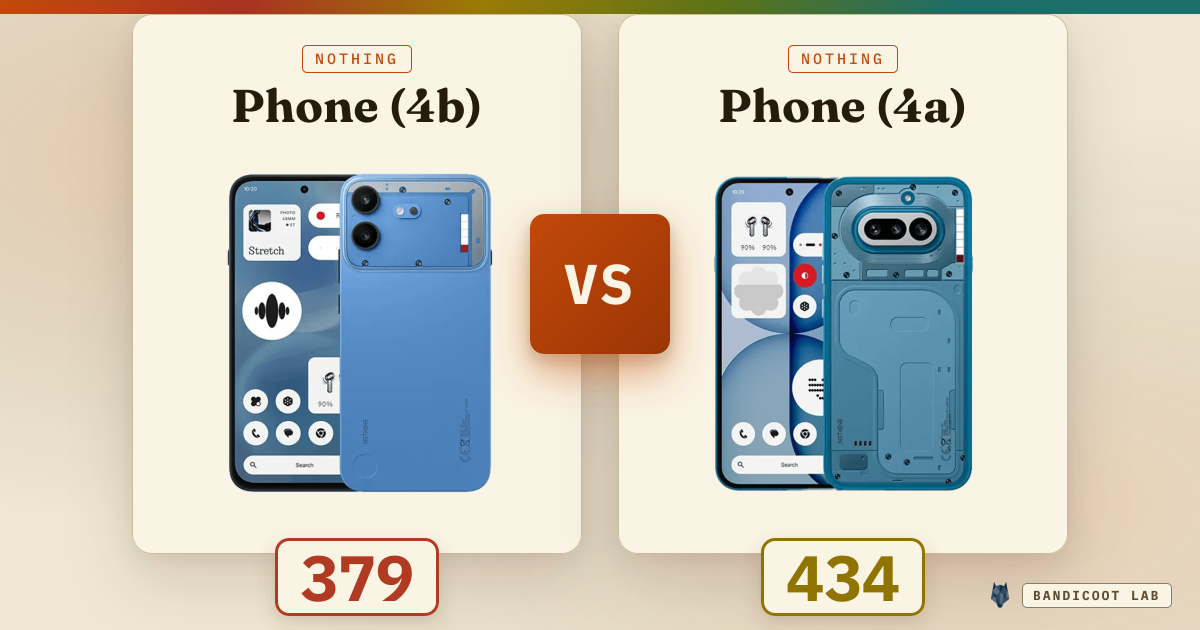
Nothing Phone (4b) vs Nothing Phone (4a)
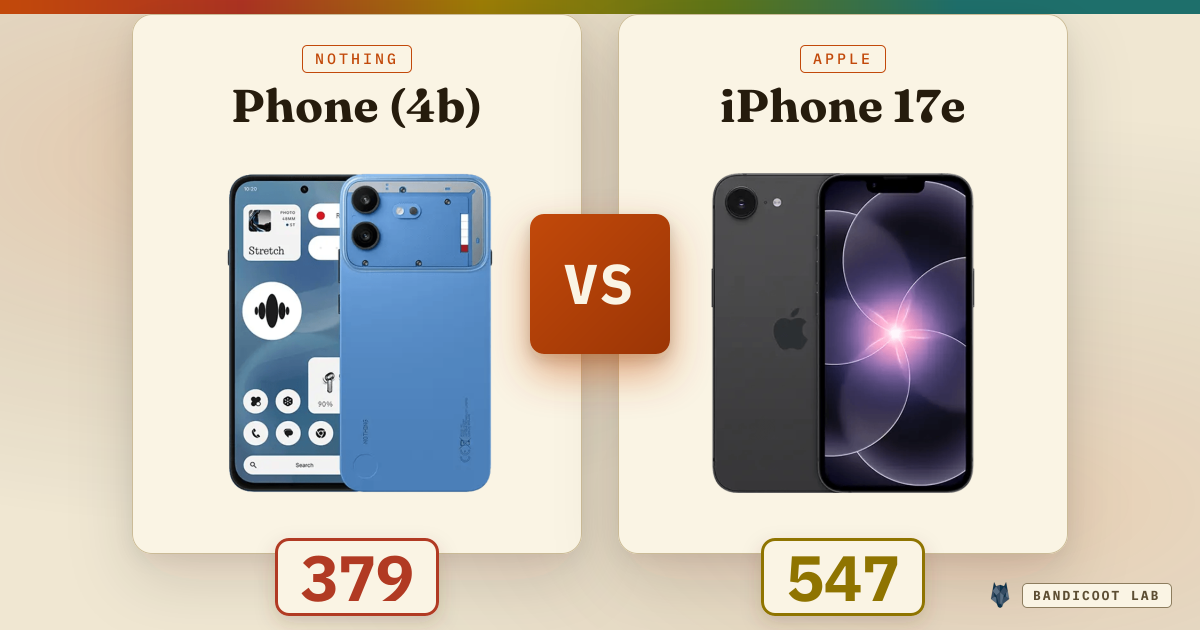
Nothing Phone (4b) vs Apple iPhone 17e

Nothing Phone (4b) vs Motorola Moto G Power (2026)
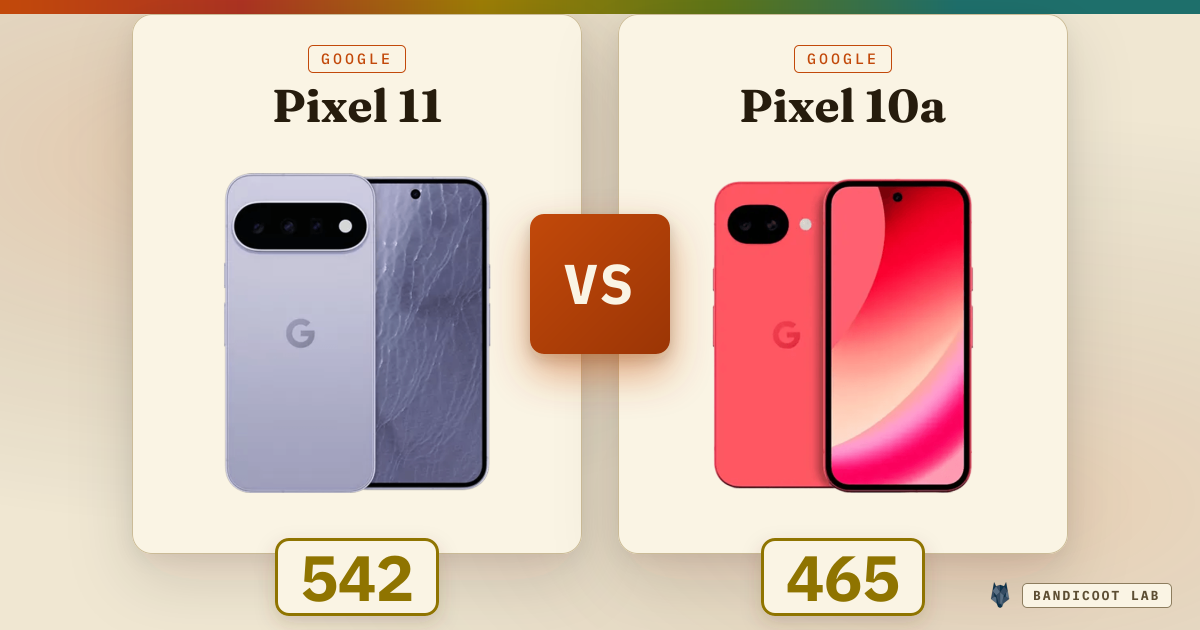
Google Pixel 11 vs Google Pixel 10a