Xiaomi 17T Pro vs Xiaomi 15T Pro
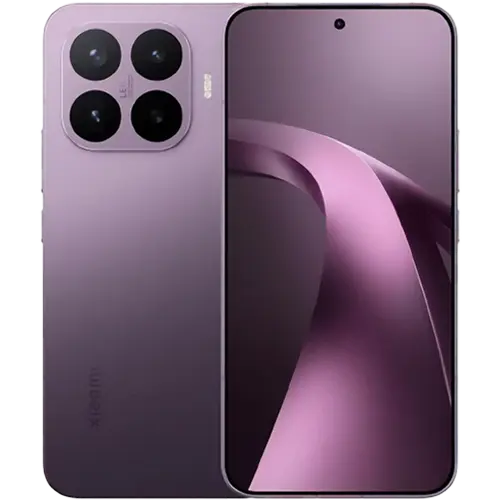
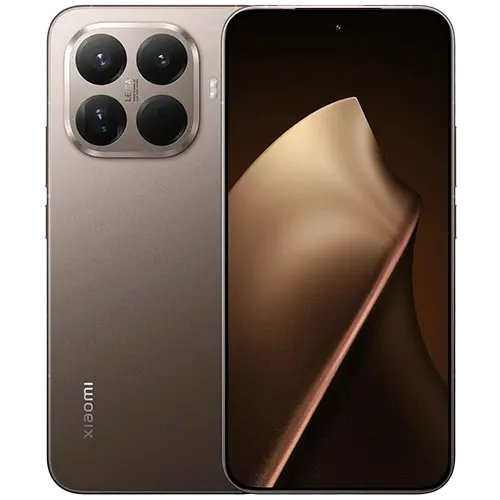
Xiaomi
Xiaomi
17T Pro
15T Pro
Ranked #12 of 60
Ranked #29 of 60
Overall
Overall
The Xiaomi 17T Pro is a generational successor to the 15T Pro. Both sit in Xiaomi's upper-mid tier, below the flagship 15 and 17 lines but borrowing heavily from them. They share the same main camera sensor, similar build philosophy, and nearly identical physical dimensions. The price gap is modest enough that most buyers will weigh them against each other directly.
The 17T Pro pulls ahead on battery life and charging, with a substantially larger cell and stronger endurance across every test. Its display gets far brighter in HDR content and it holds a clear edge in camera sharpness, especially at the front camera and deep zoom. The 15T Pro counters with a faster-refreshing display, better touch responsiveness, and faster wired charging to percentage. The gap in overall score favors the 17T Pro, but the 15T Pro holds its own in a few areas that matter daily.
Design
| Xiaomi 17T Pro | Xiaomi 15T Pro | |
|---|---|---|
| Specifications | ||
| Dimensions | 162.2 x 77.5 x 8.25 mm | 162.7 x 77.9 x 8 mm |
| Weight | 219g | 210g |
| IP Rating | IP68 | IP68 |
| Frame | Aluminum | Aluminum |
| Front | Gorilla Glass 7i | Gorilla Glass 7i |
| Back | Fiberglass | Glass fiber |
| Screen-to-body ratio | 91.1% | 85.5% |
Both phones are built around aluminum frames with Gorilla Glass 7i on the front. The 17T Pro uses a fiberglass back; the 15T Pro uses glass fiber. Both carry IP68 ratings, meaning they're rated for submersion in fresh water up to 1.5 meters for 30 minutes.
They're nearly the same size. The 17T Pro measures 162.2 x 77.5 x 8.25mm and weighs 219g. The 15T Pro is 162.7 x 77.9 x 8mm at 210g. The 9g difference is negligible in pocket or hand. The 17T Pro fits a larger 6.83-inch display with a 91.1% screen-to-body ratio, which means visibly thinner bezels than the 15T Pro's 6.7-inch panel at 85.5%. Both use a 19.5:9 and 20:9 aspect ratio respectively, so the 17T Pro is very slightly wider relative to its height.
Bandicoot Lab doesn't formally test design or durability. Everything here is based on published specifications.
Display
| Xiaomi 17T Pro | Xiaomi 15T Pro | |
|---|---|---|
609/ 881 | 526/ 881 | |
The 17T Pro has a 6.83-inch AMOLED at 2772 x 1280 resolution; the 15T Pro a 6.7-inch AMOLED at 3200 x 1440. Both land at 447 pixels per inch, so pixel density is identical. The 15T Pro refreshes up to 144Hz compared to the 17T Pro's 120Hz ceiling. In practice, most content targets 60 or 120Hz, so the 144Hz advantage is narrow and mostly relevant for specific games or scrolling.
Brightness is where the 17T Pro separates itself. It peaks at 3,653 nits in HDR, nearly triple the 15T Pro's 1,273 nits. In manual brightness mode, the story inverts: the 15T Pro reaches 860 nits versus the 17T Pro's 625 nits, so the 15T Pro is actually easier to use in direct sunlight when you're manually adjusting. The 17T Pro's HDR brightness drops significantly across larger window sizes, with 56.3% stability, while the 15T Pro holds 96.8% across window sizes. Both sustain brightness well over time: 98.7% and 97.8% respectively over the 30-minute sustained test.
Color accuracy favors the 17T Pro. Colors stay closer to reference across the board, with neutral tones reading accurately and minimal visible drift. The 15T Pro shows more visible deviation; you'll notice it most in grays and pastels that lean slightly off-target. The 17T Pro covers 99% of sRGB and 74.3% of DCI-P3 in its best mode; the 15T Pro covers 99.9% sRGB and 98.7% P3, so the 15T Pro can display a wider range of colors even if it places them less accurately.
The 17T Pro boosts highlights modestly above the mastered level in HDR and starts clipping at 90% input. The 15T Pro applies less boost, staying closer to the intended curve, but begins clipping later at 95%. The 15T Pro renders HDR more faithfully; the 17T Pro trades accuracy for extra punch but loses detail in the brightest highlights slightly sooner.
Touch latency is 16.3ms on the 17T Pro and 9.8ms on the 15T Pro. That's a meaningful gap. The 15T Pro might feel more immediate under the finger during fast scrolling and gaming.
Performance
| Xiaomi 17T Pro | Xiaomi 15T Pro | |
|---|---|---|
753/ 1012 | 717/ 1012 | |
The 17T Pro runs a MediaTek Dimensity 9500; the 15T Pro a Dimensity 9400+. Both ship with 12GB of RAM.
CPU performance goes to the 17T Pro. It scores 3,331 single-core and 10,150 multi-core in GeekBench 6, versus 2,596 and 8,206 for the 15T Pro. That's a roughly 28% single-core lead and 24% multi-core lead. You'll feel this in app launches and multitasking, though day-to-day the difference is subtle outside of heavy workloads.
GPU performance is a bigger gap. The 17T Pro peaks at 7,062 in Wild Life Extreme and 13,185 in Solar Bay, versus 5,434 and 9,880 for the 15T Pro. That's a 30% to 33% advantage in raw graphics throughput. Sustained performance is close, with 62% and 61% stability on the 17T Pro versus 67.9% and 63.3% on the 15T Pro. The 15T Pro throttles slightly less, but it's working from a lower peak, so the 17T Pro still delivers more sustained performance in absolute terms. For graphically intensive games, you'll notice smoother frame rates on the 17T Pro.
Browser performance is odd. The 15T Pro scores 35.6 on Speedometer versus the 17T Pro's 9.1. That's a dramatic gap that likely reflects software optimization rather than raw silicon capability.
Camera
| Xiaomi 17T Pro | Xiaomi 15T Pro | |
|---|---|---|
515/ 587 | 472/ 587 | |
Both phones share the same core hardware: a 50-megapixel f/1.6 main sensor (1/1.31"), a 12-megapixel f/2.2 ultrawide, and a 50-megapixel f/3 telephoto on a 1/2.76" sensor. The front camera is also identical: 32 megapixels, f/2.2, 21mm equivalent. What differs is processing, software tuning, and the telephoto's labeled zoom factor.
Sharpness is the 17T Pro's strongest camera trait. It resolves more detail across almost every lens and lighting condition. At deep zoom levels beyond the telephoto's native range, the 17T Pro retains usable detail out to 120x digital zoom, while the 15T Pro's deep zoom results essentially collapse. Neither produces images you'd want to print at those extremes, but the 17T Pro at least gives you something recognizable.
Both phones produce slightly saturated colors in bright light. The 17T Pro leans a touch cool in good light and warms slightly in dim conditions. The 15T Pro pushes toward warm and magenta-tinged tones across all lighting, with a stronger warm shift as light drops. As the color temperature of the scene falls, the 15T Pro's processing overcompensates, pushing yellows and pinks further than it should. The 17T Pro handles this transition more gracefully. Skin tones are a mixed bag on both. In bright light, the 15T Pro pushes skin tones significantly from reference. The 17T Pro is better in bright light but drifts in other conditions. Neither is a standout for portrait color accuracy.
Main
| Xiaomi 17T Pro (Main) | Xiaomi 15T Pro (Main) | |
|---|---|---|
551/ 722 | 552/ 722 | |
Sharpness is nearly identical between the two main cameras in bright and mid-level light. Both resolve high detail that holds up well when pixel-peeping. The 17T Pro has a slight edge in low light. As you crop in beyond 1x, the 17T Pro covers 1x through 5x before handing off to its telephoto, while the 15T Pro covers 1x through 4x. Both hold digital crop detail well through 2x, with gradual softening beyond that.
The 17T Pro keeps saturation lightly punchy without veering far from reality across lighting conditions. The 15T Pro pushes harder in both bright and low light. The 15T Pro's hue errors are larger in mid and low light, driven primarily by a warm, pinkish bias that increases as light gets dimmer. This looks like a white balance issue rather than a sensor limitation, since the bias shifts track the change in scene color temperature.
Both clip highlights in high-contrast scenes. The 17T Pro preserves slightly more usable tonal range overall; the 15T Pro recovers more in shadows.
Main camera stabilization is considerably better on the 15T Pro. Handheld video should be noticeably smoother on the older phone.
Ultrawide
| Xiaomi 17T Pro (Ultrawide) | Xiaomi 15T Pro (Ultrawide) | |
|---|---|---|
533/ 722 | 529/ 722 | |
Both ultrawides use the same 12-megapixel hardware. Sharpness in bright light goes to the 15T Pro, which resolves more detail at the center. In mid and dark conditions, the 17T Pro catches up or pulls slightly ahead. The ultrawide on both phones is visibly softer than their main cameras, which is typical for a smaller sensor.
Color behavior mirrors the main camera on each phone. The 15T Pro's ultrawide develops a strong warm and magenta shift in mid and low light. Skin tones are problematic on both in bright conditions, though this matters less on an ultrawide where portraits are uncommon.
Dynamic range is noticeably better on the 15T Pro's ultrawide, with cleaner shadow detail and fewer tonal artifacts. The 17T Pro clips highlights similarly but recovers less in the shadows. For landscape or architectural shots in tricky light, the 15T Pro's ultrawide handles contrast better.
Stabilization favors the 17T Pro's ultrawide by a wide margin. Handheld video on the ultrawide is significantly steadier on the newer phone.
Telephoto
| Xiaomi 17T Pro (Telephoto) | Xiaomi 15T Pro (Telephoto) | |
|---|---|---|
522/ 722 | 533/ 722 | |
Both telephoto lenses share the same 50-megapixel sensor and 115mm focal length. The 17T Pro labels this 5x; the 15T Pro calls it 4x. In practice the optical hardware appears identical.
Sharpness at the native zoom level is clearly better on the 17T Pro, especially in bright and mid-level light. The gap widens in low light, where the 17T Pro retains much more usable detail. As you push beyond the native focal length through digital crop, both degrade, but the 17T Pro maintains more texture. The 15T Pro's telephoto essentially falls apart in dim conditions.
Color on the telephoto is one area where the 15T Pro performs well. In bright and mid light, it produces slightly more accurate hues and closer skin tones than the 17T Pro. The 15T Pro leans saturated in bright light, a fairly punchy rendering, but hue placement is tight. In low light, both struggle, with the 15T Pro's hues drifting more and a warm yellow bias creeping in on both phones.
Dynamic range on the telephoto is better on the 15T Pro, though both clip highlights. The 15T Pro holds more tonal information overall, but it shows more tonal inversions, which can create slight banding artifacts in gradients.
Telephoto stabilization is better on the 17T Pro. At 5x, even small hand movements are amplified, so steadier video capture is a genuine benefit.
Front
| Xiaomi 17T Pro (Front) | Xiaomi 15T Pro (Front) | |
|---|---|---|
542/ 722 | 382/ 722 | |
The 17T Pro's front camera is meaningfully sharper across all lighting conditions. It resolves noticeably more detail in bright and mid light, and the gap holds in low light. The 15T Pro's front camera produces softer images overall.
The 17T Pro's front camera keeps saturation slightly muted, making images look more natural, almost understated. The 15T Pro's front camera pushes saturation higher in bright light, which makes selfies look more vivid but less true-to-life. Skin tones on the 17T Pro front camera are accurate in good light and drift as conditions worsen. The 15T Pro's front camera pushes skin tones warm with a pink tint across all conditions, driven by a consistent warm and rosy bias in its processing.
Dynamic range heavily favors the 15T Pro's front camera, which retains more highlight and shadow detail in high-contrast selfie scenarios. The 17T Pro clips more aggressively.
Front camera stabilization is slightly better on the 15T Pro. For video calls and walking selfie video, the 15T Pro holds steadier.
Battery
| Xiaomi 17T Pro | Xiaomi 15T Pro | |
|---|---|---|
695/ 836 | 536/ 836 | |
The 17T Pro packs a 7,000mAh cell; the 15T Pro has 5,500mAh. That 27% capacity advantage shows up across every battery test.
Video playback runs to 30.63 hours on the 17T Pro versus 26.01 hours on the 15T Pro. The 17T Pro's runtime means you could comfortably get through two full days of mixed use without charging; the 15T Pro will stretch to a day and a half for most people. Web browsing over five hours drains 18% on the 17T Pro and 24% on the 15T Pro. That translates to roughly 28 hours of continuous web browsing on the 17T Pro versus about 21 hours on the 15T Pro. Gaming drain during the stress test takes 23% from the 17T Pro and 25% from the 15T Pro. Given the 17T Pro's larger battery, that means substantially more gaming time before you need a charger. Overnight standby drain is 2% on the 17T Pro and 3% on the 15T Pro over eight hours, both well within the range where you won't worry about leaving the phone unplugged overnight.
The 17T Pro's battery advantage is consistent and meaningful. If you're a heavy user, the extra endurance adds real margin to your day.
Charging
| Xiaomi 17T Pro | Xiaomi 15T Pro | |
|---|---|---|
718/ 837 | 646/ 837 | |
The 15T Pro supports 120W wired charging; the 17T Pro tops out at 100W. Both support 50W wireless.
Despite the lower wattage, the difference in wired charging speed is modest. The 15T Pro reaches 37% in 10 minutes and 87% in 30 minutes. The 17T Pro hits 33% in 10 minutes and 79% in 30 minutes. The 15T Pro is faster to percentage, but it's also filling a smaller battery. In absolute energy delivered, they're fairly close.
Wireless charging tells a similar story. The 15T Pro reaches 23% in 10 minutes and 56% in 30 minutes, versus 19% and 48% on the 17T Pro. Both are fast for wireless, and the 15T Pro's smaller cell gives it a slight edge in time-to-usable.
Speaker
| Xiaomi 17T Pro | Xiaomi 15T Pro | |
|---|---|---|
636/ 897 | 589/ 897 | |
The 17T Pro is louder, reaching 76.3 dBA versus the 15T Pro's 72.5 dBA. That's a noticeable difference in a room. The 15T Pro has slightly lower distortion at 7.64% THD compared to 8.16%, though both are in a range where distortion isn't distracting at moderate volumes.
The 15T Pro has fuller bass response and a more even frequency response overall. The 17T Pro emphasizes clarity and presence in the upper registers but sounds thinner in the low end. If you listen to music or watch movies without headphones, the 15T Pro produces a richer, more balanced sound. The 17T Pro is better if you just need a loud speakerphone.
Microphone
| Xiaomi 17T Pro | Xiaomi 15T Pro | |
|---|---|---|
390/ 1220 | 404/ 1220 |
Both microphones perform below average. The 15T Pro is slightly more even in its frequency response, but neither phone is a strong choice for recording voice memos or calls in challenging environments. For standard phone calls in reasonable conditions, both are adequate.
Other
| Xiaomi 17T Pro | Xiaomi 15T Pro | |
|---|---|---|
| Biometrics | 461/ 1181 | 455/ 1181 |
| Data Transfer | 108/ 943 | 102/ 943 |
| Specifications | ||
| Biometric type | Fingerprint | Fingerprint |
| Ports | USB-C 2.0 | USB-C 2.0 |
| Storage | 256GB, 512GB, 1TB | 256GB, 512GB, 1TB |
Fingerprint unlock speed is nearly identical: 228ms on the 17T Pro and 231ms on the 15T Pro. Both use optical under-display sensors. The difference is imperceptible. Neither phone has hardware-based face unlock.
Data transfer speeds are low on both phones, constrained by their USB-C 2.0 ports. The 15T Pro reads at 42 MB/s and writes at 35 MB/s; the 17T Pro reads at 38 MB/s and writes at 36 MB/s. If you regularly move large files to a computer, this will be slow. Both offer 256GB, 512GB, and 1TB storage configurations.
Conclusion
The 17T Pro justifies its premium through battery life, display brightness, and camera sharpness. It lasts meaningfully longer on a charge, gets dramatically brighter in HDR, and resolves more detail across nearly every camera lens and lighting condition. Its GPU is about 30% faster, which matters for gaming. These are tangible, daily-use advantages.
The 15T Pro has its own strengths. Touch responsiveness is noticeably better at 9.8ms versus 16.3ms, which you'll feel in fast-paced games and general scrolling. Its speaker sounds fuller and more balanced. AI performance is in a different league entirely. Its display covers nearly all of DCI-P3, and it charges to usable levels a few minutes faster on the wire. And it costs $100 less.
If battery life is a priority, the 17T Pro is the clear pick. It's also the better choice for photography, particularly at zoom lengths and in low light, and for anyone who watches a lot of HDR content.
FAQ
Is the Xiaomi 17T Pro worth the extra $100 over the 15T Pro?
The 17T Pro's strongest advantages are battery life, HDR brightness, and camera sharpness across most lenses. If those matter to your daily use, the premium is easy to justify. If you prioritize touch responsiveness, speaker quality, or on-device AI, the 15T Pro delivers a better experience in those areas and costs less.
Which phone lasts longer on a charge — the 17T Pro or the 15T Pro?
The 17T Pro runs to 30.63 hours of continuous video playback versus 26.01 hours on the 15T Pro, and the gap holds across web browsing, gaming, and standby. The 17T Pro's 7,000mAh cell gives most heavy users comfortable two-day range; the 15T Pro typically stretches to a day and a half.
Does the 15T Pro charge faster than the 17T Pro?
The 15T Pro reaches 87% in 30 minutes of wired charging versus 79% on the 17T Pro, and it hits usable levels a few minutes sooner wirelessly too. The 15T Pro is faster to percentage, but it's also filling a smaller battery, so the gap in absolute energy delivered is narrower than the headline wattage difference suggests.
Which is better for gaming — the Xiaomi 17T Pro or the 15T Pro?
The 17T Pro has roughly 30% higher peak GPU performance and a faster CPU, which translates to smoother frame rates in graphically demanding games. The 15T Pro throttles slightly less, but it starts from a lower ceiling, so the 17T Pro still delivers more sustained graphics output. The 15T Pro does have a meaningful edge in touch latency at 9.8ms versus 16.3ms, which will feel more responsive in fast-paced titles.
Which phone takes better zoom and low-light photos?
The 17T Pro resolves more detail at the telephoto's native focal length, especially in low light, and holds recognizable detail further into digital zoom. The 15T Pro's telephoto color accuracy is tighter in good light, but its low-light telephoto performance essentially falls apart. For zoom and dim conditions, the 17T Pro is the clearer choice.
Which phone is better for selfies?
The 17T Pro's front camera is meaningfully sharper across all lighting and renders colors with a more natural, muted saturation. The 15T Pro's front camera applies a consistent warm, rosy tint to skin tones in all conditions and produces softer images overall. For selfie video, the 15T Pro stabilizes slightly better, but for still selfie quality the 17T Pro has the clear edge.
Related
Xiaomi
15T Pro
Xiaomi
17T Pro
Xiaomi
17 Ultra
Xiaomi
17
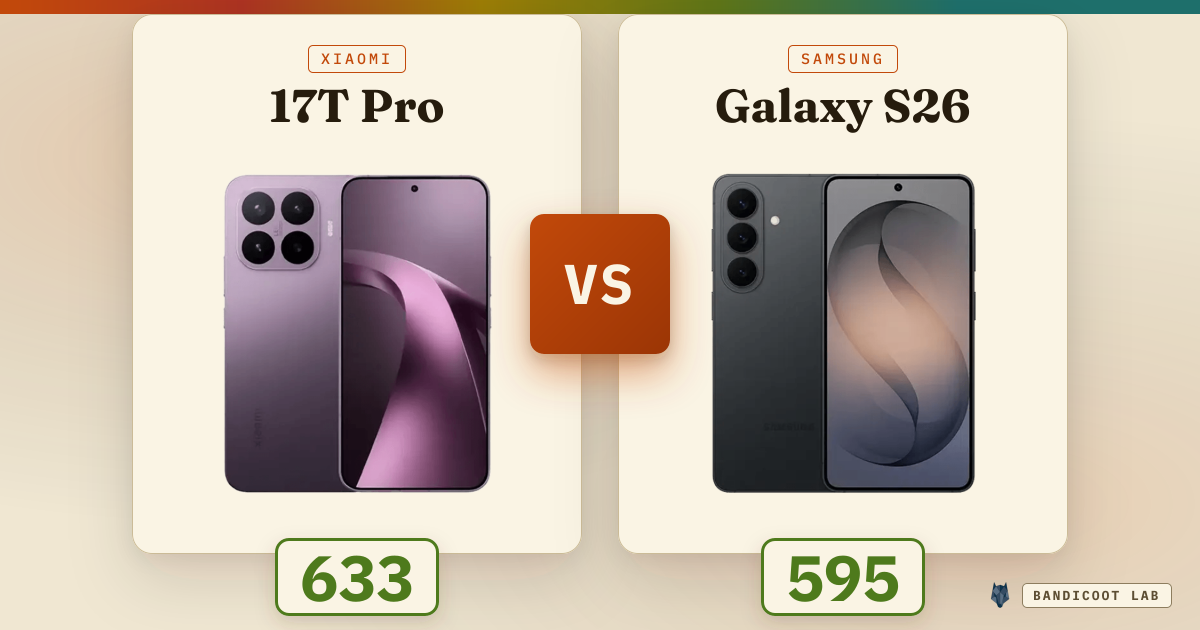
Xiaomi 17T Pro vs Samsung Galaxy S26
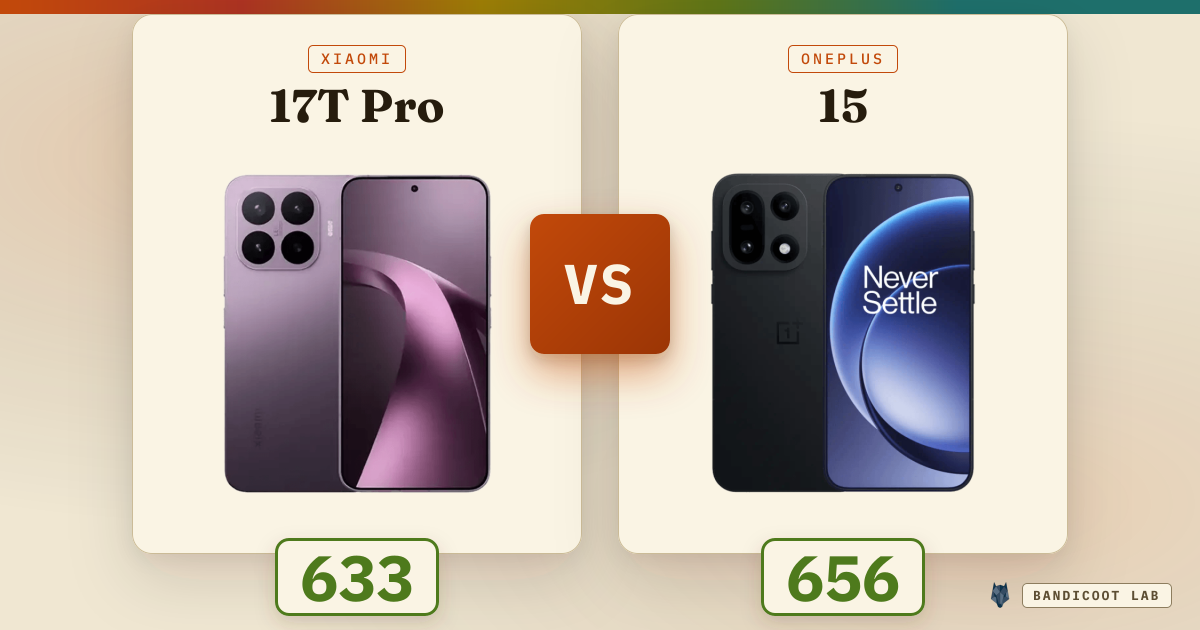
Xiaomi 17T Pro vs OnePlus 15
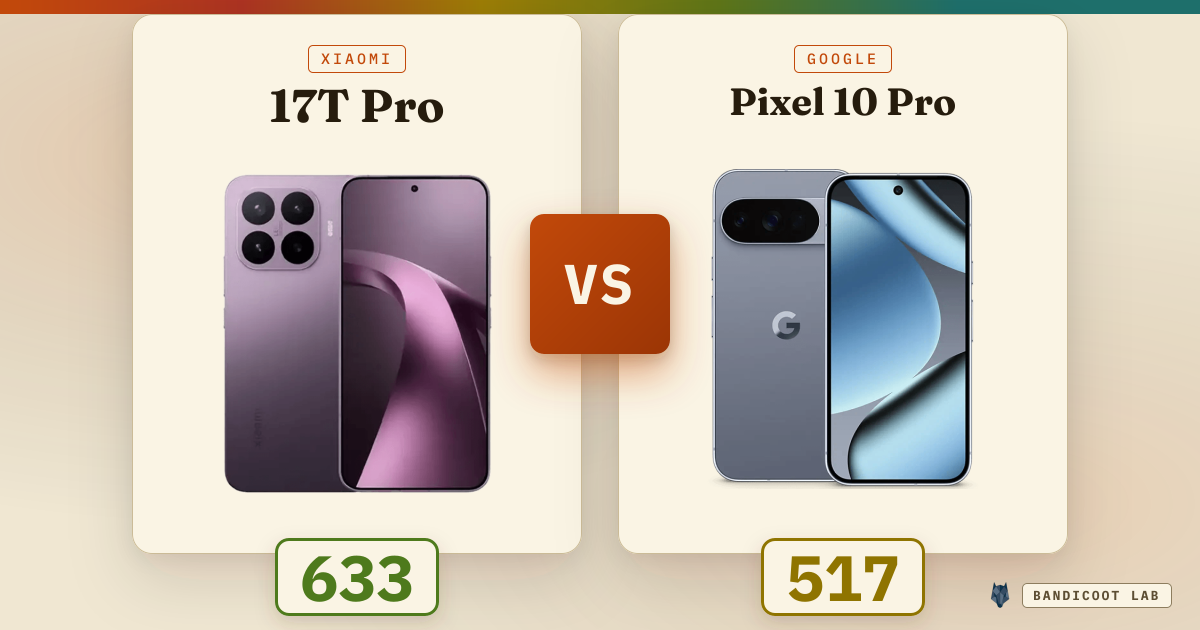
Xiaomi 17T Pro vs Google Pixel 10 Pro
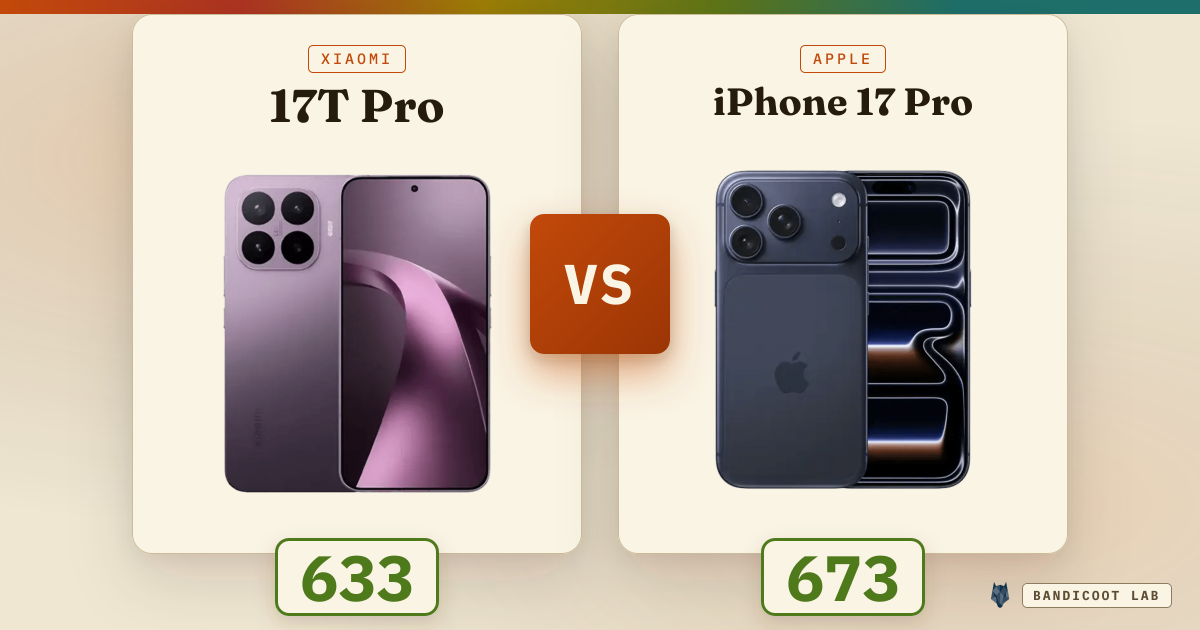
Xiaomi 17T Pro vs Apple iPhone 17 Pro