Xiaomi 17T Pro
Score Overview
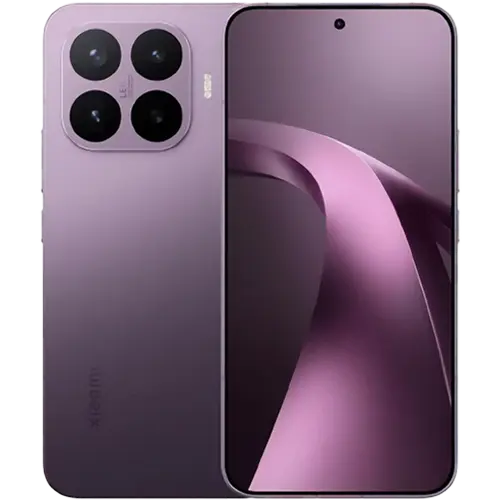
The Xiaomi 17T Pro is a €899 large-screen phone that tries to punch above its weight. It pairs a 7,000mAh battery with 100W charging and a triple camera system built around a 1/1.31-inch main sensor, all running on MediaTek's Dimensity 9500. It's positioned as a step below Xiaomi's flagship 17 series while costing €100 more than its predecessor, the 15T Pro.
The phone's strongest suits are charging speed and battery life, where it outperforms most phones at this price. The camera system delivers sharp images from its main sensor and solid color accuracy across all lenses. The display reaches extremely high brightness for HDR content. Weak spots include below-average microphone quality, middling performance benchmarks relative to similarly priced competitors, and a speaker that doesn't match the best at this price.
Design
Specifications
The 17T Pro measures 162.2 x 77.5 x 8.25mm and weighs 219g. It's a big phone, slightly heavier than the OnePlus 15 at 211g and noticeably heavier than the Samsung Galaxy S26 at 167g. Compared to its predecessor, the 15T Pro, it's marginally shorter but 9g heavier, reflecting the jump from a 5,500mAh to a 7,000mAh battery.
The frame is aluminum, the front is Gorilla Glass 7i, and the back is fiberglass. The screen-to-body ratio is 91.1% at a 19.5:9 aspect ratio, meaning bezels are thin relative to the display size. The phone carries an IP68 rating, rated for submersion in fresh water to 1.5 meters for up to 30 minutes. The port is USB-C 2.0.
Bandicoot Lab does not formally test design or durability.
Display
The 17T Pro has a 6.83-inch AMOLED display running at 2772 x 1280 resolution, 447 pixels per inch, with a 144Hz maximum refresh rate (variable down to 30Hz).
Brightness is a split story. Manual brightness tops out at 625 nits, which is modest and could make outdoor visibility a challenge in direct sunlight. The Xiaomi 15T Pro managed 860 nits in manual mode, and the Pixel 10 Pro hit 1,450 nits. HDR content is different — peak brightness reaches 3,653 nits, which is high and ahead of most phones at this price. The Pixel 10 Pro reaches 3,428 nits; the OnePlus 15 only manages 1,958 nits. Brightness stability across HDR window sizes is 56.3%, meaning the display dims substantially as the bright area of the frame expands. Sustained brightness over time is excellent at 98.7%, so it holds its peak reliably during long HDR playback.
Color accuracy is reasonable. In its best-calibrated mode, colors stay close to reference values, with sRGB coverage at 99% and DCI-P3 at 74.3%. You'll notice slight deviations in some tones, but nothing that makes everyday content look off. The Xiaomi 17 and iPhone 17 Pro both achieve tighter color accuracy.
HDR tone mapping is mostly faithful, with a slight lift applied to highlights. The display clips at 90% of the PQ input range, so the very brightest mastered highlights will lose some distinction.
Performance
The 17T Pro runs a MediaTek Dimensity 9500 with 12GB of RAM. GeekBench 6 scores land at 3,331 single-core and 10,150 multi-core. That's a meaningful step up from the 15T Pro's Dimensity 9400+ (2,596 / 8,206) but trails the Snapdragon 8 Elite Gen 5 found in the OnePlus 15 (3,606 / 11,442) and Samsung Galaxy S26 (3,709 / 11,232). In everyday use, the gap between the 17T Pro and those Snapdragon devices is unlikely to be noticeable for typical tasks. You'd feel it mainly in sustained workloads or heavy multitasking.
GPU performance is strong. The Wild Life Extreme stress test peaked at 7,062 with 62% stability, and Solar Bay peaked at 13,185 with 61% stability. These are competitive numbers — the OnePlus 15 scores similarly. Stability in the low 60s means the phone throttles moderately during sustained gaming sessions, which is typical for this tier.
Browser performance via Speedometer scored 9.1, which is low. The iPhone 17 Pro scores 43.1, and even the Pixel 10 Pro manages 15.2. Web-heavy workflows will feel slower than on competing platforms.
Camera
The 17T Pro carries a triple rear camera system: a 50-megapixel main sensor (1/1.31-inch, f/1.6, 23mm), a 12-megapixel ultrawide (1/3.06-inch, f/2.2, 15mm), and a 50-megapixel 5x telephoto (1/2.76-inch, f/3.0, 115mm). The front camera is 32 megapixels (1/3.44-inch, f/2.2, 21mm). Maximum zoom is 120x.
Sharpness is a genuine strength across the system. The main camera delivers high detail in bright and mid-light conditions and holds up well in low light. The telephoto is similarly sharp at its native 5x in good light. Compared to the iPhone 17 Pro and Pixel 10 Pro, the 17T Pro's main camera resolves more detail, and the improvement over the 15T Pro is incremental but consistent.
At extreme zoom levels, the story changes. Deep zoom sharpness drops off significantly, landing below what the Pixel 10 Pro achieves at its 100x maximum and below the OnePlus 15. Anything past about 30x is best treated as a rough framing tool.
Main
The 50-megapixel main sensor (1/1.31-inch, f/1.6, 23mm) produces consistently sharp images across all lighting conditions. Detail barely drops between bright and mid light, and the falloff in dim conditions is modest. This is one of the sharper main cameras at this price point.
As you crop in digitally from 1x toward 5x, detail holds up well through about 2x before softening becomes visible.
Color character is lightly vivid. Hue accuracy is good in bright and mid light, with only a slight shift in dimmer conditions. In bright light, skin tones drift more than ideal; this improves in mid and low light, where skin rendering gets closer to accurate.
Dynamic range is adequate. Shadows hold reasonable detail, but highlights clip in contrasty scenes. The tonal response is mostly smooth.
Ultrawide
The 12-megapixel ultrawide (1/3.06-inch, f/2.2, 15mm) delivers respectable sharpness in bright and mid light, though it trails the main camera. Low-light sharpness drops more noticeably, which is expected from the smaller sensor.
Saturation runs close to neutral, producing a more restrained look than the main camera. Hue accuracy is moderate in bright light and improves slightly in mid-light conditions. Skin tones in bright light show the largest error of any lens on this phone, so group shots in daylight may render faces with an unnatural tint. In lower light, skin accuracy is better.
Dynamic range is similar to the main camera, with highlights clipping in bright scenes. The ultrawide handles stabilization well for a wide-angle lens, keeping handheld video and photos controlled.
Telephoto
The 50-megapixel telephoto (1/2.76-inch, f/3.0, 115mm) provides a 5x optical zoom. Sharpness is high at its native length in good light and holds detail better than the Pixel 10 Pro's telephoto in bright conditions. In mid light, it softens somewhat, and in low light the drop is more significant. This is typical for a telephoto with a relatively narrow f/3.0 aperture.
Beyond 5x, digital zoom progressively degrades detail. The lens stays reasonably useful out to about 10–15x for clear subjects, but pushing further toward the 120x maximum produces very soft results.
Color tuning is close to neutral. This is slightly muted compared to the main camera, which gives telephoto shots a more natural, documentary feel. Hue accuracy is good in bright and mid light, degrading more in low light as a warm yellow shift becomes visible. This is primarily a white balance issue under warm artificial light. Skin tones are handled well across conditions, especially in bright and mid light.
Dynamic range is the most limited of the three rear cameras, with highlights clipping and less shadow depth. In well-lit scenes this rarely matters; in mixed or low light, flattened contrast becomes apparent.
Front
The 32-megapixel front camera (1/3.44-inch, f/2.2, 21mm) produces decent sharpness in bright and mid light, dropping moderately in dim conditions. It's a step ahead of the Xiaomi 15T Pro's front camera.
Color character is muted, producing a natural, understated look that avoids oversaturated rendering common from some competitors. Hue accuracy is good in bright light and reasonable in mid light, but degrades noticeably in low light. Skin tones are excellent in bright light, closer to reference than almost any competitor tested. In mid and low light, skin accuracy degrades with noticeable drift.
Dynamic range is narrow, so high-contrast selfie scenarios will lose either highlight or shadow detail. Video stabilization from the front camera is acceptable for handheld use.
Battery
The 7,000mAh battery is a substantial cell, up from the 15T Pro's 5,500mAh.
Video playback lasted 30.63 hours. For context, the OnePlus 15 with its 7,300mAh battery managed 46.11 hours, but the iPhone 17 Pro (4,252mAh) lasted 23.97 hours and the Pixel 10 Pro (4,870mAh) managed 21.83 hours. The 17T Pro outlasts its predecessor's 26.01 hours by a comfortable margin.
Web browsing drained 18% over five hours, which is efficient. Gaming drain hit 23% during the stress test, matching the OnePlus 15. Standby drain was 2% over eight hours overnight, which is excellent.
In practical terms, the 17T Pro will comfortably last a full day of heavy use and stretch well into a second day for lighter users. The combination of a large battery and efficient power management makes this one of its clearest strengths.
Charging
Wired charging runs at 100W. In 10 minutes, the phone reaches 33%; at 30 minutes, 79%. That's fast enough that a brief morning charge before leaving the house gets you through most of the day. The OnePlus 15 with its 120W charger is slightly faster (37% at 10 minutes, 88% at 30 minutes), but the gap is small in real use.
Compared to the 15T Pro, the 17T Pro charges a larger battery slightly slower in percentage terms (the 15T Pro hit 37% at 10 minutes and 87% at 30 minutes), but the absolute energy delivered is comparable given the bigger cell.
Wireless charging at 50W is genuinely useful. At 10 minutes you'll have 19%, and at 30 minutes 48%. That's roughly in line with the OnePlus 15's wired speed at 30 minutes and ahead of the Galaxy S26 (58%), achieved wirelessly. The iPhone 17 Pro's 25W wireless charging reaches 49% at 30 minutes from a much smaller battery.
Speaker
The speaker reaches a maximum of 76.3 dBA, which is loud. Distortion sits at 8.16% THD, which is on the higher side; you'll hear it as a slight harshness at full volume. The iPhone 17 Pro and Samsung Galaxy S26 both produce cleaner output at similar volumes.
The frequency character leans toward loudness over fidelity. Bass response is limited and clarity in the upper frequencies is modest, which means music and media sound more thin and forward than full-bodied. The Xiaomi 17's speaker delivers notably richer bass and better overall balance. The Samsung Galaxy S26 also produces a more rounded sound.
For calls and casual video watching, the speaker is adequate. For music or extended media consumption, it's a step below what some competitors offer at this price.
Microphone
Microphone quality is below average. Frequency response shows more unevenness than most phones in this price range, and it falls well short of the Samsung Galaxy S26 and OnePlus 15. Voice calls will sound adequate, but audio recorded with this phone for video or voice memos won't match the clarity of better-performing devices.
Other
Measurements
Specifications
The optical fingerprint sensor unlocks in an average of 228ms. That's functional but not fast. The Xiaomi 17 manages 163ms with its ultrasonic sensor, and the OnePlus 15 hits 204ms. You won't be frustrated by the 17T Pro's speed, but the difference is noticeable if you switch between phones. There is no hardware-based face unlock.
Data transfer via USB-C 2.0 is slow, with read and write speeds around 38 and 36 MB/s respectively. Transferring large files to a computer will take considerably longer than it would on phones with USB 3.2, like the Xiaomi 17 or OnePlus 15. Storage is available in 256GB, 512GB, and 1TB configurations.
Conclusion
The Xiaomi 17T Pro makes its case on battery life and charging. The 7000mAh cell delivers genuinely long endurance, and 100W wired charging means you're rarely tethered to a wall for long. The display reaches exceptionally high brightness for HDR, and the camera system produces sharp, color-accurate photos that hold up well against phones costing more. Skin tone rendering across most lenses is better than what you'd get from a Pixel 10 Pro or iPhone 17 Pro.
Browser performance lags behind Snapdragon-equipped competitors at the same price. The speaker is loud but lacks the richness and clarity of the OnePlus 15 or Xiaomi 17. The microphone underperforms. USB-C 2.0 is a frustrating omission when rival phones at €899 offer USB 3.2 speeds. If your priorities are a big screen, long battery life, fast charging, and a capable camera, the 17T Pro delivers. If you need strong all-around performance, better speakers, or fast file transfers, the Xiaomi 17 at €999 or the OnePlus 15 at a similar price address those gaps more effectively.
Related
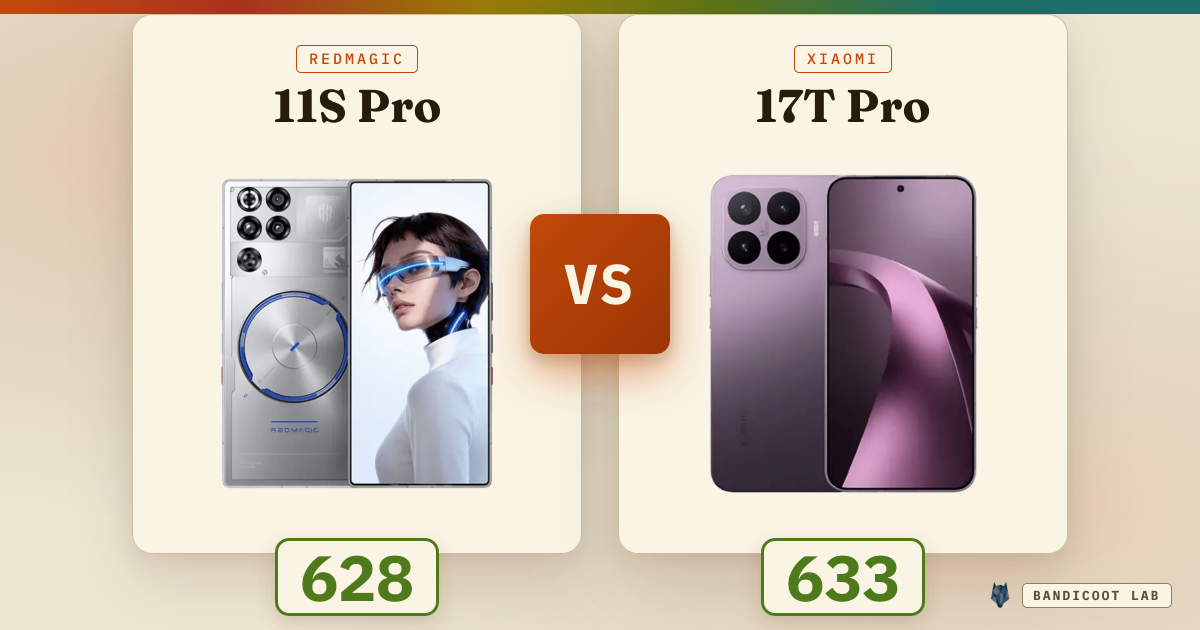
RedMagic 11S Pro vs Xiaomi 17T Pro
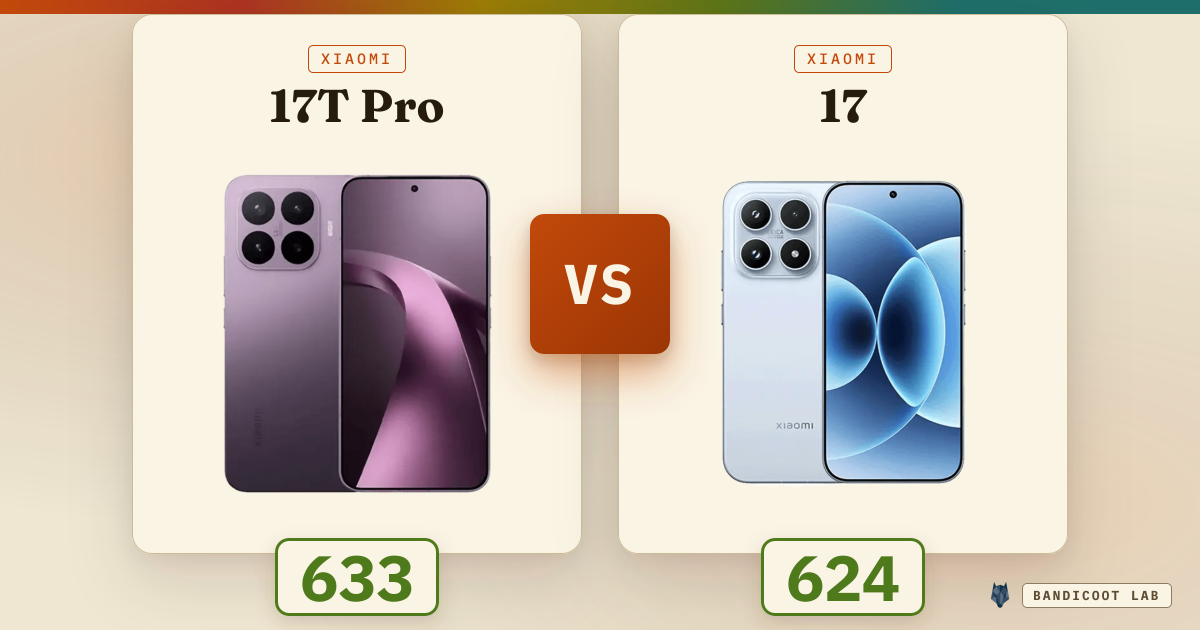
Xiaomi 17T Pro vs Xiaomi 17
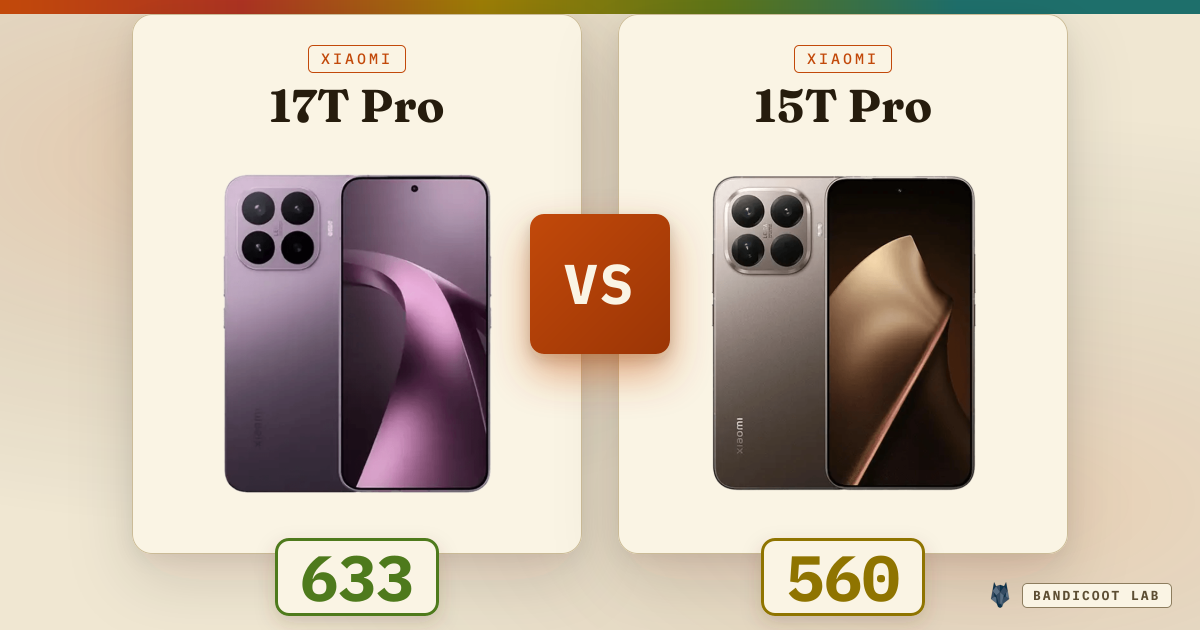
Xiaomi 17T Pro vs Xiaomi 15T Pro
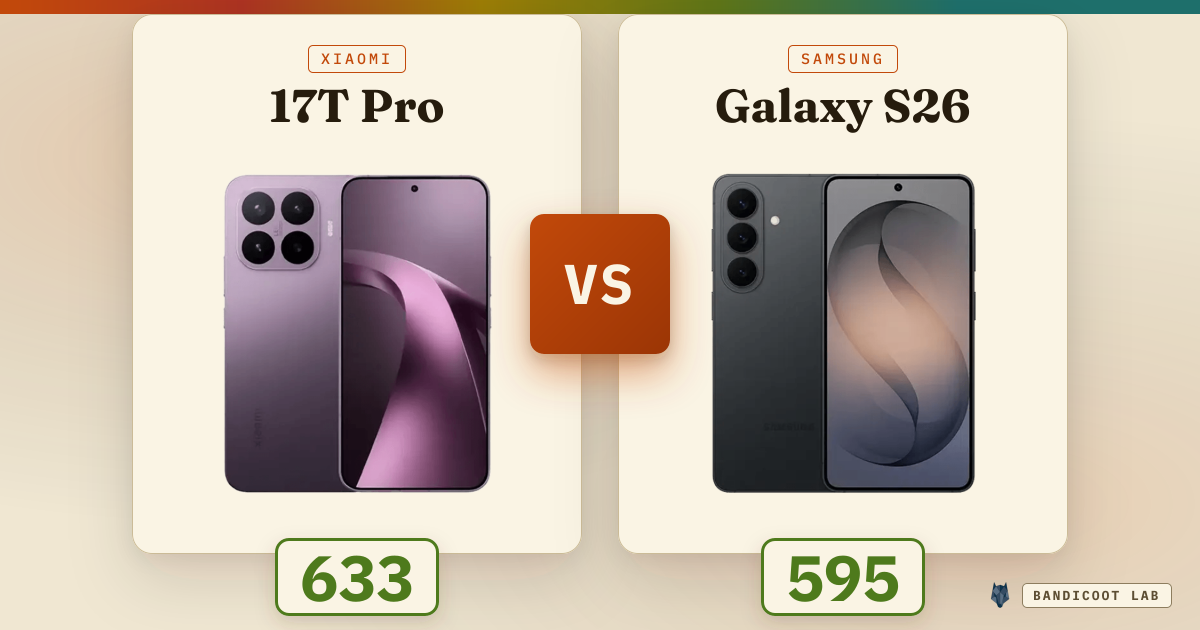
Xiaomi 17T Pro vs Samsung Galaxy S26
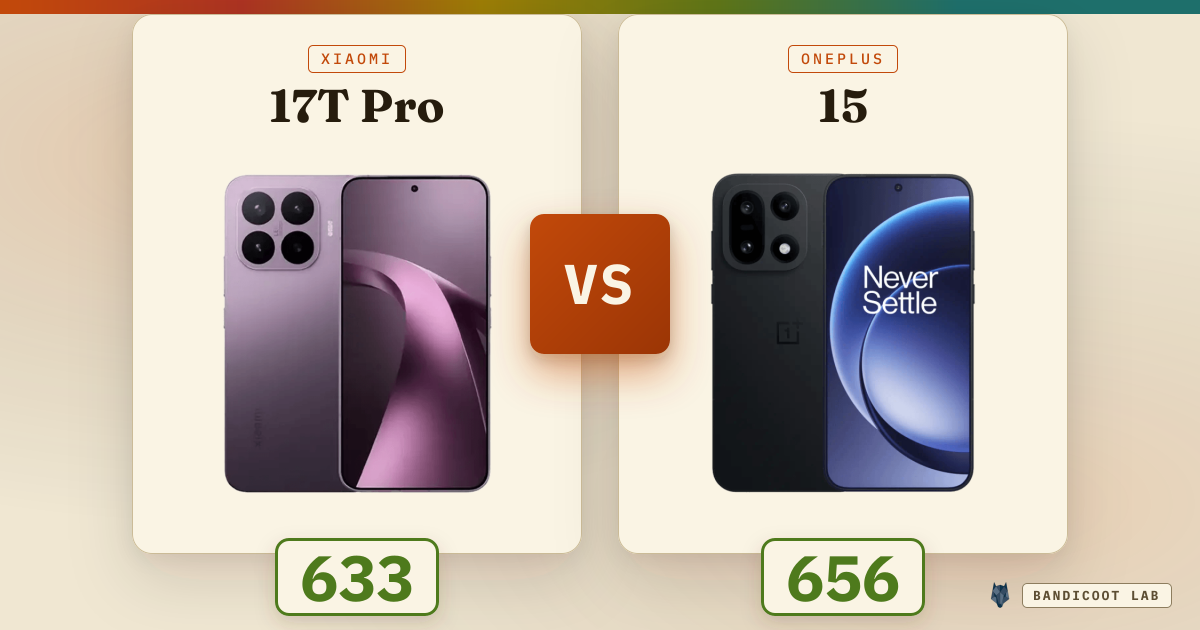
Xiaomi 17T Pro vs OnePlus 15
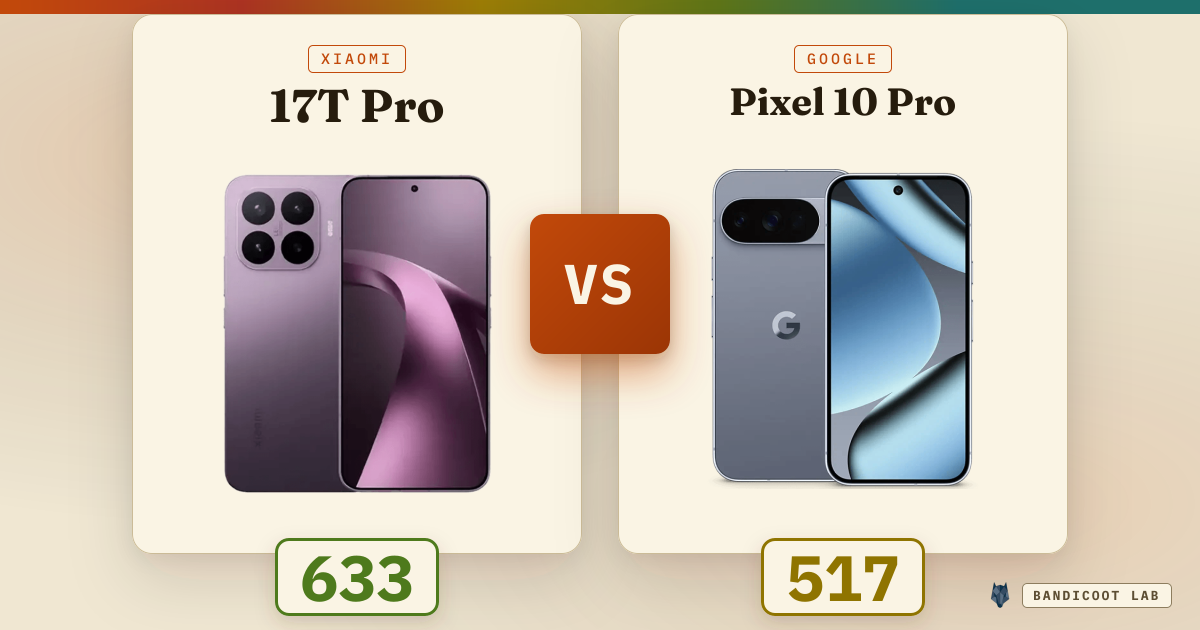
Xiaomi 17T Pro vs Google Pixel 10 Pro
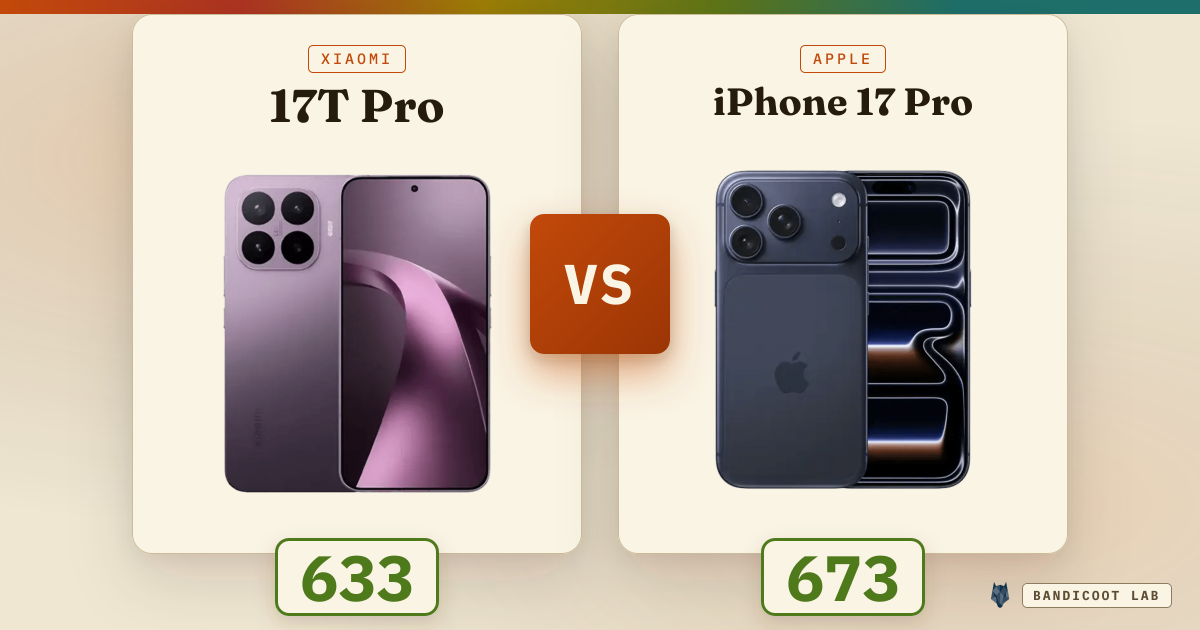
Xiaomi 17T Pro vs Apple iPhone 17 Pro
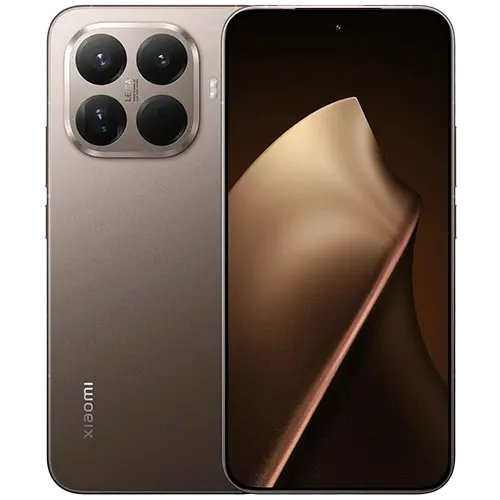
Xiaomi
15T Pro
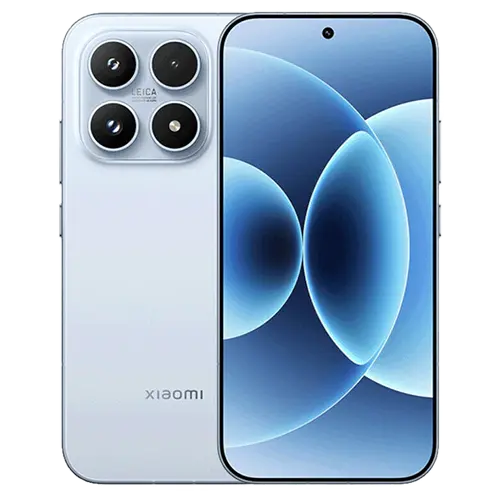
Xiaomi
17
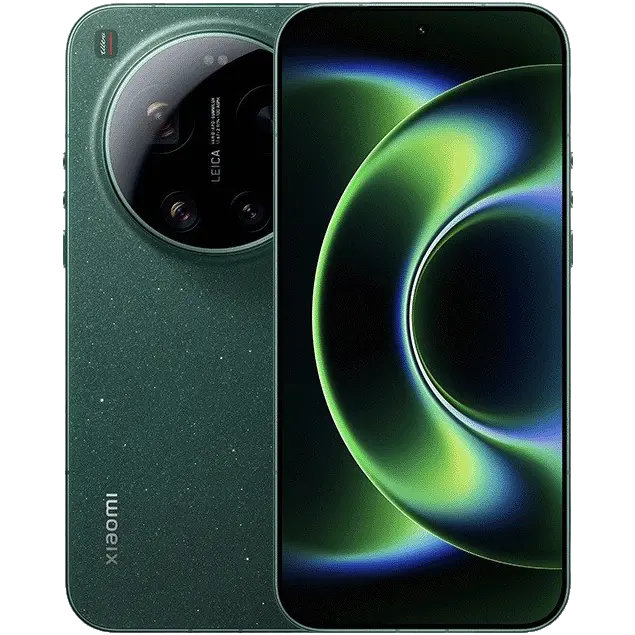
Xiaomi
17 Ultra
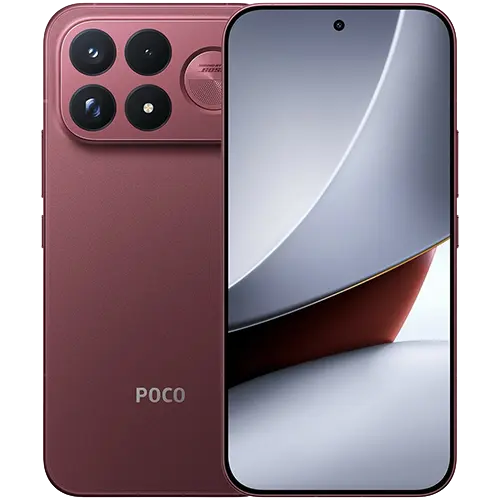
Poco
F9 Ultra

OnePlus