Motorola Razr (2026) vs Motorola Razr Fold
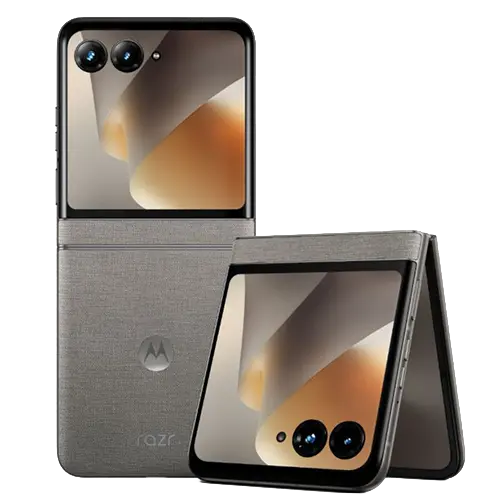
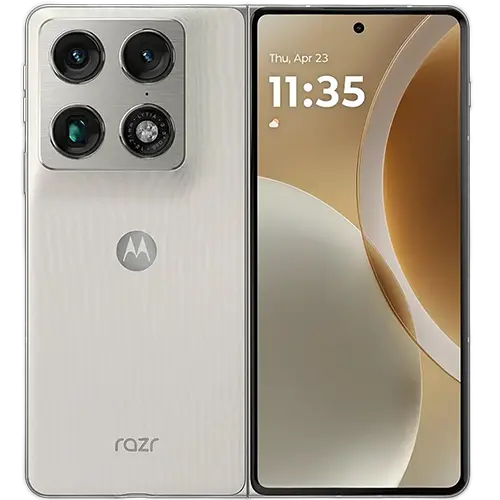
Motorola
Motorola
Razr (2026)
Razr Fold
Ranked #47 of 51
Ranked #21 of 51
Overall
Overall
The Motorola Razr (2026) and Motorola Razr Fold may have both been released at around the same time and both fold in half, but they don't share much else. The Razr (2026) is the clamshell foldable that's become Motorola's volume foldable: a normal-sized phone that folds in half, priced at $799.99 to compete with mid-range slab phones rather than premium foldables. The Razr Fold is the new book-style foldable, a phone that opens into a small tablet. At $1899.99, it costs more than twice as much and sits in the most expensive tier on the market.
The price gap maps onto the hardware fairly cleanly. The Razr Fold has the stronger camera system, a much faster processor, a better display, and quicker charging. The Razr (2026) is far cheaper, lighter, and more pocketable, and it holds its own in a few places where you might not expect, like speaker output and battery life. If your reason for buying is the novelty and convenience of a phone that disappears into a pocket, the cheaper Razr makes the case. If you want a folding screen that turns into a workspace and a camera setup that competes with proper flagships, the Fold is the one built for that.
Here’s how the Motorola Razr (2026) and Razr Fold compare in our lab testing.
Design
| Motorola Razr (2026) | Motorola Razr Fold | |
|---|---|---|
| Specifications | ||
| Dimensions (folded) | 88.1 x 74 x 15.9 mm | 160.05 × 73.6 × 9.89 mm |
| Dimensions (unfolded) | 171.3 x 74.0 x 7.3 mm | 160.05 × 144.46 x 4.55 mm |
| Weight | 188g | 243g |
| IP Rating | IP48 | IP48/IP49 |
| Frame | Aluminum | Aluminum |
| Front | Gorilla Glass Victus | Gorilla Glass Ceramic 3 |
| Back | Vegan leather | — |
| Screen-to-body ratio (inner) | 84.9% | — |
| Screen-to-body ratio (outer) | 64.1% | — |
The Razr and Razr Fold fold along different axes, which changes everything about how they sit in a pocket and a hand. The Razr (2026) is a clamshell: folded, it's a compact square at 88.1 x 74 x 15.9mm and 188g, opening to a tall 171.3 x 74 x 7.3mm slab. The Razr Fold is a book-style design that folds the long way. Closed, it's a tall, narrow phone at 160.05 x 73.6 x 9.89mm; open, it spreads to 144.46mm wide and just 4.55mm thick. At 243g, it's noticeably heavier, about the weight you'd expect from carrying two phones' worth of screen.
Frames are aluminum on both. The Razr (2026) uses Gorilla Glass Victus over its cover display and a vegan leather back. The Fold's exterior front is Gorilla Glass Ceramic 3, a tougher formulation. The Razr (2026)'s inner panel runs a 22:9 aspect ratio with an 84.9% screen-to-body ratio, so the main display fills most of the front when open. The cover screen is far more bezel-bound at 64.1%, which is normal for a clamshell front panel that has to share space with cameras. The Fold opens to a near-square 8:7.2 inner display and uses a tall 21:9 cover screen that works like a conventional phone when shut.
Both carry an IP48 rating, with the Fold adding IP49. IP48 means protection against larger solid particles and submersion, though the "4" digit indicates limited fine-dust resistance rather than the full dust-tight seal of an IP6X phone. Treat both as splash- and rain-safe, not beach-safe.
Bandicoot Lab doesn't formally test design or durability.
Display
Inner
| Motorola Razr (2026) (Inner) | Motorola Razr Fold (Inner) | |
|---|---|---|
568/ 845 | 658/ 845 | |
Both inner panels run at 1–120Hz adaptive refresh, so scrolling and animation feel equally smooth on each. Resolution density is effectively identical: 413 pixels per inch on the Razr (2026)'s 6.9-inch panel, 412 PPI on the Fold's larger 8.1-inch panel. Sharpness isn't a differentiator.
Brightness and color are though. The Fold's inner display reaches 543 nits in manual mode against the Razr (2026)'s 476 nits, and peaks at 4,142 nits on HDR content versus 3,884 nits. Both peaks are high enough that HDR highlights pop in any lighting. Color accuracy is meaningfully better on the Fold. The Razr (2026)'s inner panel covers 75.1% of the DCI-P3 wide color gamut, which means saturated reds and greens in wide-gamut content render undersaturated. The Fold covers 97.7% of P3, so it shows that content closer to intended. Both hold a low color error in their most accurate mode, with the Fold edging ahead.
Touch latency is 15.1ms on the Fold against 26.4ms on the Razr (2026). That 11ms gap is large enough to feel in fast interactions like gaming or drawing; the Fold registers input more immediately.
HDR tone mapping is where the panels diverge most. The Fold tracks the HDR reference curve closely and applies only a slight highlight boost, so HDR looks faithful to how it was mastered. The Razr (2026) lifts highlights more aggressively and starts clipping before the Fold's does, meaning the brightest details blow out earlier. Both hold brightness well over the 30-minute sustained test, but the Fold renders HDR more honestly.
Outer
| Motorola Razr (2026) (Outer) | Motorola Razr Fold (Outer) | |
|---|---|---|
427/ 845 | 691/ 845 | |
The cover displays are where the gap widens. The Razr (2026)'s 3.6-inch cover panel runs 60–90Hz; the Fold's 6.6-inch cover screen runs 30–165Hz and behaves like a full phone display. Both sit around 413–415 PPI.
Brightness separates them sharply. The Fold's cover display reaches 851 nits in manual mode, while the Razr (2026)'s manages 481 nits. Outdoors, the Fold's cover screen stays readable where the Razr (2026)'s struggles in direct sun. Color accuracy on the Razr (2026)'s cover panel is its weakest display result: neutral tones drift and saturated colors look flat, since it's the same narrow-gamut behavior as the inner panel but tuned less carefully. The Fold's cover display holds color close to its inner panel, which is to say accurate.
The Fold's cover screen is a phone you can use indefinitely without opening it. The Razr (2026)'s cover screen handles notifications, quick replies, and glanceable widgets, but it's small and dimmer, so most real work happens with the phone open.
Performance
| Motorola Razr (2026) | Motorola Razr Fold | |
|---|---|---|
203/ 1012 | 668/ 1012 | |
The Razr (2026) runs a MediaTek Dimensity 7450X with 8GB of RAM. The Fold runs a Qualcomm Snapdragon 8 Gen 5 with 16GB. This is the largest gap between these two phones.
CPU results aren't close. The Fold posts 2,628 single-core and 9,178 multi-core in GeekBench 6, against 1,113 and 3,377 for the Razr (2026). In browser performance, the Fold scores 16.9 in Speedometer to the Razr (2026)'s 9.1. GPU is a similar story: the Fold peaks at 5,401 in Wild Life Extreme, more than five times the Razr (2026)'s 1,063. The Razr (2026) holds that lower output rock-steady at 99.5% stability across the stress loop, while the Fold sags to 68.6% as it heats up. Even throttled, the Fold is delivering far more.
In daily use, the Razr (2026) is fine for messaging, browsing, social apps, and light multitasking. The Fold is in a different class for sustained work, demanding games, and heavy multitasking across its large screen. AI workloads also favor the Fold by a wide margin, which matters as on-device processing becomes more common. The Razr (2026)'s chip handles the basics; it isn't built for anything heavy.
Camera
| Motorola Razr (2026) | Motorola Razr Fold | |
|---|---|---|
391/ 587 | 481/ 587 | |
The Fold carries the more complete system: a large 50-megapixel main sensor (1/1.28"), a 50-megapixel ultrawide, and a 50-megapixel 3x telephoto. The Razr (2026) has a 50-megapixel main and a 50-megapixel ultrawide, with no dedicated telephoto. The Fold's overall camera result reflects that breadth and tuning advantage.
Sharpness is more nuanced than the scores suggest. The Razr (2026)'s main camera resolves more fine detail at base focal lengths in good light, but it has no optical reach beyond its main and ultrawide. Its digital zoom tops out at 10x, and deep-zoom output falls apart well before that: beyond a few times magnification, detail smears badly. The Fold's main camera resolves less raw detail at 1x but holds up far better as you push in, and its telephoto plus longer digital range carry it cleanly through the middle zoom range and into usable territory at high magnification. Deep zoom on the Fold remains soft at the extreme end, as all digital zoom does, but it's in a different league than the Razr (2026)'s long-zoom collapse.
Main
| Motorola Razr (2026) (Main) | Motorola Razr Fold (Main) | |
|---|---|---|
405/ 722 | 537/ 722 | |
In bright light, the Razr (2026)'s main camera resolves more fine detail than the Fold's, and it holds detail well into mid and low light too: its sharpness barely drops as light falls. The Fold's main sensor is sharpest in bright light and softens somewhat in dimmer conditions. Across the zoom range each main camera has to cover, the difference is reach: the Razr (2026) must handle everything on its own and softens quickly past a 2x crop, while the Fold only needs its main lens through 3x before the telephoto takes over, and crops to 2x cleanly.
Color and skin tone go to the Fold. Its main camera renders skin close to accurate in bright light and keeps colors neutral; the Razr (2026)'s main camera oversaturates and pushes faces toward orange in good light. Both clip highlights in harsh scenes, with the Fold preserving slightly more midtone depth.
Ultrawide
| Motorola Razr (2026) (Ultrawide) | Motorola Razr Fold (Ultrawide) | |
|---|---|---|
466/ 722 | 422/ 722 | |
Both use 50-megapixel ultrawide sensors and both soften relative to their own main camera, as ultrawides do. The Razr (2026)'s ultrawide is sharpest in bright light and loses noticeable detail in the dark; the Fold's drops less in low light. Neither matches its main lens for fine detail.
Color is a weak point for both ultrawides. Each renders skin tones poorly in bright light before tightening in dimmer conditions. The Fold's ultrawide skews further from accurate skin in bright and mid light than the Razr (2026)'s. If you shoot people with the ultrawide, expect color that doesn't match the main camera on either phone.
Telephoto
| Motorola Razr (2026) (Telephoto) | Motorola Razr Fold (Telephoto) | |
|---|---|---|
| — | 476/ 722 | |
Only the Fold has a telephoto camera: a 50-megapixel 3x lens at 71mm. The Razr (2026) has no telephoto, so anything past its main camera is a digital crop, and it shows.
The Fold's telephoto holds detail consistently from its native 3x and stays usable as you push past it, which is what gives the phone its long-zoom advantage. Color at the native length is accurate with good skin rendering. Hue accuracy slips in warmer mid and low light, with a rising warm cast: a white balance behavior rather than a sensor flaw, since the shift tracks color temperature. Stabilization on the telephoto is adequate for stills but not a standout. For anyone who shoots distant subjects, this lens is the single biggest reason to choose the Fold.
Front
| Motorola Razr (2026) (Front) | Motorola Razr Fold (Front Inner) | Motorola Razr Fold (Front Outer) | |
|---|---|---|---|
455/ 722 | 566/ 722 | 449/ 722 | |
The Razr (2026) has one 32-megapixel front camera. The Fold has two: a 32-megapixel inner camera and a 20-megapixel outer camera. Both phones can also use their rear cameras for selfies via the cover screen, which is sharper than any front-facing sensor on either, the usual clamshell and book-fold trick.
Among the actual front cameras, the Razr (2026)'s resolves strong detail in bright light. The Fold's inner front camera is comparable in good light and softens more in the dark; its outer front camera is the lowest-resolution of the group and the softest in low light. Skin tone in bright light runs off-accurate on both front cameras, improving as light dims. The Fold's inner front camera holds highlights and shadows well. For straightforward selfies, all three sensors are serviceable, and using the rear cameras with the cover display gives the best result on either phone.
Battery
| Motorola Razr (2026) | Motorola Razr Fold | |
|---|---|---|
481/ 799 | 481/ 799 | |
The Razr (2026) carries a 4,800mAh battery; the Fold has 6,000mAh, which it needs to feed a much larger screen and faster chip. Despite the gap in capacity, the two finish close.
In video playback to depletion on the inner screen, the Razr (2026) ran just under 27 hours and the Fold about 26.2 hours, effectively a tie. On the more efficient cover displays, both stretch much longer, with the Fold reaching nearly 40 hours. The Razr (2026) edges ahead in web browsing: it drained 23% over the five-hour test against the Fold's 32%, so day-to-day mixed use leans slightly toward the smaller phone. Gaming is the reverse: the Fold drained 29% during the stress test to the Razr (2026)'s 17%, reflecting how much harder its chip works. Standby drain is low on both at 3–4% overnight.
Both get a typical user through a full day comfortably and into a light second day. The Razr (2026) is the steadier choice for browsing and reading; the Fold pays a battery penalty when you push its hardware.
Charging
| Motorola Razr (2026) | Motorola Razr Fold | |
|---|---|---|
288/ 837 | 394/ 837 | |
The Fold supports 80W wired charging, the Razr (2026) 30W. Both top out at 15W wireless.
The difference is most visible early in a charge. In ten minutes, the Fold reaches 25% against the Razr (2026)'s 14%. By thirty minutes they nearly converge: 65% on the Fold, 63% on the Razr (2026), because the Fold's larger 6000mAh battery eats up some of its wattage advantage. A quick top-up favors the Fold; a half-hour charge is close. Wireless charging is identical in practice, with both hitting 26% at thirty minutes.
Speaker
| Motorola Razr (2026) | Motorola Razr Fold | |
|---|---|---|
657/ 857 | 749/ 857 | |
The Razr (2026) is the louder of the two at 77.9 dBA against the Fold's 74.5 dBA, but loudness comes with a cost: its distortion is considerably higher, so output gets harsher as you turn it up. The Fold plays cleaner and fuller, with stronger bass and noticeably lower distortion. Its low-end extends deeper, giving music and video more body.
The Razr (2026) leans toward high-end clarity and gets loud, which is useful for speakerphone and alarms. For actual listening, the Fold sounds better balanced.
Microphone
| Motorola Razr (2026) | Motorola Razr Fold | |
|---|---|---|
322/ 949 | 364/ 949 |
Both record below average among phones we've tested, with the Fold slightly ahead. The Fold captures voice with marginally more even frequency response, so recordings sound a touch more natural. Neither is a strong choice for serious audio capture, but both handle calls and casual voice notes fine.
Other
| Motorola Razr (2026) | Motorola Razr Fold | |
|---|---|---|
| Biometrics | 447/ 1036 | 641/ 1036 |
| Data Transfer | 89/ 877 | 612/ 877 |
| Specifications | ||
| Biometric type | Fingerprint | Fingerprint |
| Ports | USB-C 2.0 | USB-C 3.2 |
| Storage | 128GB, 256GB | 512GB |
Both use capacitive fingerprint sensors and both unlock quickly, with the Fold faster at 164ms against the Razr (2026)'s 235ms. Neither has hardware-based face unlock: any face unlocking relies on the camera and is less secure than a dedicated sensor.
Data transfer is a real gap. The Razr (2026)'s USB-C 2.0 port reads and writes at roughly 35MB/s, which makes moving large files slow. The Fold's USB-C 3.2 port reaches 273MB/s read and 249MB/s write, several times faster. Storage also differs: the Razr (2026) comes in 128GB or 256GB with 8GB of RAM, while the Fold ships only as 512GB with 16GB of RAM. If you move a lot of footage or large files off the phone by cable, the Fold's port saves real time.
Conclusion
The Fold wins most categories outright: performance by a wide margin, display brightness and color accuracy, the camera system's reach and tuning, charging speed off the line, speaker balance, biometrics, and data transfer. That's expected from a phone costing more than twice as much. Where the two come close is battery life: they trade wins depending on whether you're browsing or gaming. Raw loudness goes to the smaller Razr, if at the cost of distortion. The Razr (2026)'s main camera resolves more fine detail at base focal lengths in good light, though it can't zoom past a short crop.
For most people deciding between these, the question isn't which is better but which form factor and budget fit. The Razr (2026) is for someone who wants a foldable that's genuinely pocketable and costs the same as a normal mid-range phone, who mostly browses, messages, and shoots casual photos, and who values the clamshell's compactness over outright capability. It's a good phone for that use, and the lower price is a real part of its appeal.
The Razr Fold is for someone who wants a small tablet that folds into a phone, with a flagship processor, a three-lens camera with proper telephoto reach, and a cover screen good enough to use as a full phone. It costs $1899.99 and asks you to carry 243g, but it delivers the capability to match. If you want a folding workspace and a camera that competes with real flagships, it's the one built for that. If you want a foldable you'll barely notice in your pocket, the cheaper Razr makes more sense.
FAQ
Is the Razr Fold worth the extra $1,100 over the Razr (2026)?
The Fold's processor, display, and camera system are in a different class, and its cover screen works as a full phone on its own. Battery life, though, is about equal between the two. The price gap makes sense if you want a portable workspace, serious zoom capability, and a flagship-grade display; if your main use is messaging, browsing, and casual photos in a compact foldable, the Razr (2026) covers those needs without the cost.
Does the Razr (2026) or the Razr Fold take better photos when you need to zoom in?
The Fold is the clear choice for zoom. It has a dedicated 3x telephoto that stays sharp through the middle zoom range and holds usable detail well beyond it. The Razr (2026) has no telephoto, so anything past its main camera is a digital crop that softens quickly after a short magnification. For wide-angle and standard shots in good light, the gap is smaller — the Razr (2026)'s main camera actually resolves more fine detail at base focal lengths.
Which phone handles gaming better, the Razr (2026) or the Fold?
The Fold handles demanding games far better. Its Snapdragon chip scores more than five times the Razr (2026) in GPU benchmarks, and even when it throttles under sustained load, it's still delivering much more than the Razr (2026) at its peak. The Razr (2026) is fine for casual titles but isn't built for graphically intensive games. The trade-off is battery: gaming drains the Fold faster, since its chip works considerably harder.
Can I actually use the Razr Fold without opening it, the way I'd use a normal phone?
Yes. The Fold's 6.6-inch cover screen runs up to 165Hz and matches its inner panel for brightness and color accuracy, so it works as a full phone when closed. The Razr (2026)'s 3.6-inch cover panel handles notifications and quick replies but is too small and dim for extended use, so most real tasks require opening it.
Related
Motorola
Razr Fold
Motorola
Razr (2026)
Motorola
Razr Ultra (2026)
Motorola
Razr+ (2026)

Motorola
Moto G Power (2026)
Best Foldable Phones
Motorola Razr Fold vs OnePlus Open

Motorola Razr (2026) vs Motorola Razr+ (2026)

Motorola Razr (2026) vs Motorola Razr Ultra (2026)

Motorola Razr (2026) vs Motorola Razr (2025)
Best Flip Phones
Best Phones Under $1,000