Motorola Razr Ultra (2026) vs Motorola Razr Fold
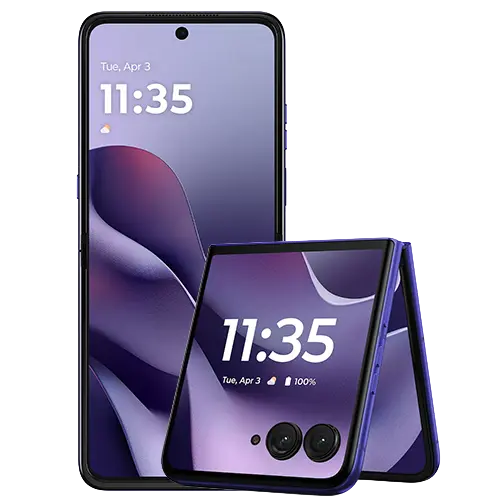

Motorola
Motorola
Razr Ultra (2026)
Razr Fold
Ranked #23 of 60
Ranked #26 of 60
Overall
Overall
Motorola sells two very different answers to the foldable question. The Razr Ultra (2026) is the flip phone: a compact clamshell that folds a full-size screen into something closer to a makeup compact, aimed at people who want a phone that disappears into a pocket. The Razr Fold is Motorola's book-style foldable, a regular phone that opens into a small tablet, aimed at people who want more screen rather than less phone. At $1,499.99 for the Ultra and $1,899.99 for the Fold, the Fold asks $400 more for the privilege of the bigger canvas.
The Ultra has the faster processor, longer battery endurance in everyday use, and a lower price. The Fold has the better displays, much better speakers, a telephoto lens the Ultra simply doesn't have, and far faster data transfer. The camera systems land close overall, with each winning different lenses. Which one makes sense depends almost entirely on which shape of foldable you want in the first place.
Design
| Motorola Razr Ultra (2026) | Motorola Razr Fold | |
|---|---|---|
| Specifications | ||
| Dimensions (folded) | 88.1 x 74 x 15.7 mm | 160.05 × 73.6 × 9.89 mm |
| Dimensions (unfolded) | 171.5 x 74.0 x 7.2 mm | 160.05 × 144.46 x 4.55 mm |
| Weight | 199g | 243g |
| IP Rating | IP48 | IP48/IP49 |
| Frame | Aluminum | Aluminum |
| Front | Gorilla Glass Ceramic | Gorilla Glass Ceramic 3 |
| Back | Vegan leather / Alcantara / Wood | — |
| Screen-to-body ratio (inner) | 87.3% | — |
| Screen-to-body ratio (outer) | 78.1% | — |
The Ultra is the smaller, lighter device by a wide margin: 199g against the Fold's 243g. Folded, the Ultra measures 88.1 x 74 x 15.7mm, a thick square that takes up half the pocket space of a normal phone. Unfolded it becomes a 171.5 x 74 x 7.2mm slab with a tall 22:9 inner screen and an 87.3% screen-to-body ratio, which means thin bezels by foldable standards. The outer screen covers 78.1% of the closed front. The Fold goes the other direction: 160.05 x 73.6 x 9.89mm closed, so a normal phone footprint but noticeably thick, opening to 160.05 x 144.46 x 4.55mm. The inner panel is a nearly square 8:7.2, the cover screen a conventional 21:9.
Both use aluminum frames and Gorilla Glass Ceramic on the front, with the Fold on the newer Ceramic 3. The Ultra offers vegan leather, Alcantara, or wood backs; Motorola doesn't specify a back material for the Fold. Both carry IP48 ratings, meaning submersion protection but only limited dust protection, which is typical for foldables with moving hinges. The Fold adds IP49, covering high-pressure hot water jets. That's an unusual rating for any phone and a meaningful durability edge on paper.
Bandicoot Lab doesn't formally test design or durability.
Display
Inner
| Motorola Razr Ultra (2026) (Inner) | Motorola Razr Fold (Inner) | |
|---|---|---|
632/ 881 | 658/ 881 | |
The Ultra's inner display is a 7" LTPO AMOLED at 1224 x 2992 (462 PPI) with a 1–165Hz refresh range. The Fold's is an 8.1" AMOLED at 2484 x 2232 (412 PPI) running 1–120Hz. The Ultra wins on pixel density and refresh ceiling; the Fold wins on nearly everything we measure.
Brightness is the clearest gap. The Fold reaches 543 nits in manual mode against the Ultra's 474, and peaks at 4,142 nits in HDR against the Ultra's 2,919. The Fold's peak is less stable across window sizes, holding 41.6% of it as the bright area grows versus 56.3% for the Ultra, but it starts so much higher that it stays ahead in practice. Both panels hold their output over a 30-minute HDR session almost perfectly, at 97.9% and 98.9%.
Color accuracy also favors the Fold. Its best mode is close enough to reference that errors won't be visible, and it covers 97.7% of the P3 gamut. P3 is the wide color space used by most streaming video and modern photos. The Ultra's best mode is also accurate on average but with larger worst-case misses, and it only covers 76.6% of P3, so wide-gamut content loses some of its punch. Tone mapping differs in character: the Ultra renders HDR slightly dimmer than mastered, while the Fold lifts highlights a touch above reference. Both start clipping highlights at the same point near the top of the signal. Touch latency is 15.1ms on the Fold and 19ms on the Ultra, a gap you won't feel.
Outer
| Motorola Razr Ultra (2026) (Outer) | Motorola Razr Fold (Outer) | |
|---|---|---|
567/ 881 | 691/ 881 | |
The Ultra's cover screen is a 4" LTPO AMOLED at 417 PPI, nearly square at 10.6:9, running 1–165Hz. The Fold's is a 6.6" LTPO P-OLED at 415 PPI, a normal 21:9 phone shape, running 30–165Hz. The practical difference is large: the Fold's cover screen is a complete phone display you can live on, while the Ultra's is a capable but cramped panel for quick tasks.
The Fold's outer panel is also its brighter one, measuring higher than its own inner display and well above the Ultra's cover screen. Color accuracy on both devices' outer panels tracks their inner ones: the Fold stays accurate, the Ultra drifts a little more, though its cover screen is actually slightly more accurate than its main panel.
Performance
| Motorola Razr Ultra (2026) | Motorola Razr Fold | |
|---|---|---|
761/ 1012 | 668/ 1012 | |
The Ultra runs a Qualcomm Snapdragon 8 Elite; the Fold runs a Snapdragon 8 Gen 5. Both come with 16GB of RAM as the only configuration.
The Ultra's chip is faster where it counts. GeekBench single-core comes in at 3062 versus 2628, a 16% gap that shows up in app launches and general responsiveness. Multi-core is a dead heat: 9161 versus 9178. The GPU gap is larger. The Ultra scores 6420 in Wild Life Extreme against the Fold's 5401, and 11538 versus 9631 in Solar Bay. Stability under sustained load is nearly identical, both holding roughly 66–69% of peak, so both throttle a similar amount during long gaming sessions. The Ultra just throttles from a higher starting point.
Browser performance follows the same pattern, with the Ultra scoring 20.8 on Speedometer to the Fold's 16.9.
Camera
| Motorola Razr Ultra (2026) | Motorola Razr Fold | |
|---|---|---|
482/ 587 | 481/ 587 | |
Overall, these camera systems land within a point of each other in our scoring, but they get there differently. The Ultra pairs a 50-megapixel main, 50-megapixel ultrawide, and 50-megapixel front camera with no telephoto and a 30x digital zoom ceiling. The Fold runs a larger-sensor 50-megapixel main, a 50-megapixel ultrawide, a 3x 50-megapixel telephoto, and two front cameras, with digital zoom out to 100x. Neither system competes with camera-first flagships; dynamic range is a weakness on both, with high-contrast scenes losing highlight detail.
The zoom story splits cleanly. The Ultra's main sensor has to cover everything from 1x to 30x alone, and past roughly 5x the results fall apart into soft, processed mush. The Fold's telephoto keeps deep zoom usable considerably further out; by 10x and beyond it holds visibly more detail than the Ultra, though at the extreme end of its 100x range you're looking at shapes, not photographs. If you zoom at all, the Fold is the better tool.
Main
| Motorola Razr Ultra (2026) (Main) | Motorola Razr Fold (Main) | |
|---|---|---|
491/ 722 | 537/ 722 | |
The Ultra's main camera is a 50-megapixel f/1.8 with a 1/1.56" sensor. The Fold's is a 50-megapixel f/1.6 on a larger 1/1.28" sensor. At 1x the Ultra resolves slightly more detail in bright light, and it holds up well as light drops. The Fold's main lens only needs to carry you to 3x before the telephoto takes over, and it handles that range cleanly. The Ultra's main softens progressively as it crops, and by mid-zoom the detail loss is obvious.
Color character differs. The Fold is tuned almost perfectly neutral, with saturation sitting right at reference in every lighting condition. The Ultra pushes colors about 10% more vivid in bright light, settling toward neutral as light dims. Hue accuracy is good on both. Skin tones are the weak spot for both in bright light, drifting noticeably from reference, with the Fold slightly closer. Both phones pick up a mild warm cast under dim, warm lighting, a white balance correction that doesn't quite finish the job, but it's subtle on both.
Dynamic range favors the Ultra. Its main camera retains more shadow and highlight detail in high-contrast scenes, while the Fold's compresses harder and clips highlights sooner, leaving backlit scenes flatter. The Fold's main camera video is also notably shakier handheld; the Ultra's stabilization isn't great, but it's more than twice as effective.
Ultrawide
| Motorola Razr Ultra (2026) (Ultrawide) | Motorola Razr Fold (Ultrawide) | |
|---|---|---|
551/ 722 | 422/ 722 | |
Both phones use 50-megapixel f/2 ultrawides on similar sensor sizes. The Ultra's is the better lens across the board. It's sharper in every lighting condition, closer to its own main camera in detail, and more accurate on color. The Fold's ultrawide has a real skin tone problem in bright and mid lighting, where faces drift far enough from reference to be obvious, and its hue errors are larger generally.
The Ultra's ultrawide pushes saturation hard in bright light, roughly 20% above reference, so landscapes come out punchy rather than true. Dynamic range is a genuine strength for it, holding more usable scene depth than either phone's main camera. The Fold's ultrawide is decent on dynamic range but clips harder on the way there.
Telephoto
| Motorola Razr Ultra (2026) (Telephoto) | Motorola Razr Fold (Telephoto) | |
|---|---|---|
| — | 476/ 722 | |
The Fold has a 3x telephoto: 50-megapixel, f/2.4, 71mm equivalent, on a healthy 1/1.95" sensor. The Ultra has nothing here, which is the single biggest hardware gap between these cameras.
The telephoto's standout trait is consistency. Sharpness barely moves between bright light and near-darkness, which is rare for a telephoto and comes down to that large sensor. Skin tones are the most accurate of any lens on either phone. Hue accuracy is the catch: under warm mid and low light, colors shift noticeably yellow, and the bias pattern points to white balance correction falling behind rather than the sensor confusing colors. Dynamic range is limited, so contrasty telephoto shots clip highlights. Detail holds reasonably from 3x up through 10x before digital processing takes over. Handheld telephoto video is shaky, so brace against something for clips at 3x.
Front
| Motorola Razr Ultra (2026) (Front) | Motorola Razr Fold (Front Inner) | Motorola Razr Fold (Front Outer) | |
|---|---|---|---|
557/ 722 | 566/ 722 | 449/ 722 | |
The Ultra's front camera is a 50-megapixel f/2 and it's the best single lens on either phone. Sharpness is high in bright and mid light, color is good with only a slight cool lean and somewhat muted saturation, and video stabilization is excellent. Handheld selfie video is nearly tripod-steady.
The Fold has two front cameras: a 32-megapixel f/2.4 inside and a 20-megapixel f/2.4 on the cover. The inner camera is the better one, with solid detail, strong dynamic range that preserves backlit faces better than anything else in this matchup, and accurate skin tones in mid and low light. In bright light, skin tones drift well off reference. The outer front camera is the weakest lens here: noticeably soft, worse in low light, and poorly stabilized. In practice you'd use the Fold's rear cameras with the cover screen as a viewfinder for serious selfies, which somewhat makes up for it.
Battery
| Motorola Razr Ultra (2026) | Motorola Razr Fold | |
|---|---|---|
584/ 836 | 481/ 836 | |
The Fold carries a 6,000mAh battery to the Ultra's 5,000mAh, but capacity doesn't decide this one. On the inner displays, the Ultra ran our video playback test for 31.23 hours against the Fold's 26.22. The Fold's larger panel eats its capacity advantage and then some. On the cover screens the order flips: 39.69 hours for the Fold versus 32.89 for the Ultra, since the Fold's cover screen is a normal phone display drawing from a huge battery.
Mixed use favors the Ultra more clearly. Five hours of web browsing drained 19% of the Ultra and 32% of the Fold, which is the difference between a phone that comfortably does two days of light use and one that's a solid single-day device. Gaming reverses it: the Fold lost 29% during our 20-loop stress test to the Ultra's 39%, partly because its GPU draws less. Overnight standby is close, 3% versus 4%.
The Ultra lasts longer doing the things most people do most of the day. The Fold lasts longer if you live on its cover screen and only open it when the big screen earns its power draw.
Charging
| Motorola Razr Ultra (2026) | Motorola Razr Fold | |
|---|---|---|
329/ 837 | 394/ 837 | |
The Fold advertises 80W wired to the Ultra's 68W, but the test results barely separate. At 10 minutes the Ultra reaches 27% to the Fold's 25%; at 30 minutes it's 70% versus 65%. The Ultra's lower wattage goes further on a smaller battery, so in minutes-to-usable terms they're effectively tied, with the Ultra slightly ahead.
Wireless is stranger. The Ultra supports 30W wireless to the Fold's 15W, yet the Fold charged faster in testing: 11% versus 10% at 10 minutes, 26% versus 22% at 30. Neither is quick wirelessly. Plan on the cable for both.
Speaker
| Motorola Razr Ultra (2026) | Motorola Razr Fold | |
|---|---|---|
544/ 897 | 749/ 897 | |
The Fold has the better speakers and it isn't close. Distortion at volume measures 3.19% against the Ultra's 8.74%, so the Fold stays clean where the Ultra gets rough. The Fold also reaches noticeably lower into the bass range, giving music and video some actual body, where the Ultra's output is thin and treble-forward. The Fold's high end is clearer too.
The Ultra's one advantage is raw volume, hitting 77.6 dBA to the Fold's 74.5. Given what the Ultra's speakers do to the sound at that volume, it's not an advantage you'll want to use.
Microphone
| Motorola Razr Ultra (2026) | Motorola Razr Fold | |
|---|---|---|
610/ 1220 | 364/ 1220 |
The Ultra's microphones are solidly mid-pack, with a reasonably even frequency response that keeps voices natural in recordings and calls. The Fold's microphones test below average, with a more uneven response that colors voice recordings noticeably. If you record voice memos or video with speech, the Ultra is the safer pick.
Other
| Motorola Razr Ultra (2026) | Motorola Razr Fold | |
|---|---|---|
| Biometrics | 713/ 1181 | 641/ 1181 |
| Data Transfer | 116/ 943 | 612/ 943 |
| Specifications | ||
| Biometric type | Fingerprint | Fingerprint |
| Ports | USB-C 2.0 | USB-C 3.2 |
| Storage | 512GB | 512GB |
Both phones use capacitive fingerprint sensors and neither offers hardware-based face unlock. The Ultra unlocks in 147ms on average, the Fold in 164ms. Both are fast; the difference isn't something you'll feel.
Data transfer is a real gap. The Ultra's USB-C 2.0 port manages 39 MB/s reads and 38 MB/s writes, while the Fold's USB-C 3.2 port hits 273 MB/s and 249 MB/s. Moving a large video library off the Ultra over cable is a coffee-break job; the Fold does it in a fraction of the time. It's an odd corner to cut on a $1,500 phone. Both come in a single configuration: 16GB of RAM and 512GB of storage.
Conclusion
These two land within about ten points of each other in our overall scoring, which tracks with how the categories split. The Ultra wins performance, battery endurance, microphones, and front camera quality, and it costs $400 less. The Fold wins both displays, speakers, data transfer, and the long end of the zoom range, and it's the only one of the two with a telephoto. The camera systems as a whole are a near-tie, with the Ultra stronger on the ultrawide and selfies and the Fold stronger past 3x.
The real decision is the form factor, and the test results mostly reinforce it. If you want a foldable because you want a smaller phone, the Ultra is the better execution: faster, longer-lasting in daily use, cheaper, and its cameras hold their own everywhere except zoom. If you want a foldable because you want a bigger screen, the Fold delivers the better screens, by a clear margin on brightness and color, plus speakers that actually suit watching things on an 8.1" panel.
The $400 premium buys the Fold's display quality, telephoto, and that unusual IP49 water resistance. It doesn't buy faster performance or longer battery life, and in both of those areas you'd be paying more for less. Know which shape you want, and the rest of the decision mostly follows.
FAQ
Does the Razr Ultra or Razr Fold have better battery life?
The Razr Ultra lasts longer in most everyday use. Its inner display ran video playback for 31.23 hours against 26.22 for the Razr Fold, and five hours of web browsing drained 19% of the Ultra versus 32% of the Fold. The Fold wins if you mostly use its cover screen (39.69 hours versus 32.89 for the Ultra) and in gaming, where it lost 29% in our stress test to the Ultra's 39%.
Which has the better camera, the Razr Ultra or the Razr Fold?
The two camera systems are close overall and win different lenses. The Razr Fold has a 3x telephoto and holds much more detail at 10x and beyond, while the Razr Ultra has no telephoto and gets soft past roughly 5x. The Ultra has the better ultrawide, the best front camera of the two, steadier main-camera video, and more dynamic range from its main lens.
Is the Razr Fold worth $400 more than the Razr Ultra?
The extra money buys the Razr Fold's brighter and more color-accurate displays, a telephoto lens, much better speakers, far faster USB transfers, and an IP49 rating on top of IP48. It does not buy faster performance or longer everyday battery life, since the Razr Ultra is ahead on both. The Fold is worth it if you want the larger screen, and the Ultra is the better value if you want a compact flip phone.
Is the Razr Ultra or Razr Fold better for gaming?
The Razr Ultra has the faster GPU, scoring 6420 in Wild Life Extreme to the Fold's 5401 and 11538 in Solar Bay to 9631. Both phones throttle by a similar amount in long sessions, holding roughly 66–69% of peak. The Razr Fold uses less battery while gaming, losing 29% in our stress test against 39% for the Ultra, and its larger inner screen suits some games better.
Which is better for watching video, the Razr Ultra or the Razr Fold?
The Razr Fold is the better video device. Its 8.1" inner display reaches 543 nits in manual mode and 4,142 nits in HDR, against 474 and 2,919 for the Razr Ultra, and it covers 97.7% of the P3 gamut versus 76.6% for the Ultra. Its speakers also distort far less at volume (3.19% versus 8.74%) and have noticeably more bass.
Should I get the Razr Ultra or Razr Fold if I want a smaller phone?
The Razr Ultra is the better choice for a smaller phone. It weighs 199g against the Razr Fold's 243g and folds to a compact square roughly half the pocket space of a normal phone. The Fold closes to a normal-sized but thick phone and opens into a small tablet, so it suits people who want more screen rather than less phone.
Related
Motorola
Razr Ultra (2026)
Motorola
Razr Fold
Motorola
Razr+ (2026)
Motorola
Razr (2026)

Motorola
Moto G Power (2026)

Motorola Razr Ultra (2026) vs Motorola Razr Ultra (2025)

Motorola Razr+ (2026) vs Motorola Razr Ultra (2026)

Motorola Razr+ (2026) vs Motorola Razr Fold
Best Phones for Gaming
Best Foldable Phones
Motorola Razr Fold vs OnePlus Open

Motorola Razr (2026) vs Motorola Razr Ultra (2026)