Motorola Razr+ (2026) vs Motorola Razr Fold
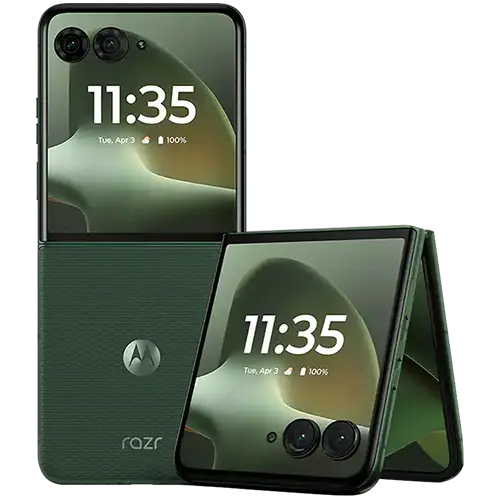

Motorola
Motorola
Razr+ (2026)
Razr Fold
Ranked #48 of 60
Ranked #26 of 60
Overall
Overall
These are two different ideas of what a folding Motorola should be. The Razr+ (2026) is a flip phone at $1,099.99. It folds down to a square you can drop in a jacket pocket, opens to a normal-sized slab, and treats its cover screen as a quick-glance surface. The Razr Fold costs $1,899.99 and folds the other way, opening from a phone-sized cover display into a small tablet. One is about portability and a lower price of entry into foldables. The other is about carrying a big screen without carrying a big device, and it charges nearly twice as much for the privilege.
The Razr Fold leads in most of the places where the extra $800 should show up. It has the faster chip, the larger and brighter inner display, a proper telephoto lens the Razr+ simply doesn't have, and a bigger battery. The Razr+ holds its own on a few fronts — it's lighter, its cover display responds to touch faster, and its microphone is the better of the two. Neither phone is a performance or battery standout in the broader field. The gap between them tracks the price difference fairly closely rather than exceeding it.
Design
| Motorola Razr+ (2026) | Motorola Razr Fold | |
|---|---|---|
| Specifications | ||
| Dimensions (folded) | 88.1 x 74 x 15.3 mm | 160.05 × 73.6 × 9.89 mm |
| Dimensions (unfolded) | 171.4 x 74.0 x 7.1 mm | 160.05 × 144.46 x 4.55 mm |
| Weight | 189g | 243g |
| IP Rating | IP48 | IP48/IP49 |
| Frame | Aluminum | Aluminum |
| Front | Gorilla Glass Victus | Gorilla Glass Ceramic 3 |
| Back | Vegan leather | — |
| Screen-to-body ratio (inner) | 85.1% | — |
| Screen-to-body ratio (outer) | 78.1% | — |
The two phones fold along different axes, which makes the dimensions read differently. The Razr+ closes to 88.1 x 74 x 15.3mm — short and thick, the classic clamshell shape — and opens to a 171.4mm-tall slab that's 7.1mm thick. At 189g it's the lighter of the two by a wide margin. The Razr Fold stays phone-shaped folded at 160.05 x 73.6 x 9.89mm, then opens to a 144.46mm-wide panel just 4.55mm thick unfolded. It weighs 243g, which you'll feel in a pocket.
Both use aluminum frames. The fronts differ: the Razr+ uses Gorilla Glass Victus on its cover, the Razr Fold uses the newer Gorilla Glass Ceramic 3. The Razr+ wraps its back in vegan leather, a texture choice that also helps with grip on a phone you'll be flipping open one-handed.
The Razr+ carries an IP48 rating: dust-resistant against larger particles, protected against sustained water immersion. The Razr Fold lists IP48/IP49, the IP49 part adding resistance to high-temperature, high-pressure water jets. Neither rating means fine dust is kept out, which is unfortunate given plenty of newer foldables have IP68 ratings. The Razr+'s inner screen reaches an 85.1% screen-to-body ratio with thin bezels; its 4-inch cover sits at 78.1%.
Bandicoot Lab doesn't formally test design or durability.
Display
Inner
| Motorola Razr+ (2026) (Inner) | Motorola Razr Fold (Inner) | |
|---|---|---|
652/ 881 | 658/ 881 | |
The Razr+'s inner panel is a 6.9-inch LTPO AMOLED at 1084 x 2640 (414 pixels per inch), refreshing from 1 to 165Hz. The Razr Fold's inner display is an 8.1-inch AMOLED at 2484 x 2232 (412 PPI), nearly square at 8:7.2, topping out at 120Hz. Pixel density is effectively identical; the Razr Fold simply gives you a lot more screen.
Brightness favors the Fold. In manual mode it reaches 543 nits against the Razr+'s 483, and on HDR content it peaks higher: 4,142 nits versus 3,236. Both are bright enough that outdoor visibility isn't a concern on either. HDR brightness stability across window sizes tells a different story. The Razr+ holds 81.8% of its brightness as the bright area of the frame changes size, while the Fold drops to 41.6% — its highlights dim noticeably when more of the screen is lit. Over the sustained 30-minute test both stay flat, near 100%.
Color accuracy goes to the Fold. Its inner panel tracks reference more closely and covers 97.7% of the wider DCI-P3 gamut, against 75.1% for the Razr+, which limits how saturated the Razr+ can render wide-gamut content. Both follow the HDR reference curve closely and begin clipping highlights at the same point, with the Razr+ pushing highlights slightly brighter than mastered.
Touch latency splits the two: the Razr+ responds in 6.8ms, the Fold in 15.1ms. That's a gap you won’t feel.
Outer
| Motorola Razr+ (2026) (Outer) | Motorola Razr Fold (Outer) | |
|---|---|---|
592/ 881 | 691/ 881 | |
The Razr+'s cover screen is a 4-inch LTPS AMOLED at 1272 x 1080 (417 PPI). The Razr Fold's cover is a 6.6-inch LTPO P-OLED at 2520 x 1080 (415 PPI), a full phone-sized display you can run apps on rather than a glance panel. Both go to 165Hz.
The Fold's cover is the brighter and more accurate of the two. Colors on it stay close to neutral, while the Razr+'s cover drifts moderately and renders neutral tones with a slight cast. The Razr+'s cover also responds more slowly to touch than its inner display — a meaningful drop in responsiveness rather than a few milliseconds. The Fold keeps its two displays much closer in touch behavior.
Performance
| Motorola Razr+ (2026) | Motorola Razr Fold | |
|---|---|---|
377/ 1012 | 668/ 1012 | |
The Razr+ runs a Snapdragon 8s Gen 3 with 12GB of RAM. The Razr Fold runs a Snapdragon 8 Gen 5 with 16GB. This is the clearest hardware gap between the two.
On GeekBench, the Razr+ posts 1,940 single-core and 4,905 multi-core. The Fold nearly doubles the multi-core result at 9,178 and reaches 2,628 single-core. Browser performance follows: 16.9 on Speedometer for the Fold against 12.3 for the Razr+. The GPU gap is just as wide. In the Wild Life Extreme stress test the Fold peaks at 5,401 and holds 68.6% of that across 20 loops; the Razr+ peaks at 3,149 and sustains 52.8%, so it both starts lower and throttles harder.
In daily use, both feel fine for messaging, browsing, and video. The difference shows in sustained load. The Fold holds frame rates better in long gaming sessions and chews through heavy multitasking on its larger screen more comfortably. The Razr+ is the phone that warms up and slows down first.
Camera
| Motorola Razr+ (2026) | Motorola Razr Fold | |
|---|---|---|
468/ 587 | 481/ 587 | |
Neither phone is a camera-first device, but the Razr Fold has the more complete system. It adds a dedicated 3x telephoto the Razr+ lacks entirely, and it carries digital zoom out to 100x against the Razr+'s 10x ceiling. Both use a 50-megapixel main and a 50-megapixel ultrawide. Overall sharpness between the two main lenses is close in good light; the Fold's larger main sensor (1/1.28 versus 1/1.95) gives it an edge as light drops.
At the long end the difference is decisive. The Razr+ relies on cropping its main sensor, and detail collapses well before 10x — its deep-zoom output is soft and largely unusable past a modest crop. The Fold's telephoto and higher zoom ceiling keep far more detail at extreme magnification. It's still digital mush at 100x, but the usable range stretches considerably further.
On color character, both main cameras lean neutral with restrained saturation, slightly muted rather than punchy. The Fold's main camera holds hues accurately across all three lighting conditions and keeps skin tones close to reference even in warm, dim light. The Razr+'s main camera is accurate in bright light but drifts as light warms, with skin tones pulling slightly off and a mild warm shift creeping in — a white balance correction issue more than a sensor failing.
Main
| Motorola Razr+ (2026) (Main) | Motorola Razr Fold (Main) | |
|---|---|---|
501/ 722 | 537/ 722 | |
The Razr+ main camera is sharpest in mid light and holds detail well through bright conditions, softening some in the dark. Across its 1x–10x range it stays clean through a 2x crop but degrades steadily beyond that, since there's no second lens to hand off to. The Fold's main is sharpest in bright light and stays more consistent into low light thanks to the larger sensor. It only needs to carry 1x–3x before the telephoto takes over, and it holds detail cleanly across that shorter span.
Dynamic range is a weak point for both, and both clip highlights in high-contrast scenes. The Razr+ retains slightly more usable range in bright conditions; the Fold flattens harder when the scene has both deep shadow and bright sky.
Ultrawide
| Motorola Razr+ (2026) (Ultrawide) | Motorola Razr Fold (Ultrawide) | |
|---|---|---|
426/ 722 | 422/ 722 | |
Both pair a 50-megapixel ultrawide with the main. Sharpness is similar, with the Fold's ultrawide a touch crisper in bright light and both falling off in the dark. Each is softer than its own main lens, as expected.
Color is the issue on both ultrawides. They render skin tones poorly in bright light — the Razr+ and Fold both push faces well off reference at 1000 lux, with the Fold the worse of the two there. Both also lean cool. The Fold's ultrawide pulls in more dynamic range than its main, while the Razr+'s ultrawide is the more limited of its lenses for high-contrast scenes.
Telephoto
| Motorola Razr+ (2026) (Telephoto) | Motorola Razr Fold (Telephoto) | |
|---|---|---|
| — | 476/ 722 | |
Only the Razr Fold has one: a 50-megapixel 3x at 71mm. It holds detail well at its native length and stays sharp or sharper in dim conditions than in bright. As you push past 3x into digital territory, detail tapers gradually rather than falling off a cliff. Color is accurate at the native length in bright light but drifts toward warm as light dims, and saturation drops in the dark. Stabilization is among its weaker points, so longer handheld shots need a steady hand.
The Razr+ has no telephoto. Anything past its main lens is a crop, and as covered above, that range is short.
Front
| Motorola Razr+ (2026) (Front) | Motorola Razr Fold (Front Inner) | Motorola Razr Fold (Front Outer) | |
|---|---|---|---|
583/ 722 | 566/ 722 | 449/ 722 | |
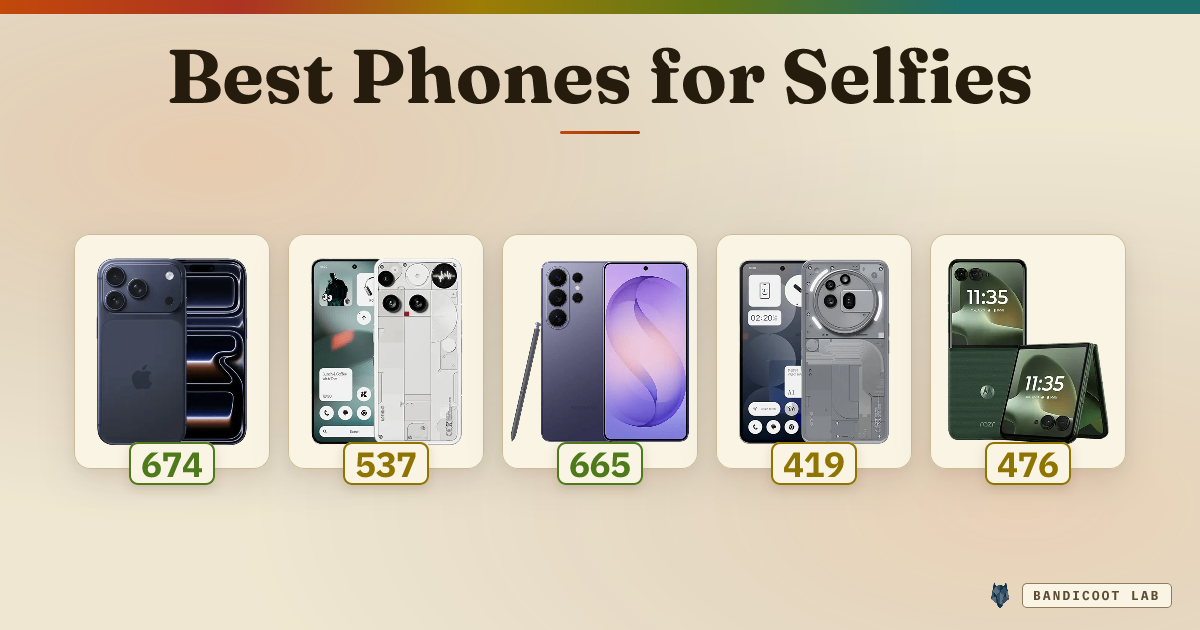
The Razr+ has a single 32-megapixel selfie camera. It's sharp in bright and mid light, softer in the dark, with accurate skin tones across lighting and good dynamic range. Stabilization on video is solid for a front camera.
The Razr Fold has two: a 32-megapixel inner camera and a 20-megapixel outer one, the latter for selfies using the cover display. The inner camera is the better of the pair — sharp, accurate skin tones in mid and dim light, and the widest dynamic range of any front camera here. Its one stumble is skin tone accuracy in bright light, where faces shift noticeably off reference. The outer 20-megapixel camera is lower resolution and softer, especially in low light, and its colors drift more across lighting. For serious selfies, the inner camera and main display is the combination to use.
Battery
| Motorola Razr+ (2026) | Motorola Razr Fold | |
|---|---|---|
445/ 836 | 481/ 836 | |
The Razr+ packs a 4500mAh battery; the Razr Fold, 6000mAh. The Fold has more capacity but also far more screen to drive.
Video playback on the inner display runs 25 hours on the Razr+ and 26.22 hours on the Fold — close, with the Fold's larger panel eating much of its capacity advantage. On the cover screens the gap widens: the Razr+ manages 25.13 hours, the Fold 39.69, since its efficient cover display sips power. In practice both clear a full day of mixed use comfortably and stretch into a second day for lighter users.
Web browsing tells the opposite story. Over the five-hour test the Razr+ drains 25%, the Fold 32% — so for sustained on-screen work the Razr+ is the more efficient of the two. Gaming drain is closer, 26% against 29% over the stress run. Standby is negligible on both, 3% and 4% over an eight-hour overnight idle. Neither phone is a strong battery performer in the wider field, and you'll want to charge nightly with either.
Charging
| Motorola Razr+ (2026) | Motorola Razr Fold | |
|---|---|---|
300/ 837 | 394/ 837 | |
The Razr+ supports 45W wired and 15W wireless. The Razr Fold steps up to 80W wired with the same 15W wireless.
Despite the wattage difference, the wired results land close and even favor the Razr+. At 10 minutes the Razr+ reaches 27%, the Fold 25%. At 30 minutes the Razr+ hits 70% against the Fold's 65% — the Fold simply has more capacity to fill, so its higher peak wattage doesn't translate to a higher percentage. Wireless is similar between them, around a quarter charge at 30 minutes. The Fold's larger pack means a longer total time to full, even with the faster charger.
Speaker
| Motorola Razr+ (2026) | Motorola Razr Fold | |
|---|---|---|
488/ 897 | 749/ 897 | |
The Razr+ is the louder phone at 77.8 dBA versus the Fold's 74.5. Loudness is where its speaker advantage ends. It distorts heavily at volume — total harmonic distortion near 9% — and its tonal balance is uneven, with rolled-off bass and a thinner overall character.
The Razr Fold plays quieter but cleaner. Distortion is well under a third of the Razr+'s, its bass extends lower and fuller, and its high end is clearer and better balanced. It's the more pleasant speaker for music and video despite the lower ceiling.
Microphone
| Motorola Razr+ (2026) | Motorola Razr Fold | |
|---|---|---|
699/ 1220 | 364/ 1220 |
The Razr+ has the better microphone, with a flatter, more even response that places it above average for voice capture. The Razr Fold's microphone is below average, with a less even response that makes recorded voice sound less natural.
Other
| Motorola Razr+ (2026) | Motorola Razr Fold | |
|---|---|---|
| Biometrics | 556/ 1181 | 641/ 1181 |
| Data Transfer | 114/ 943 | 612/ 943 |
| Specifications | ||
| Biometric type | Fingerprint | Fingerprint |
| Ports | USB-C 2.0 | USB-C 3.2 |
| Storage | 256GB | 512GB |
Both use capacitive fingerprint sensors, and both unlock quickly. The Fold is the faster of the two at 164ms against the Razr+'s 189ms — a difference you're unlikely to perceive. Neither phone has hardware-based face unlock; any face-based unlocking relies on the camera and isn't the dedicated, secure variety.
Data transfer is a clear split. The Razr+ uses a USB-C 2.0 port and tops out around 42 MB/s read and 36 MB/s write — slow for moving large files. The Razr Fold's USB-C 3.2 port reaches 273 MB/s read and 249 MB/s write, several times faster, which matters if you offload video regularly. The Razr+ ships with 256GB of storage; the Fold doubles that to 512GB.
Conclusion
The Razr Fold is the stronger phone in most categories that justify a price premium. It has the faster chip and far better sustained performance, the larger and brighter inner display with more accurate color, a more complete camera system with a real telephoto and far more usable zoom, the cleaner speaker, much faster data transfer, and double the storage. If you want the biggest screen you can fold into a pocket and you're spending nearly two thousand dollars, it delivers on that.
The Razr+ wins on the things that come with being smaller and cheaper. It's much lighter, its cover display responds faster to touch, its microphone is better, its speaker is louder, and it's the more efficient phone for browsing. It also charges to a higher percentage in the first half hour. None of these overturn the Fold's advantages, but together they make the Razr+ a coherent package for someone who wants a foldable that disappears into a pocket and costs $800 less.
FAQ
Is the Razr Fold worth the extra $800 over the Razr+?
The Razr Fold earns its premium in specific areas: a larger, more color-accurate inner display, a real telephoto lens, far faster sustained performance, much quicker data transfer, and double the storage. The Razr+ closes the gap on weight, touch responsiveness, microphone quality, and browsing efficiency. The extra $800 makes sense if you'll regularly use the bigger screen or longer zoom; if you mostly want a pocketable foldable, the Razr+ covers the basics without the cost.
Which phone is better for gaming — the Razr+ (2026) or the Razr Fold?
The Razr Fold handles sustained gaming more comfortably. It starts at a higher graphics performance ceiling and holds closer to that ceiling across extended play, while the Razr+ both starts lower and throttles further during long sessions, warming up and slowing down sooner. For short bursts both feel capable, but the Fold is the better choice if sessions run long.
Does the Razr+ or the Razr Fold take better zoom photos?
The Razr Fold is decisively better at zoom. It carries a dedicated 3x telephoto that maintains real detail through its native length and tapers gradually beyond it, with usable results well past what the Razr+ can manage. The Razr+ has no telephoto at all — any zoom past 1x is a crop from the main sensor, and detail collapses quickly. Unless your zoom needs stay at or near 1x, the Fold has a meaningful advantage.
Does the Razr Fold charge faster than the Razr+?
Despite supporting 80W wired charging against the Razr+'s 45W, the Fold does not reach a higher charge percentage in the first half hour — the Razr+ actually edges ahead at both the 10-minute and 30-minute marks. The Fold's higher wattage goes toward filling a much larger 6000mAh battery, so the faster charger keeps pace rather than pulling ahead. Total time to full is longer on the Fold.
Which has better audio — speakers and microphone combined?
Each phone wins one half. The Razr Fold has the better speaker: it plays quieter than the Razr+ but with far less distortion, fuller bass, and clearer highs, making it the more pleasant choice for music and video. The Razr+ has the better microphone, with a more even response that captures voice more naturally — the Fold's microphone is below average for recorded speech.
Related
Motorola
Razr+ (2026)
Motorola
Razr Fold
Motorola
Razr Ultra (2026)
Motorola
Razr (2026)

Motorola
Moto G Power (2026)

Motorola Razr Ultra (2026) vs Motorola Razr Fold

Motorola Razr+ (2026) vs Motorola Razr Ultra (2026)

Motorola Razr+ (2026) vs Samsung Galaxy Z Flip 7
Motorola Razr Fold vs OnePlus Open

Motorola Razr (2026) vs Motorola Razr+ (2026)

Motorola Razr (2026) vs Motorola Razr Fold
Best Phones for Selfies