Motorola Razr+ (2026) vs Motorola Razr Ultra (2026)
Motorola
Motorola
Razr+ (2026)
Razr Ultra (2026)
Ranked #48 of 60
Ranked #23 of 60
Overall
Overall
The Razr+ (2026) and Razr Ultra (2026) are part of the same series of phones. Both are Motorola flip foldables with near-identical footprints, the same hinge, the same 4-inch cover screen concept, and the same vegan-leather-adjacent styling. The Razr+ at $1,099.99 is the sensible entry into the lineup for people who want the flip form factor without flagship pricing. The Ultra at $1,499.99 asks $400 more for a flagship chip, a bigger battery, more storage, and upgraded camera hardware.
The Ultra earns most of its premium. It's substantially faster, lasts meaningfully longer on a charge, zooms further, and has the better ultrawide and front cameras. The Razr+ answers with a brighter, more responsive inner display and a slightly better microphone, and its main camera trades blows with the Ultra's rather than losing to it. Both phones share the same weaknesses: mediocre speakers, slow data transfer, and no hardware-based face unlock.
Design
| Motorola Razr+ (2026) | Motorola Razr Ultra (2026) | |
|---|---|---|
| Specifications | ||
| Dimensions (folded) | 88.1 x 74 x 15.3 mm | 88.1 x 74 x 15.7 mm |
| Dimensions (unfolded) | 171.4 x 74.0 x 7.1 mm | 171.5 x 74.0 x 7.2 mm |
| Weight | 189g | 199g |
| IP Rating | IP48 | IP48 |
| Frame | Aluminum | Aluminum |
| Front | Gorilla Glass Victus | Gorilla Glass Ceramic |
| Back | Vegan leather | Vegan leather / Alcantara / Wood |
| Screen-to-body ratio (inner) | 85.1% | 87.3% |
| Screen-to-body ratio (outer) | 78.1% | 78.1% |
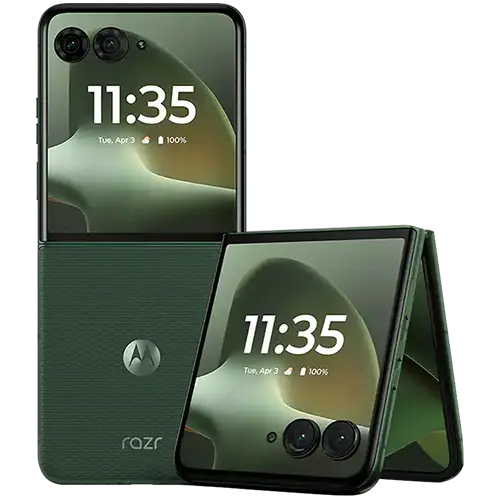
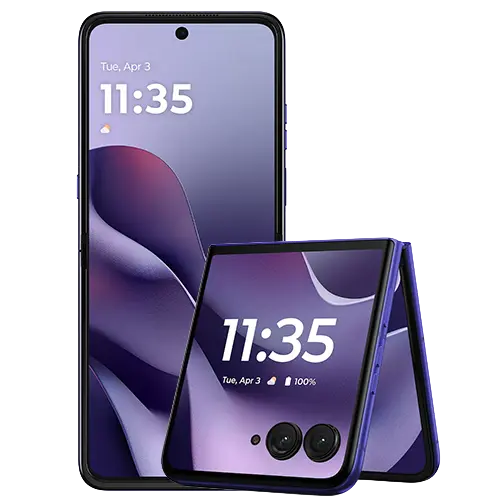
On paper, these two are nearly indistinguishable in design. Folded, the Razr+ measures 88.1 x 74 x 15.3mm against the Ultra's 88.1 x 74 x 15.7mm. Unfolded, it's 171.4 x 74 x 7.1mm versus 171.5 x 74 x 7.2mm. The Ultra weighs 199g to the Razr+'s 189g. Ten grams is detectable side by side and forgettable otherwise.
Both use an aluminum frame and both carry an IP48 rating. The front glass differs: the Razr+ uses Gorilla Glass Victus while the Ultra gets Gorilla Glass Ceramic, Corning's newer composite aimed at better drop resistance. Backs are vegan leather on the Razr+; the Ultra adds Alcantara and wood options.
The Ultra's inner display fills slightly more of its face, with an 87.3% screen-to-body ratio against 85.1%, so its bezels are a touch thinner around a slightly larger panel. Both inner screens use the same tall 22:9 aspect ratio, and both cover screens sit at 78.1% screen-to-body.
Bandicoot Lab doesn't formally test design or durability, so this section covers what's on paper.
Display
Inner
| Motorola Razr+ (2026) (Inner) | Motorola Razr Ultra (2026) (Inner) | |
|---|---|---|
652/ 881 | 632/ 881 | |
The Ultra's 7-inch LTPO AMOLED runs at 1224 x 2992, which works out to 462 pixels per inch. The Razr+'s 6.9-inch panel is 1084 x 2640 at 414 PPI. Both refresh from 1Hz to 165Hz. The resolution gap is modest; text looks slightly crisper on the Ultra if you look for it.
Brightness favors the Razr+. Manual brightness is effectively tied at 483 nits versus 474 nits, but HDR peak reaches 3,236 nits on the Razr+ against 2,919 nits on the Ultra. The bigger difference is how each holds brightness as the bright area grows: the Razr+ keeps 81.8% of its peak across window sizes while the Ultra keeps only 56.3%, so large bright scenes dim more visibly on the Ultra. Both sustain output over time without fading. Tone mapping differs in character: the Razr+ pushes highlights brighter than the content was mastered, while the Ultra tracks the reference more faithfully with a slightly restrained hand. Both start clipping highlight detail at the same point near the top of the signal.
Color accuracy is a dead heat. Both panels render colors very close to reference in their best mode, with errors small enough that you'd need instruments to find them. Touch latency is the one lopsided result: the Razr+ averages 6.8ms while the Ultra averages 19ms. One of the faster touch responses we've measured against a fairly ordinary one, and fast-paced games will feel slightly more immediate on the cheaper phone.
Outer
| Motorola Razr+ (2026) (Outer) | Motorola Razr Ultra (2026) (Outer) | |
|---|---|---|
592/ 881 | 567/ 881 | |
Both cover screens are 4 inches at 417 PPI, so sharpness is identical. The Ultra's outer panel is LTPO and can drop to 1Hz, while the Razr+'s LTPS panel bottoms out at 30Hz; both top out at 165Hz. The lower floor gives the Ultra a small efficiency edge for always-on content on the cover screen.
The Razr+'s outer display tested brighter, and its color accuracy on the cover screen is slightly better than the Ultra's, though both drift a little more than their inner panels. Touch response on the outer screens is ordinary on both. The two cover screens are close enough that neither should sway a purchase.
Performance
| Motorola Razr+ (2026) | Motorola Razr Ultra (2026) | |
|---|---|---|
377/ 1012 | 761/ 1012 | |
This is the widest gap between the two. The Ultra runs a Snapdragon 8 Elite with 16GB of RAM; the Razr+ runs a Snapdragon 8s Gen 3 with 12GB. The "s" in that name does a lot of work. In GeekBench, the Ultra scores 3,062 single-core and 9,161 multi-core against the Razr+'s 1,940 and 4,905. That's not flagship versus near-flagship. It's roughly double the multi-core throughput.
The GPU gap is the same story. In the Wild Life Extreme stress test the Ultra peaks at 6,420 with 68.6% stability under sustained load; the Razr+ peaks at 3,149 and holds only 52.8% of that. The Ultra starts twice as fast and throttles less. Browser performance follows suit, with the Ultra scoring 20.8 on Speedometer to the Razr+'s 12.3.
You'll feel this. The Razr+ handles daily tasks fine, but heavy web apps, demanding games, and anything that keeps the chip busy for more than a few minutes will run noticeably better on the Ultra. For a $1,099.99 phone, the Razr+'s chip is the clearest place Motorola saved money.
Camera
| Motorola Razr+ (2026) | Motorola Razr Ultra (2026) | |
|---|---|---|
468/ 587 | 482/ 587 | |
Both phones use a 50-megapixel main, 50-megapixel ultrawide, and no telephoto, which puts them behind camera-focused rivals at similar prices before any testing starts. The Ultra's main sensor is larger (1/1.56" versus 1/1.95") and sits behind a slightly wider 24mm lens, and it pairs with a 50-megapixel front camera against the Razr+'s 32-megapixel unit. Neither camera system is a reason to buy either phone, but the Ultra's is the more complete of the two.
The sharpness splits by lens. The main cameras are closely matched, the Ultra's ultrawide and front cameras are clearly sharper than the Razr+'s, and the long end of the zoom range belongs to the Ultra. Without a telephoto, everything past 1x is a digital crop, and the Ultra's larger sensor holds together further: it's rated to 30x and keeps usable, if soft, detail into the deep-zoom range, while the Razr+ caps at 10x and falls apart well before reaching it. Neither competes with a phone that has real zoom glass, but the Ultra at 10x is recognizably a photo where the Razr+ at 10x is a suggestion.
Main
| Motorola Razr+ (2026) (Main) | Motorola Razr Ultra (2026) (Main) | |
|---|---|---|
501/ 722 | 491/ 722 | |
At 1x the two main cameras are effectively tied for detail in bright light, and both soften only mildly in dim conditions. The Razr+ actually resolves a touch more in moderate indoor light. Where they diverge is cropping: the Razr+'s smaller sensor degrades faster as you push past 2x and 3x, while the Ultra holds detail deeper into its range before the inevitable digital softening sets in.
Color character differs more than accuracy does. The Ultra tunes its main camera noticeably vivid in bright light; the Razr+ stays closer to neutral outdoors and only pushes saturation modestly indoors. The Ultra holds hues closer to correct across all three lighting conditions, while the Razr+ drifts more as light gets warmer. Both phones show a warm pull under tungsten-style lighting that points to white balance correction not fully keeping up, and it's more pronounced on the Razr+. Skin tones are a weak point for both in bright light, where faces drift visibly from reference; both improve indoors, with the Ultra ending up slightly more faithful in dim light.
Dynamic range is similar and similarly limited. Both clip bright highlights in high-contrast scenes, so expect blown skies in harsh light from either phone.
Ultrawide
| Motorola Razr+ (2026) (Ultrawide) | Motorola Razr Ultra (2026) (Ultrawide) | |
|---|---|---|
426/ 722 | 551/ 722 | |
This one isn't close. The Ultra's ultrawide resolves meaningfully more detail than the Razr+'s in every lighting condition, and it's sharp enough to sit close behind the Ultra's own main camera. The Razr+'s ultrawide is the softest rear lens between the two phones and the drop from its main camera is obvious in side-by-side shots.
Dynamic range widens the gap. The Ultra's ultrawide retains shadow detail and scene depth unusually well, better than its own main camera, while the Razr+'s ultrawide flattens high-contrast scenes and clips early. Color is the Razr+'s one partial answer: its ultrawide leans cool across all lighting, with a consistent blue tint that reads as a tuning signature rather than a white balance failure. The Ultra's ultrawide only shows that cool lean in bright light and neutralizes indoors, though skin tone accuracy on this lens is mediocre on both phones. Both ultrawides push blues and greens in daylight.
Front
| Motorola Razr+ (2026) (Front) | Motorola Razr Ultra (2026) (Front) | |
|---|---|---|
583/ 722 | 557/ 722 | |
The Ultra's 50-megapixel front camera is sharper than the Razr+'s 32-megapixel unit by a wide margin, in bright light and especially in dim conditions where the Razr+ gets soft. The Ultra's front camera is also the steadier of the two for handheld video, though both are respectable there. Both phones let you shoot selfies with the main camera using the cover screen, which sidesteps the front camera entirely and is the better option on either phone.
Color is where the Razr+ claws something back. Its front camera renders skin tones more accurately in bright and moderate light, and it has considerably better dynamic range, holding onto highlight and shadow detail in backlit selfies where the Ultra clips. Both front cameras shoot slightly muted, with a mild cool cast that gets more subdued as light drops.
Battery
| Motorola Razr+ (2026) | Motorola Razr Ultra (2026) | |
|---|---|---|
445/ 836 | 584/ 836 | |
The Ultra carries 5000mAh to the Razr+'s 4500mAh, and the results scale beyond the capacity difference. In our video playback test the Ultra ran 31.2 hours on the inner screen versus 25 hours for the Razr+. Both numbers translate to comfortably more than a full day of heavy use, but the Ultra's margin means two days of moderate use is realistic where the Razr+ will want a nightly charge. Both phones last essentially as long playing video on the cover screen as on the main one, which is odd but consistent across both.
Web browsing tells the same story: the Ultra drained 19% over our 5-hour test against 25% for the Razr+, so the more efficient chip pays off in everyday use despite the Ultra's higher-resolution display. Gaming reverses it. During the hour-long Wild Life Extreme stress test the Ultra burned 39% versus the Razr+'s 26%, because the Elite chip is doing twice the work. Frame-capped real games won't punish the Ultra that hard, but sustained heavy gaming drains it faster. Overnight standby is identical at 3% over 8 hours.
Charging
| Motorola Razr+ (2026) | Motorola Razr Ultra (2026) | |
|---|---|---|
300/ 837 | 329/ 837 | |
On paper the Ultra should win this easily: 68W wired and 30W wireless against 45W and 15W. In testing, the two are identical. Both hit 27% in 10 minutes and 70% in 30 minutes wired, and both manage about 10% in 10 minutes and low-20s in 30 minutes wireless. The Ultra's higher wattage mostly goes toward filling its larger battery at the same pace, so you get the same percentages with more total energy banked.
A 30-minute top-up covers most of a day on either phone, and neither is fast by flagship standards. Wireless charging on both is slow enough to treat as overnight-only.
Speaker
| Motorola Razr+ (2026) | Motorola Razr Ultra (2026) | |
|---|---|---|
488/ 897 | 544/ 897 | |
Neither phone has good speakers, and they're bad in almost exactly the same way. Max volume is a near-tie at 77.8 dBA for the Razr+ and 77.6 dBA for the Ultra, which is quieter than most slab flagships. Distortion at volume is similar and on the high side for both, around 9%, so pushing them to max gets audibly rough.
Both roll off steeply below roughly 450Hz, meaning bass is largely absent; music sounds thin on either. The Ultra separates itself in the upper range, with noticeably better clarity in the highs, so vocals and dialogue come through cleaner. That's the only meaningful audio difference. Plan on headphones with either phone.
Microphone
| Motorola Razr+ (2026) | Motorola Razr Ultra (2026) | |
|---|---|---|
699/ 1220 | 610/ 1220 |
The Razr+ has the better microphone, and it's above average overall, with an even, natural frequency response that keeps voices sounding like themselves. The Ultra sits mid-pack, perfectly usable for calls and voice notes but a step behind. It's a small win for the cheaper phone, and one of the few areas where the price order inverts.
Other
| Motorola Razr+ (2026) | Motorola Razr Ultra (2026) | |
|---|---|---|
| Biometrics | 556/ 1181 | 713/ 1181 |
| Data Transfer | 114/ 943 | 116/ 943 |
| Specifications | ||
| Biometric type | Fingerprint | Fingerprint |
| Ports | USB-C 2.0 | USB-C 2.0 |
| Storage | 256GB | 512GB |
Both phones use capacitive fingerprint sensors and neither has hardware-based face unlock. The Ultra's sensor is quicker, averaging 147ms against the Razr+'s 189ms. Both are fast enough that the difference barely registers in practice.
Both use USB-C 2.0, and transfer speeds reflect it: around 42 MB/s read and 36 MB/s write on the Razr+, 39 MB/s read and 38 MB/s write on the Ultra. Effectively identical, and slow for phones at either price. Moving a large video library over cable will test your patience on both. Storage is the more practical difference: the Razr+ comes only in 256GB, the Ultra only in 512GB, with no expansion on either. The Ultra also doubles RAM at 16GB versus 12GB.
Conclusion
The Ultra is stronger where it counts most often: performance is roughly twice the Razr+'s and it shows in sustained loads, battery life runs a quarter longer in most scenarios, the ultrawide and front cameras are clearly better, zoom reaches further, and you get double the storage and RAM. The Razr+ wins the inner display on brightness and touch response, has the better microphone, and its main camera and front-camera dynamic range hold their own. Charging, speakers, design, and water resistance are washes.
The question is whether the Ultra's advantages are worth $400. If you game, shoot a lot of photos beyond 1x, or want a flip that doesn't need charging every night, the Ultra justifies its price and will age better on the strength of its chip alone. If your usage is messaging, browsing, social apps, and cover-screen selfies, the Razr+ does all of that competently, has the nicer screen to do it on, and leaves $400 in your pocket. The Razr+'s chip is already a tier behind, and that gap only grows over a multi-year ownership window.
FAQ
Is the Razr Ultra worth $400 more than the Razr+?
For gaming, photography beyond 1x, or a phone that lasts two days of moderate use, yes. The Ultra at $1,499.99 has a much faster chip, a bigger battery, better ultrawide and front cameras, and 512GB of storage against the Razr+'s 256GB. For messaging, browsing, social apps, and cover-screen selfies, the Razr+ at $1,099.99 handles everything competently.
Which lasts longer on a charge, the Razr+ or the Razr Ultra?
The Ultra lasts longer in most uses. It played video for 31.2 hours on the inner screen versus 25 hours for the Razr+, and it drained 19% in the 5-hour web test against 25% for the Razr+. Sustained heavy gaming reverses this: the Ultra used 39% in the Wild Life Extreme stress test versus 26% for the Razr+. Overnight standby drain is identical at 3% over 8 hours.
Does the Razr+ or Razr Ultra charge faster?
They charge at the same pace in testing, despite the Ultra's higher rating of 68W wired and 30W wireless versus 45W and 15W. Both reach 27% in 10 minutes and 70% in 30 minutes over a cable. Wireless is slow on both, so treat it as an overnight option.
Is the Razr Ultra or Razr+ better for gaming?
The Ultra is the better gaming phone. Its Wild Life Extreme peak is 6,420 versus 3,149 for the Razr+, and it holds 68.6% of that under sustained load against 52.8%. The Razr+ has the faster touch response, averaging 6.8ms versus 19ms, but its chip falls behind in demanding games.
Which has the better camera, the Razr+ or the Razr Ultra?
The Ultra has the more complete camera system. Its ultrawide is clearly sharper, its 50-megapixel front camera beats the Razr+'s 32-megapixel unit in detail, and its zoom holds up much further. The two main cameras are closely matched, and the Razr+'s front camera has more accurate skin tones and better dynamic range. Neither phone has a telephoto lens.
Does the Razr+ have a better inner display than the Razr Ultra?
In most respects, yes. The Razr+ reaches a higher HDR peak (3,236 nits versus 2,919 nits) and keeps 81.8% of its brightness as bright areas grow, where the Ultra keeps 56.3%. It also has faster touch response. The Ultra's panel is slightly sharper at 462 PPI versus 414 PPI, and color accuracy is effectively tied.
Related
Motorola
Razr Ultra (2026)
Motorola
Razr+ (2026)

Motorola
Razr Fold
Motorola
Razr (2026)

Motorola
Moto G Power (2026)

Motorola Razr Ultra (2026) vs Motorola Razr Ultra (2025)

Motorola Razr Ultra (2026) vs Motorola Razr Fold

Motorola Razr+ (2026) vs Motorola Razr Fold
Best Phones for Gaming
Best Foldable Phones

Motorola Razr+ (2026) vs Samsung Galaxy Z Flip 7

Motorola Razr (2026) vs Motorola Razr+ (2026)