Nothing Phone (3) vs Nothing Phone (4a) Pro
Nothing
Nothing
Phone (3)
Phone (4a) Pro
Ranked #37 of 60
Ranked #45 of 60
Overall
Overall
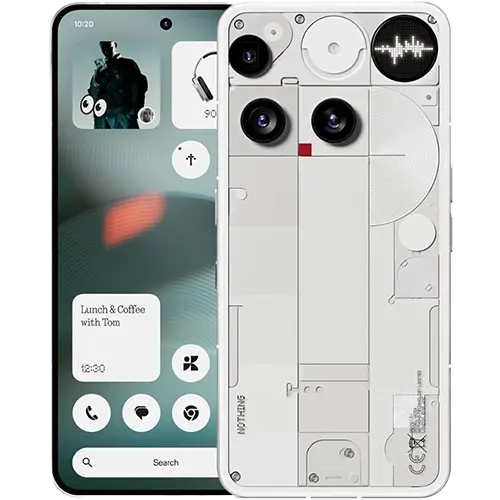
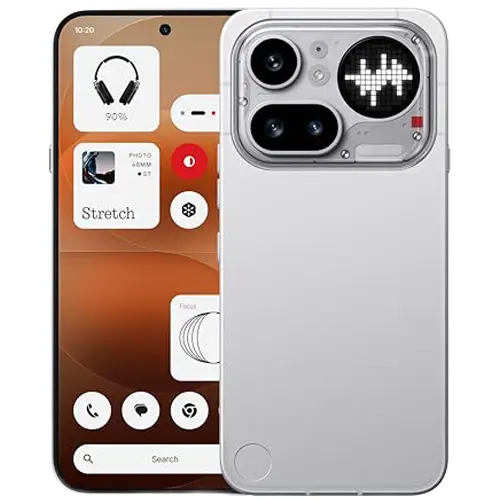
The Nothing Phone (3) is the company's flagship, priced at $799 and built around a top-tier chipset, a triple-camera system with a large main sensor, and wireless charging. It's aimed at buyers who want a full-featured phone without paying the $1,000+ prices that Samsung and Apple charge for their top models. The Nothing Phone (4a) Pro sits at $499, a midrange device that punches into flagship territory in specific areas: it gets a higher-refresh display, a longer telephoto reach, and a slightly larger battery, all while costing $300 less.
The Phone (3) leads in raw processing power, camera sharpness on most lenses, and speaker quality. Its Snapdragon 8 Gen 3 gives it a substantial edge in CPU and GPU tasks. The Phone (4a) Pro counters with a brighter, more color-accurate display, a higher refresh rate, better battery efficiency during web browsing, and faster wired charging in the first ten minutes.
Here’s how the two phones compared in our thorough testing.
Design
| Nothing Phone (3) | Nothing Phone (4a) Pro | |
|---|---|---|
| Specifications | ||
| Dimensions | 160.6 x 75.6 x 9 mm | 163.7 x 76.6 x 8 mm |
| Weight | 218g | 210g |
| IP Rating | IP68 | IP65 |
| Frame | Aluminum | Aluminum |
| Front | Gorilla Glass 7i | Gorilla Glass 7i |
| Back | Gorilla Glass Victus | Aluminum |
| Screen-to-body ratio | 89.0% | 89.8% |
The Phone (3) measures 160.6 x 75.6 x 9mm and weighs 218g. The Phone (4a) Pro is taller and wider at 163.7 x 76.6 x 8mm but lighter at 210g. Both use aluminum frames and Gorilla Glass 7i on the front. The backs differ: the Phone (3) uses Gorilla Glass Victus, while the Phone (4a) Pro has an aluminum back panel.
The Phone (3) carries an IP68 rating, meaning it's rated for submersion in fresh water up to 1.5 meters for 30 minutes. The Phone (4a) Pro has an IP65 rating, which protects against low-pressure water jets but not submersion. If you regularly use your phone around pools or in heavy rain, that's a meaningful gap.
Screen-to-body ratios are close: 89% on the Phone (3), 89.8% on the Phone (4a) Pro.
Bandicoot Lab doesn't formally test design or durability, so these observations come from published specs alone.
Display
| Nothing Phone (3) | Nothing Phone (4a) Pro | |
|---|---|---|
525/ 881 | 579/ 881 | |
The Phone (4a) Pro has the brighter display by every measure. Its max manual brightness hits 876 nits versus the Phone (3)'s 790 nits. For HDR content, the gap widens: the Phone (4a) Pro peaks at 1,755 nits, while the Phone (3) reaches 1,602 nits. Both displays hold their HDR brightness well across different window sizes. The Phone (4a) Pro scores a perfect 100% brightness stability across window sizes, and the Phone (3) is close behind at 98.7%. Sustained brightness over 30 minutes of HDR playback is strong on both too: 98.8% on the Phone (4a) Pro, 97.9% on the Phone (3). Neither phone dims meaningfully under prolonged HDR load.
Both displays handle HDR tone mapping similarly. Each clips at the 90% input level and renders content slightly below the reference PQ curve, meaning highlights are rendered faithfully rather than being artificially boosted. The Phone (4a) Pro pushes highlights marginally less than the Phone (3), but the difference is minor. Both produce accurate, unboosted HDR that doesn't crush or lift highlights aggressively.
Color accuracy is where the Phone (4a) Pro pulls clearly ahead. In its best-calibrated mode, colors stay very close to their targets with only minor deviations. Neutral tones look neutral, and the display doesn't push any particular color cast. The Phone (3) shows moderate color drift: some tones shift noticeably from reference, and the worst-case deviations are visible in side-by-side comparisons with a calibrated monitor. For sRGB content, the Phone (4a) Pro covers 97.2% of the gamut versus 95.6% on the Phone (3). Display P3 coverage is nearly identical at around 72% on both.
The Phone (3) runs at 1080 x 2412 on a 6.7-inch panel, yielding 460 pixels per inch. The Phone (4a) Pro has a 6.83-inch panel at 1260 x 2800, coming in at 440 PPI. Both are sharp enough that individual pixels aren't visible at normal viewing distances. The Phone (4a) Pro's refresh rate tops out at 144Hz compared to 120Hz on the Phone (3). Most won’t notice the difference, and it won’t even be supported in many apps. Touch latency averages 13.6ms on the Phone (3) and 15.9ms on the Phone (4a) Pro. That 2.3ms gap is small enough that most people won't feel a difference.
Performance
| Nothing Phone (3) | Nothing Phone (4a) Pro | |
|---|---|---|
553/ 1012 | 301/ 1012 | |
The Phone (3) runs a Qualcomm Snapdragon 8 Gen 3 with 16GB of RAM. The Phone (4a) Pro uses a Snapdragon 7 Gen 4 with 12GB. This is a generational and tier gap, and the benchmarks reflect it clearly.
In GeekBench 6, the Phone (3) scores 2,209 single-core and 6,992 multi-core. The Phone (4a) Pro manages 1,377 single-core and 4,313 multi-core. That's a 60% advantage in single-threaded work and over 60% in multi-threaded work. You'll feel this in app launch times, photo processing, and export tasks. Browser performance follows a similar pattern: the Phone (3) scores 20.6 in Speedometer compared to 14.2 for the Phone (4a) Pro. Complex web apps and heavy pages load and respond more quickly on the Phone (3).
GPU performance shows a large gap. The Phone (3) peaks at 4,459 in Wild Life Extreme, more than double the Phone (4a) Pro's 2,100. However, the Phone (4a) Pro holds 99.2% of its peak GPU performance across the stress test, barely throttling at all. The Phone (3) drops to 64.4% stability, meaning its sustained performance falls off significantly under prolonged load — though to be fair, its throttled performance is still better than the Phone (4a) Pro’s peak.
Camera
| Nothing Phone (3) (Overall) | Nothing Phone (4a) Pro (Overall) | |
|---|---|---|
| Specifications | ||
| Main | 50MP, f/1.7, 24mm, 1/1.3" | 50MP, f/1.9, 24mm, 1/1.56" |
| Ultrawide | 50MP, f/2.2, 15mm, 1/2.76" | 8MP, f/2.2, 15mm, 1/4.0" |
| Telephoto | 50MP, f/2.7, 72mm, 1/2.75" | 50MP, f/2.9, 80mm, 1/2.75" |
| Front | 50MP, f/2.2, 25mm, 1/2.76" | 32MP, f/2.2, 22mm, 1/3.42" |
The Phone (3) has the stronger camera system overall, scoring 571.8 to the Phone (4a) Pro's 544.5. Its main sensor is physically larger (1/1.3-inch versus 1/1.56-inch), and it produces sharper images across most lenses and lighting conditions. The Phone (4a) Pro responds with better ultrawide dynamic range, a longer telephoto reach (4x optical versus 3x), and a front camera with wider dynamic range.
At deep zoom levels, the two phones diverge. The Phone (3) maxes out at 60x digital zoom, and its images stay usable up to about 40x before detail drops off sharply. The Phone (4a) Pro pushes to 140x, but image quality degrades at extreme levels. At 30x in bright light, the Phone (3) resolves more detail. Beyond 60x, the Phone (4a) Pro is the only option, and results at 80x to 100x in good light are serviceable for identifying distant subjects but not much more. At 120x and beyond, images lose most useful detail.
Main
| Nothing Phone (3) (Main) | Nothing Phone (4a) Pro (Main) | |
|---|---|---|
572/ 722 | 576/ 722 | |
The Phone (3)'s main camera is sharper across all lighting conditions. In bright light, it produces high detail with clean edges. In mid-light, performance barely drops. In low light, it loses more resolution, but that's normal for any camera. The Phone (4a) Pro's main camera is close in bright and mid-light conditions, just a step behind, but retains more detail than the Phone (3) in low light. That's a genuine strength for a $499 phone.
Both phones produce near-neutral saturation in bright light, keeping colors close to what the eye sees. The Phone (4a) Pro's processing pushes a slight warm cast under mid-light conditions (around 4000K lighting), with both pink and yellow tints becoming visible. This looks like a white balance correction issue: as the ambient color temperature drops, the processing overcorrects, adding warmth. The Phone (3)'s main camera stays more neutral under the same conditions, with minimal color cast shift across lighting. Hue accuracy degrades on both phones as light dims, but the Phone (4a) Pro shows more drift in mid-light specifically.
Skin tones tell a similar story. In bright light, both phones push skin tones away from reference by a noticeable amount, with the Phone (4a) Pro slightly closer to accurate. In mid and low light, the Phone (3) delivers more accurate skin tones.
Dynamic range on the main camera slightly favors the Phone (4a) Pro. High-contrast scenes retain a bit more separation between shadows and highlights, with less compression.
Ultrawide
| Nothing Phone (3) (Ultrawide) | Nothing Phone (4a) Pro (Ultrawide) | |
|---|---|---|
549/ 722 | 555/ 722 | |
The Phone (3) has a 50-megapixel ultrawide with an f/2.2 aperture and a 1/2.76-inch sensor. The Phone (4a) Pro drops to an 8-megapixel ultrawide with an f/2.2 aperture and a smaller 1/4.0-inch sensor. Despite that spec gap, the Phone (4a) Pro's ultrawide delivers solid sharpness in bright and mid conditions. It doesn't match the Phone (3)'s ultrawide resolution, but it's closer than the megapixel count would suggest.
Dynamic range is where the Phone (4a) Pro's ultrawide wins. It pulls more detail from shadows and holds highlights better in high-contrast scenes. The Phone (3)'s ultrawide clips highlights more aggressively.
Color on both ultrawides is a weak spot. Both push skin tones significantly off reference in bright light. The Phone (4a) Pro's ultrawide shows a growing warm-pink cast as light drops, which is a white balance overcorrection: the bias toward pink and yellow increases in mid and low light. The Phone (3)'s ultrawide has a similar tendency but with a more consistent pink lean across all lighting, suggesting more of a sensor-level characteristic than a white balance failure. In dark conditions, the Phone (4a) Pro's ultrawide handles skin tones better than the Phone (3)'s.
Telephoto
| Nothing Phone (3) (Telephoto) | Nothing Phone (4a) Pro (Telephoto) | |
|---|---|---|
584/ 722 | 495/ 722 | |
The Phone (3) uses a 3x telephoto (72mm, 50 megapixels, f/2.7, 1/2.75-inch sensor). The Phone (4a) Pro has a 4x telephoto (80mm, 50 megapixels, f/2.9, same 1/2.75-inch sensor size). The Phone (3)'s 3x telephoto is notably sharper at its native focal length in bright and mid conditions, resolving visibly more detail. The Phone (4a) Pro's 4x telephoto trades some of that sharpness for extra reach, and detail drops off faster as light dims.
Both telephoto lenses push saturation slightly above neutral, giving images a vivid, punchy character. The Phone (3)'s telephoto delivers better skin tone accuracy across all lighting conditions. The Phone (4a) Pro's telephoto develops a strong warm bias as light drops: under lower-temperature ambient lighting, the processing pulls heavily toward yellow-pink. This warm-direction bias grows dramatically in warmer ambient light, pointing to a white balance issue. Hue accuracy on the Phone (4a) Pro's telephoto degrades substantially in mid and low light, more than on any other lens in either phone.
Dynamic range favors the Phone (3)'s telephoto. It holds more highlight and shadow separation in contrasty scenes. The Phone (4a) Pro clips highlights earlier and compresses tones more aggressively.
Video stabilization performance is similar on both telephoto lenses: handheld footage shows comparable amounts of shake correction, with neither phone standing out as significantly steadier.
Front
| Nothing Phone (3) (Front) | Nothing Phone (4a) Pro (Front) | |
|---|---|---|
673/ 722 | 621/ 722 | |
The Phone (3) has a 50-megapixel front camera (f/2.2, 25mm, 1/2.76-inch sensor). The Phone (4a) Pro uses a 32-megapixel sensor (f/2.2, 22mm, 1/3.42-inch sensor). The Phone (3) is sharper across all lighting conditions, with a particularly clear lead in bright and mid light. Its larger sensor gives it an inherent resolution advantage.
Dynamic range is better on the Phone (4a) Pro's front camera. It pulls more detail from both highlights and shadows, and it does so with less compression, meaning high-contrast selfies look more natural and less processed.
Color character differs. The Phone (3)'s front camera pushes a cool, slightly blue cast in bright light, which shifts toward neutral in mid-light conditions. Skin tones in bright light drift noticeably. The Phone (4a) Pro's front camera leans slightly green-cool in bright light but keeps saturation close to neutral across all conditions. Skin tone accuracy is roughly comparable between the two phones, with neither delivering truly reference-grade results. Hue accuracy in bright light favors the Phone (4a) Pro.
The Phone (3) produces meaningfully steadier front-facing video, with noticeably less residual shake during handheld recording. The Phone (4a) Pro's front camera stabilization is weaker.
Battery
| Nothing Phone (3) | Nothing Phone (4a) Pro | |
|---|---|---|
593/ 836 | 572/ 836 | |
Both phones have nearly identical battery capacities: 5,000mAh in the Phone (3) and 5,080mAh in the Phone (4a) Pro.
In video playback, the Phone (3) lasts 27.5 hours and the Phone (4a) Pro lasts 26.3 hours. Both are strong results. Either phone will get through a full day of heavy use, and the difference between them is small enough that it won't matter in practice. For context, 26+ hours of continuous video playback translates to comfortably two full days of typical mixed use before needing a charge.
Web browsing drain tells a slightly different story. Over a 5-hour test, the Phone (3) drains 30% while the Phone (4a) Pro uses 28%. That two-percentage-point gap is modest but consistent: the Snapdragon 7 Gen 4 appears to sip power more efficiently during lighter tasks. Gaming drain is close: 28% on the Phone (3) versus 27% on the Phone (4a) Pro during the stress test. Standby drain is identical at 1% over eight hours overnight on both phones. Neither has a background drain problem.
Charging
| Nothing Phone (3) | Nothing Phone (4a) Pro | |
|---|---|---|
268/ 837 | 246/ 837 | |
The Phone (3) supports 65W wired and 15W wireless charging. The Phone (4a) Pro supports 50W wired and no wireless charging.
The Phone (4a) Pro charges faster in the first ten minutes, hitting 27% versus 22% for the Phone (3), despite its lower wattage rating. By the 30-minute mark, both phones reach 63%. The Phone (3)'s higher peak wattage doesn't translate to a faster fill at the half-hour point. If you're grabbing a quick top-up before heading out, the Phone (4a) Pro gives you more charge in less time during that critical first stretch.
The Phone (3)'s wireless charging at 15W is slow. After 10 minutes on a wireless charger, you'll have gained 4%, and after 30 minutes, just 10%. It's really only practical as an overnight option. The Phone (4a) Pro has no wireless charging.
Speaker
| Nothing Phone (3) | Nothing Phone (4a) Pro | |
|---|---|---|
652/ 897 | 612/ 897 | |
The Phone (3) is louder, hitting 73.1 dBA maximum volume compared to the Phone (4a) Pro's 71.8 dBA. The Phone (3) also produces significantly cleaner audio, with an average total harmonic distortion of 3.46% versus 8.39% on the Phone (4a) Pro. At higher volumes, you'll hear more breakup and harshness from the Phone (4a) Pro.
The Phone (3)'s speaker has a fuller bass response and produces a more balanced sound overall. The Phone (4a) Pro's high-end clarity gives vocals and treble more presence, but the bass is thinner. If you watch a lot of video or play games without headphones, the Phone (3) delivers a noticeably richer audio experience.
Microphone
| Nothing Phone (3) | Nothing Phone (4a) Pro | |
|---|---|---|
437/ 1220 | 455/ 1220 |
Both phones produce below-average microphone quality. The Phone (4a) Pro is marginally more consistent across frequencies, but neither phone stands out as a strong performer for voice recording or calls in challenging environments. If voice recording quality is a priority, you'd want to look elsewhere or use an external microphone.
Other
| Nothing Phone (3) | Nothing Phone (4a) Pro | |
|---|---|---|
| Biometrics | 504/ 1181 | 367/ 1181 |
| Data Transfer | 102/ 943 | 92/ 943 |
| Specifications | ||
| Biometric type | Fingerprint | Fingerprint |
| Ports | USB-C 2.0 | USB-C 2.0 |
| Storage | 256GB, 512GB | 128GB, 256GB |
Both phones use optical fingerprint sensors. The Phone (3) unlocks in an average of 208ms, while the Phone (4a) Pro takes 286ms. That's a perceptible difference. The Phone (3) feels snappier every time you pick it up. Neither phone has hardware-based face unlock.
Data transfer speeds are similar and slow on both devices. The Phone (3) reads and writes at around 38 MB/s, and the Phone (4a) Pro at about 37 MB/s. Both use USB-C 2.0, which limits transfer speeds. Moving large files to or from either phone will be a patience exercise.
The Phone (3) is available in 256GB and 512GB storage with 12GB or 16GB of RAM. The Phone (4a) Pro comes in 128GB and 256GB configurations with 8GB or 12GB of RAM. If you need more local storage, the Phone (3) offers more headroom.
Conclusion
The Phone (3) is the stronger device in processing power, camera sharpness, speaker quality, fingerprint speed, and overall camera performance. Its Snapdragon 8 Gen 3 delivers roughly 60% more CPU throughput and over double the peak GPU output. Its main, telephoto, and front cameras are all sharper, and its telephoto produces better color accuracy across lighting conditions. The speaker sounds fuller and cleaner at any volume.
The Phone (4a) Pro wins on display quality, GPU thermal stability, early charging speed, and select camera metrics. Its screen is brighter, better calibrated, and refreshes at 144Hz. Its GPU barely throttles during extended gaming sessions, which partially closes the raw performance gap during prolonged play. Its ultrawide captures better dynamic range, and its front camera pulls more detail from high-contrast scenes. It also costs $300 less.
Overall, the Nothing Phone (3) is still a better phone, even if it is starting to age.
Related
Nothing
Phone (3)
Nothing
Phone (4a) Pro
Nothing
Phone (4a)
Nothing
Phone (4b)
Best Phones Under $1,000
Best Phones Under $800
Best Phones For Any Budget
Best Android Phones
Best Phones
Nothing Phone (4a) Pro vs Nothing Phone (3a) Pro
Best Phones for Selfies
Best Phones Under $500