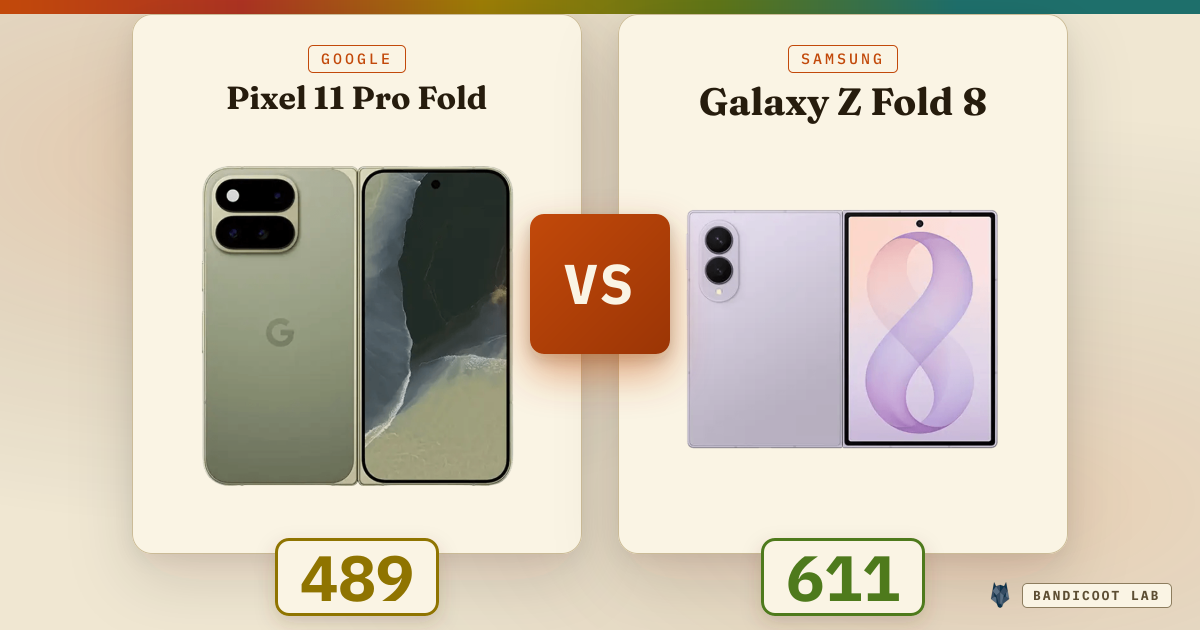
Google Pixel 11 Pro Fold vs Samsung Galaxy Z Fold 8 Ultra
Samsung
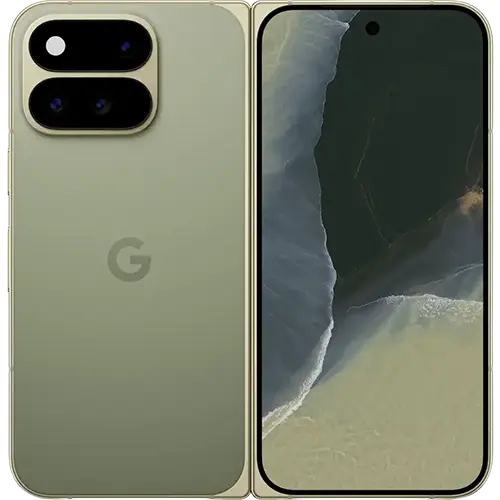
Pixel 11 Pro Fold
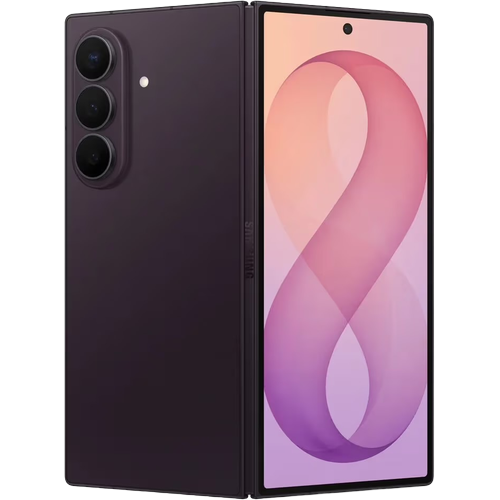
Galaxy Z Fold 8 Ultra
Ranked #45 of 61
Ranked #18 of 61
Overall
Overall

Google's flagship foldable and Samsung's have been inching toward the same footprint for a while. The Pixel 11 Pro Fold at $1,899 and the Galaxy Z Fold 8 Ultra at $2,099.99 both open to an 8-inch inner screen and fold down to a 6.5-inch cover display. These are the two flagship book-style foldables running Android, and the $200 price gap is narrow enough that the decision hinges on what each phone does best rather than what you can afford.
The Galaxy Z Fold 8 Ultra pulls ahead in most measurable categories: faster processor, longer battery life, sharper rear cameras with better dynamic range. The Pixel 11 Pro Fold wins fewer categories, and wins them convincingly. Its display is brighter and more color-accurate on both panels, its microphone quality is exceptional, and its wireless charging is meaningfully faster. The Pixel's 5x telephoto also delivers the best color accuracy of any lens across both phones, and it resolves more detail at extreme zoom.
Design
| Google Pixel 11 Pro Fold | Samsung Galaxy Z Fold 8 Ultra | |
|---|---|---|
| Specifications | ||
| Dimensions (folded) | 155.2 x 76 x 10.1 mm | 158.4 x 72.8 x 8.9 mm |
| Dimensions (unfolded) | 155.2 x 150.4 x 5 mm | 158.4 x 143.2 x 4.1 mm |
| Weight | 239g | 215g |
| IP Rating | IP68 | IP48 |
| Frame | Aluminum | Aluminum |
| Front | Ultra Thin Glass (inner) / Glass ceramic (outer) | Gorilla Glass Victus Ceramic 3 |
| Back | Composite matte | Gorilla Glass Victus 2 |
| Screen-to-body ratio (inner) | 88.4% | 90.5% |
| Screen-to-body ratio (outer) | 87.9% | 85.6% |
Both phones use aluminum frames. The Samsung pairs Gorilla Glass Victus Ceramic 3 on the outer display with Gorilla Glass Victus 2 on the back. The Pixel uses glass ceramic on the outer display and a composite matte material on the back, with Ultra Thin Glass covering the inner foldable panel. Folded, the Samsung is narrower (72.8mm vs 76mm) and thinner (8.9mm vs 10.1mm), though slightly taller (158.4mm vs 155.2mm). Unfolded, the Samsung is again thinner at 4.1mm versus 5mm. It is also 24g lighter at 215g compared to the Pixel's 239g. The thinner profile and lower weight make the Samsung the more pocketable device on paper, particularly when closed.
The Pixel carries an IP68 rating: fully dust-tight and rated for sustained water submersion. The Samsung's IP48 rating shares the same water resistance but offers less dust protection. It blocks particles larger than 1mm rather than sealing completely against fine dust. For a device with a folding hinge, that difference in dust ingress protection is worth paying attention to. On the inner display, the Samsung has a 90.5% screen-to-body ratio with a 10:9 aspect versus the Pixel's 88.4% at 9.33:9, meaning thinner bezels on the Samsung's larger panel. The outer displays flip that: the Pixel's 87.9% screen-to-body ratio beats Samsung's 85.6%. Samsung's outer panel uses a taller 21:9 aspect compared to the Pixel's 19.5:9.
Bandicoot Lab doesn't formally test design or durability, so this section covers what's on paper.
Display
Inner
| Google Pixel 11 Pro Fold (Inner) | Samsung Galaxy Z Fold 8 Ultra (Inner) | |
|---|---|---|
584/ 881 | 552/ 881 | |
Both inner panels are 8-inch OLEDs running 1–120Hz adaptive refresh. The Samsung has the higher resolution at 2256 x 2504 (422 pixels per inch) compared to the Pixel's 2076 x 2152 (372 PPI). That 50 PPI gap shows up in fine text and detailed UI elements.
Brightness is where the Pixel pulls firmly ahead. The Pixel reaches 1,427 nits in manual brightness mode and peaks at 3,592 nits for HDR content. The Samsung manages 683 nits manually and 2,832 nits in HDR. The Pixel is more than twice as bright in manual mode, a meaningful difference when you're outdoors and want direct control of the screen. For HDR brightness stability across different window sizes, the Pixel holds 57.6% compared to Samsung's 46.6%. Neither is exceptional, but the Pixel maintains more consistent brightness as on-screen content changes size. Both sustain brightness well over time: 97.7% for the Pixel and 98.6% for the Samsung across a 30-minute test. The Samsung dims lower at minimum brightness (0.8 nits vs 1.77 nits), which is better for reading in a dark room.
Color accuracy favors the Pixel's inner panel. Colors stay close to reference across the gamut, with minimal drift in neutral tones and skin tones. The Samsung's inner display shows more color variation. It isn't dramatically off, but the shift is noticeable if you're doing color-sensitive work or comparing panels side by side. Both cover sRGB nearly completely (99.9% for the Pixel, 99.6% for the Samsung), with P3 gamut coverage at 79.1% and 76.1% respectively.
The Pixel renders HDR content faithfully, with only light highlight boosting and clipping that doesn't start until near the very top of the input range. The Samsung boosts highlights well above their mastered levels and begins clipping much earlier. HDR content looks punchier on the Samsung but loses highlight detail sooner. Average touch latency measures 15.4ms for the Pixel and 19.5ms for the Samsung. The 4ms difference is unlikely to be perceptible in everyday use, though the Pixel does score higher in responsiveness.
Outer
| Google Pixel 11 Pro Fold (Outer) | Samsung Galaxy Z Fold 8 Ultra (Outer) | |
|---|---|---|
693/ 881 | 576/ 881 | |
The outer displays are both 6.5 inches with 1–120Hz refresh. The Samsung runs at 1080 x 2520 (422 PPI) in a 21:9 aspect. The Pixel runs at 1080 x 2342 (399 PPI) in a 19.5:9 aspect. Samsung's cover screen is taller and slightly sharper; Pixel's is wider relative to its height.
Brightness again favors the Pixel on the outer panel. Per-display scores show the Pixel's outer screen outperforming the Samsung's by a meaningful margin, though the gap is smaller than on the inner displays. Both phones' outer screens score slightly higher for brightness than their inner panels, which is typical since smaller displays can push more luminance per area.
Color accuracy on the Pixel's outer display is strong. It is the most color-accurate panel across either phone, tracking reference closely with clean neutral tones. The Samsung's outer display shows similar color characteristics to its own inner panel: more drift from reference, visible in direct comparison but not troublesome in isolation. The same tone mapping behavior applies to both phones' outer panels: the Pixel stays closer to the HDR standard while the Samsung lifts highlights and clips earlier.
Performance
| Google Pixel 11 Pro Fold | Samsung Galaxy Z Fold 8 Ultra | |
|---|---|---|
478/ 1012 | 853/ 1012 | |
The Pixel 11 Pro Fold runs Google's Tensor G6 with 16GB of RAM. The Galaxy Z Fold 8 Ultra uses Qualcomm's Snapdragon 8 Elite Gen 5 with a base of 12GB (a 16GB option exists). The performance gap between these two chips is large.
In CPU benchmarks, the Samsung scores 3,666 single-core and 10,878 multi-core in GeekBench 6. The Pixel scores 2,706 and 6,648. That's a 35% single-core gap and a 64% multi-core gap. You'll feel it in demanding multitasking and heavy app launches. For GPU workloads, the Samsung's peak Wild Life Extreme score of 5,993 nearly doubles the Pixel's 3,478. The Pixel throttles less, maintaining 72.3% stability versus 56.3% for the Samsung, but the Samsung's sustained output still sits well above the Pixel's peak. Browser performance tells a similar story: the Samsung's Speedometer score of 45.1 versus 24.8 means noticeably snappier web rendering on complex pages.
In daily use, both phones handle standard apps and navigation without issue. The performance gap surfaces in sustained workloads, heavy gaming, and split-screen multitasking.
Camera
| Google Pixel 11 Pro Fold | Samsung Galaxy Z Fold 8 Ultra | |
|---|---|---|
426/ 587 | 518/ 587 | |
The Galaxy Z Fold 8 Ultra carries the stronger rear camera system. Its 200-megapixel main sensor (1/1.3-inch, f/1.7) and 50-megapixel ultrawide (1/2.5-inch, f/1.9) are substantially larger sensors than the Pixel's 48-megapixel main (1/1.56-inch, f/1.7) and 10.5-megapixel ultrawide (1/3.4-inch, f/2.2). The Samsung resolves more detail from the main camera across all lighting conditions, and the gap is most pronounced in bright and medium light. In dim conditions, the two main cameras are closer in resolved detail, though Samsung still holds an edge. The Samsung's ultrawide is also sharper, particularly as light drops.
The telephoto picture is more nuanced. Samsung sits at 3x (67mm, f/2.4) with a 1/3.94-inch sensor. The Pixel's is a 5x (112mm, f/3.1) with a 1/3.2-inch sensor. At their native focal lengths, Samsung resolves slightly more detail in good light, and both drop off similarly in dim conditions. The Pixel's longer native reach means it doesn't need to crop as far for distant subjects. At extreme digital zoom approaching 30x, the Pixel holds noticeably more detail. If you regularly shoot at 10x or beyond, the Pixel's deep zoom advantage is real.
Both phones produce vivid color from their rear cameras, but the character differs. The Pixel's main camera pushes saturation above reference across all lighting conditions, and it leans more saturated as light gets dimmer. Images look punchy and colorful. The Samsung's main camera is more restrained. Saturation is close to neutral in good light and drops below reference in dim conditions, producing muted images when light is scarce. The Pixel consistently delivers vivid output; the Samsung is more accurate in bright light but less pleasing in the dark.
The Samsung's main camera renders skin tones well in bright and medium light. Faces look natural. In dim light, skin tones drift significantly. The color biases don't swing dramatically, which points to a sensor-level loss of color fidelity rather than a white balance problem. The Pixel's skin tones carry moderate error across all conditions. Faces are a bit off regardless of lighting, but the error doesn't spike the way Samsung's does in the dark. The Pixel's telephoto is the standout for color accuracy: hues stay consistent across lighting conditions, and skin tones actually improve as light decreases. Samsung's telephoto develops a warm-magenta cast with a strong cool counterbias under medium indoor light. The processing overcorrects for the warmer ambient color temperature. Skin tones collapse further in dim conditions.
Dynamic range on the rear cameras clearly favors the Samsung. The main and ultrawide both retain more shadow detail and handle highlight transitions more cleanly in high-contrast scenes. The Pixel's rear cameras clip highlights and show more tonal irregularities, producing flatter-looking results when the scene has deep contrast.
Main
| Google Pixel 11 Pro Fold (Main) | Samsung Galaxy Z Fold 8 Ultra (Main) | |
|---|---|---|
452/ 722 | 679/ 722 | |
The Samsung's 200-megapixel main sensor resolves visibly more detail than the Pixel's 48-megapixel sensor in bright and medium light. Both shoot at 24mm. The Samsung's advantage is clear at 1x and holds through its digital crop range up to 3x, where it hands off to the telephoto. The Pixel's main camera covers a wider crop range, 1x through 5x, from fewer megapixels. At 2x it's still reasonable, but by 3x–4x the Pixel is cropping harder and detail softens noticeably. The Samsung's higher-resolution sensor gives it more headroom for digital zoom from the main lens.
Color from the Pixel's main camera is vivid and warm, with saturation climbing further in dimmer lighting. The Samsung stays closer to reference in good light but undersaturates in the dark. In bright conditions, Samsung produces notably more accurate skin tones; in dim conditions, the Pixel is more reliable despite its saturation push. Both cameras clip highlights, but the Samsung preserves more usable range in high-contrast scenes and handles tonal gradients more smoothly.
Ultrawide
| Google Pixel 11 Pro Fold (Ultrawide) | Samsung Galaxy Z Fold 8 Ultra (Ultrawide) | |
|---|---|---|
407/ 722 | 600/ 722 | |
The Samsung's ultrawide uses a 50-megapixel, 1/2.5-inch sensor at 14mm with an f/1.9 aperture. The Pixel's is 10.5 megapixels on a 1/3.4-inch sensor at 13mm, f/2.2. The Samsung resolves more detail, especially in medium and dim light where the larger sensor and faster aperture help. The gap is moderate in bright light and widens as conditions get harder.
Relative to their own main cameras, the two ultrawides tell different stories. The Pixel's ultrawide roughly matches its main lens in sharpness across lighting conditions, which says more about the main camera's limitations than the ultrawide's strengths. The Samsung's ultrawide is a clear step down from its 200-megapixel main but still resolves well on its own terms.
The Pixel's ultrawide has a notable cool cast in bright light that warms as lighting shifts to indoor temperatures. Skin tones drift considerably in daylight. The Samsung's ultrawide leans slightly warm with a subtle cool undertone; skin tones are more controlled but still not reference-accurate. Dynamic range again favors Samsung, with cleaner tonal transitions and more usable shadow detail.
Telephoto
| Google Pixel 11 Pro Fold (Telephoto) | Samsung Galaxy Z Fold 8 Ultra (Telephoto) | |
|---|---|---|
524/ 722 | 561/ 722 | |
The Pixel's 5x telephoto (112mm, f/3.1, 10.8 megapixels) and Samsung's 3x (67mm, f/2.4, 10 megapixels) serve different purposes. Samsung's shorter focal length is more versatile for everyday portrait and mid-distance shots. The Pixel's longer reach is better suited to distant subjects without leaning on digital zoom.
At their respective native lengths, Samsung resolves slightly more detail in bright and medium light. In dim conditions, both drop off significantly, limited by small sensors. As zoom increases beyond each lens's native length, the Pixel holds detail better at the long end. It's already at 5x natively, so reaching 15x or 20x requires less digital cropping than the Samsung does from 3x.
Color accuracy is where the Pixel's telephoto excels. Hues stay consistent from bright to dim lighting, and skin tones are well-rendered across conditions. The Samsung's telephoto struggles under warm indoor light: the processing overcorrects white balance and introduces a noticeable warm-magenta cast paired with a cool shift. Colors go noticeably askew at medium light levels. In dim conditions, Samsung's skin tones degrade sharply. The Pixel's telephoto produces the most natural-looking color of any lens across both phones. Dynamic range on both telephotos is similar, with the Samsung handling tonal transitions somewhat more cleanly. Both clip highlights.
Front Inner
| Google Pixel 11 Pro Fold (Front Inner) | Samsung Galaxy Z Fold 8 Ultra (Front Inner) | |
|---|---|---|
404/ 722 | 349/ 722 | |
Both phones have 10-megapixel inner front cameras. The Pixel shoots at 23mm, the Samsung at a wider 18mm. The Pixel is significantly sharper across all lighting conditions. The gap is clear in bright and medium light and persists in dim.
The Pixel's inner selfie camera saturates slightly, with a mild warm push in dim light. Skin tones carry moderate error in bright and medium conditions but actually improve in dim. The Samsung's inner front camera stays closer to neutral saturation. Hue accuracy degrades considerably in dim light on both, but the Samsung's color shifts are more severe: an increasing warm-magenta push paired with a cool counterbias indicates white balance overcorrection under warm ambient lighting. Skin tones on the Samsung are more accurate in medium light but less consistent across conditions. The Pixel captures somewhat more dynamic range, though both cameras clip highlights. Neither inner front camera offers meaningful stabilization.
Front Outer
| Google Pixel 11 Pro Fold (Front Outer) | Samsung Galaxy Z Fold 8 Ultra (Front Outer) | |
|---|---|---|
444/ 722 | 386/ 722 | |
The outer front cameras are also 10-megapixel units. The Pixel shoots at 23mm, Samsung at 24mm. The Pixel is again sharper, with an advantage that's visible across lighting conditions. Samsung's outer selfie camera is particularly soft in dim light.
Color behavior mirrors the inner front cameras closely. Both develop hue issues in dim light; Samsung's are more pronounced, with the same warm-magenta and cool shift pattern pointing to white balance overcorrection. Skin tones on both outer cameras are inconsistent across lighting. The Pixel retains slightly better dynamic range. The Pixel's outer front camera also provides noticeably better video stabilization, keeping footage more controlled handheld.
Battery
| Google Pixel 11 Pro Fold | Samsung Galaxy Z Fold 8 Ultra | |
|---|---|---|
434/ 836 | 616/ 836 | |
The Galaxy Z Fold 8 Ultra has a 5,000mAh battery; the Pixel 11 Pro Fold carries 4,806mAh. The Samsung wins every battery test, usually by a comfortable margin.
For continuous video playback on the inner display, the Samsung lasts 27.99 hours versus the Pixel's 21.86 hours. That's about six extra hours. On the outer display, it's 31.14 hours for the Samsung and 27.17 for the Pixel. The Samsung's inner-display endurance translates to roughly two days of typical mixed use before you need a charger. The Pixel is closer to a day and a half. Over a five-hour web browsing session, the Samsung drains 23% compared to the Pixel's 27%. During sustained gaming, measured across 20 loops of the 3DMark Wild Life Extreme stress test, the Samsung drops 19% while the Pixel loses 25%. That's a wide gap, especially considering the Samsung's GPU is doing considerably more work per frame. Overnight standby drain over eight hours is 2% for the Samsung and 4% for the Pixel.
Charging
| Google Pixel 11 Pro Fold | Samsung Galaxy Z Fold 8 Ultra | |
|---|---|---|
336/ 837 | 333/ 837 | |
The Samsung charges faster over a wire: 45W versus the Pixel's 30W. At 10 minutes, the Samsung reaches 31% compared to the Pixel's 19%. At 30 minutes, it's 74% versus 56%. If you need a quick top-up before heading out, the Samsung gives you more in less time.
Wireless charging reverses the story. The Pixel supports 25W magnetic wireless charging compatible with Qi2-standard chargers, and it delivers: 16% in 10 minutes and 41% in 30 minutes. The Samsung's 20W wireless charging manages only 8% in 10 minutes and 20% in 30 minutes. That's roughly half the Pixel's pace. If wireless charging is your primary method, the Pixel's advantage here is substantial.
Speaker
| Google Pixel 11 Pro Fold | Samsung Galaxy Z Fold 8 Ultra | |
|---|---|---|
678/ 897 | 698/ 897 | |
The Samsung is louder at 77.4 dBA compared to the Pixel's 74.8 dBA. Distortion is similar and low on both: 4.68% THD for the Samsung, 5.14% for the Pixel.
The character of the two speakers is distinct. The Samsung has fuller, warmer sound with deep bass that gives music and movies real low-end presence. The Pixel's bass is thin, dropping off well above where most bass content sits. The Pixel compensates with stronger high-end clarity: vocals and treble detail are more forward and defined. Neither speaker is exceptional for phones at this price. The Samsung is the more balanced of the two. If you mainly watch spoken-word content, the Pixel's clarity advantage is useful. For music or anything with a bass line, the Samsung is more complete.
Microphone
| Google Pixel 11 Pro Fold | Samsung Galaxy Z Fold 8 Ultra | |
|---|---|---|
1220/ 1220 | 671/ 1220 |
The Pixel 11 Pro Fold has an exceptionally flat, even microphone response. Audio captured during video, calls, and voice recordings sounds natural with minimal frequency coloration. The Samsung's microphone is above average but noticeably less even. Recorded audio carries more coloration, with some frequencies emphasized over others. For anyone who records video regularly or relies on call quality, the Pixel's microphone is a genuine differentiator.
Other
| Google Pixel 11 Pro Fold | Samsung Galaxy Z Fold 8 Ultra | |
|---|---|---|
| Biometrics | 270/ 1181 | 681/ 1181 |
| Data Transfer | 308/ 943 | 737/ 943 |
| Specifications | ||
| Biometric type | Fingerprint | Fingerprint |
| Ports | USB-C 3.2 | USB-C 3.2 |
| Storage | 256GB, 512GB, 1TB | 256GB, 512GB, 1TB |
Both phones use capacitive fingerprint sensors, but the speed difference is large. The Samsung unlocks in an average of 154ms; the Pixel takes 389ms. You'll feel the Samsung's sensor respond the moment you touch it. The Pixel's is a perceptible beat slower. Neither phone has hardware-based face unlock.
Data transfer speeds favor the Samsung: read speeds reach 326 MB/s and writes hit 287 MB/s, compared to the Pixel's 126 MB/s read and 140 MB/s write. Both use USB-C 3.2 ports. For large file transfers, the Samsung is roughly 2.5 times faster. Both phones are available in 256GB, 512GB, and 1TB storage configurations. Samsung offers 12GB or 16GB RAM; the Pixel comes standard at 16GB.
Conclusion
The Galaxy Z Fold 8 Ultra is the more capable device across a wider range of categories. Its processing power, battery life, rear camera system, fingerprint speed, and data transfer speeds all outpace the Pixel 11 Pro Fold. The camera advantage is particularly broad. Samsung's main and ultrawide sensors resolve more detail, handle dynamic range better, and produce cleaner results in high-contrast scenes. Battery life is comfortably longer across every usage pattern.
The Pixel 11 Pro Fold's strengths are concentrated but hard to ignore. Its display is brighter and more color-accurate on both panels, which matters every time you look at the screen. Its microphone quality is exceptional. Wireless charging is fast enough to be a genuine daily convenience. The 5x telephoto delivers the best color fidelity of any lens across both phones, and deep zoom holds together better than Samsung's. At $200 less, the Pixel makes a real case for itself if these areas align with how you actually use your phone.
For most buyers, the Samsung's broader strengths will carry the decision. Longer battery life, stronger performance, and sharper everyday camera results touch nearly everything you do with a phone. The Pixel is the better pick for someone who prioritizes display quality, values excellent audio capture, or relies heavily on wireless charging. A content creator who records a lot of video and reads on-screen all day, for instance, would find the Pixel's specific advantages more relevant than the Samsung's across-the-board lead.
FAQ
Does the Pixel 11 Pro Fold or Galaxy Z Fold 8 Ultra have better battery life?
The Galaxy Z Fold 8 Ultra lasts longer in every battery test. Inner-display video playback runs 27.99 hours versus 21.86 hours on the Pixel 11 Pro Fold. A five-hour web session drains 23% on the Samsung and 27% on the Pixel, and overnight standby costs 2% versus 4%. The Samsung's 5,000mAh battery is also slightly larger than the Pixel's 4,806mAh.
Which is better for photos, the Pixel 11 Pro Fold or the Galaxy Z Fold 8 Ultra?
The Galaxy Z Fold 8 Ultra has the stronger main and ultrawide cameras, with more resolved detail and better handling of high-contrast scenes. The Pixel 11 Pro Fold's 5x telephoto has more consistent color and holds more detail at extreme zoom. The Pixel also has sharper selfie cameras on both the inner and outer screens. If you mostly shoot at 1x and wide angle, the Samsung is the safer pick. If you zoom far or care about telephoto color, the Pixel has the edge.
Does the Pixel 11 Pro Fold or Galaxy Z Fold 8 Ultra charge faster?
It depends on how you charge. Over a cable, the Samsung's 45W charging reaches 31% in 10 minutes and 74% in 30 minutes, versus 19% and 56% for the Pixel's 30W. Wirelessly the Pixel is about twice as fast, reaching 16% in 10 minutes and 41% in 30 minutes. The Samsung's 20W wireless charging reaches 8% and 20% in the same times.
Is the Pixel 11 Pro Fold's screen better than the Galaxy Z Fold 8 Ultra's?
For most uses, yes. The Pixel's inner display reaches 1,427 nits in manual brightness versus 683 nits on the Samsung, and its colors sit closer to reference on both the inner and outer panels. The Samsung has a sharper inner screen at 422 PPI versus 372 PPI, dims lower for dark-room reading (0.8 nits versus 1.77 nits), and makes HDR look punchier, though it clips highlights sooner.
Is the Galaxy Z Fold 8 Ultra better than the Pixel 11 Pro Fold for gaming?
Yes. The Samsung's Snapdragon 8 Elite Gen 5 produces far higher graphics and CPU results than the Pixel's Tensor G6. The Pixel throttles less under sustained load, holding 72.3% stability versus 56.3%, but the Samsung's sustained output still sits well above the Pixel's peak. The Samsung also used less battery in the gaming stress test, dropping 19% against the Pixel's 25%.
Is the Pixel 11 Pro Fold worth choosing over the Galaxy Z Fold 8 Ultra to save $200?
For most buyers the Galaxy Z Fold 8 Ultra's longer battery life, faster performance, and stronger rear cameras justify the extra $200. The Pixel 11 Pro Fold at $1,899 suits people who put display quality, microphone quality, or wireless charging first. It also has IP68 dust protection, while the Samsung's IP48 rating offers less dust resistance. Someone who records a lot of video and reads on screen all day would get the most from the Pixel.
Related
Pixel 11 Pro Fold
Samsung
Galaxy Z Fold 8 Ultra

Samsung
Galaxy S26 Ultra
Samsung
Galaxy S26+
Samsung
Galaxy Z Fold 8
Samsung
Galaxy S26
Pixel 11 Pro XL
Samsung
Galaxy Z Flip 8
Pixel 11 Pro
Pixel 11
Pixel 10a
Google Pixel 11 Pro Fold vs Samsung Galaxy Z Fold 8