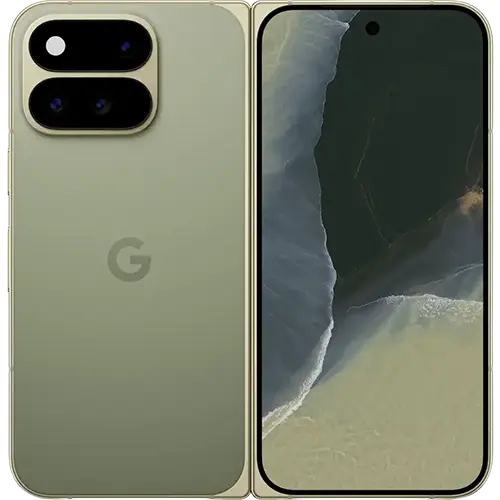
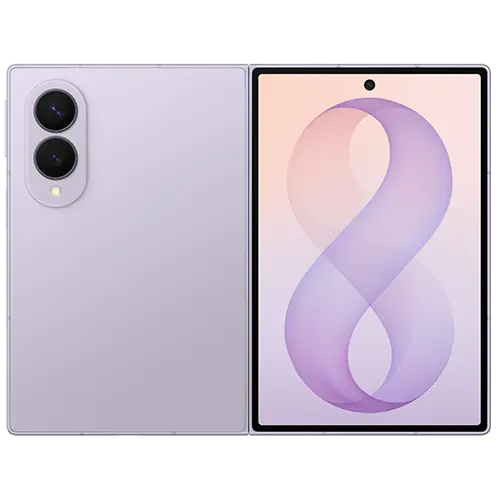
Samsung Galaxy Z Fold 8
Samsung
Galaxy Z Fold 8
Ranked #19 of 60 devices tested
Score Overview
The Galaxy Z Fold 8 is Samsung's book-style foldable, a phone that unfolds into a 7.6-inch tablet and asks $1,899.99 for the privilege. It also happens to represent a somewhat new form-factor for Samsung, with its shorter, wider, passport-style shape.
In our testing, the Fold 8 excels as a computing device. The processor is fast, biometrics are quick, the microphones are good, and battery life on the outer display in particular stretches well past what most flagships manage. The camera system is where the compromises show. There's no telephoto lens, so zoom quality falls apart quickly, and video stabilization is weak. Charging is unhurried, especially wireless. If the camera is a secondary concern for you, there's a lot here. If it isn't, there are better ways to spend this much money.
Design
Specifications
Folded, the Z Fold 8 measures 81.9 x 123.9 x 9.7 mm. Unfolded, it spreads to 161.4 x 123.9 mm at just 4.5 mm thick. At 201 grams it weighs less than plenty of non-folding flagships, which is unusual for this category. The frame is aluminum, the outer display is covered in Gorilla Glass Victus Ceramic 3, and the back uses Gorilla Glass Victus 2. The inner display fills 89% of the unfolded front in a 4:3 aspect ratio, so bezels are thin for a foldable.
The IP48 rating means the phone survives submersion in water, but the "4" in that rating only certifies protection against solid objects larger than 1 mm. It isn't dust-tight, which is unfortunate given the IP68 rating of many newer folding phones.
Bandicoot Lab doesn't formally test design or durability, so hinge longevity and drop resistance are outside what we can verify.
Display
Inner
The inner panel is a 7.6-inch Dynamic LTPO AMOLED 2X at 2448 x 1848, which works out to 404 pixels per inch. Refresh rate scales from 1 to 120 Hz, so scrolling is smooth and static content doesn't waste power.
HDR output peaks at 3,469 nits, but that figure applies to small highlights only. Brightness stability across window sizes is 45%, meaning full-screen bright scenes run at far lower output than the peak suggests. While it drops brightness with window size, it doesn’t really over time though — it sustained 98.7% of its output over 30 minutes, effectively meaning it didn’t throttle its maximum brightness over the test. Maximum manual brightness is 740 nits, which is fine indoors but modest in direct sun if you keep auto-brightness off.
Color accuracy is middling. Even in its most accurate mode, colors drift slightly from reference, and the panel covers only about three quarters of the DCI-P3 gamut. Standard sRGB content is fully covered, so most apps and web content look correct, but wide-gamut photos and HDR video won't render at full saturation. Touch latency averaged 16.3 ms.
Outer
The outer display is a 5.5-inch panel of the same LTPO AMOLED type at 1248 x 1972 and 428 PPI, also running 1 to 120 Hz.
It's slightly sharper than the inner panel by pixel density and measured more accurate in color, with less drift from reference values. It's noticeably dimmer, though, which you'll feel outdoors more than anywhere else. Touch response is in line with the inner display.
Performance
The Z Fold 8 runs a Qualcomm Snapdragon 8 Elite Gen 5 with 12GB or 16GB of RAM. CPU results are excellent — hitting 3,646 single-core and 11,070 multi-core in GeekBench 6. App launches, multitasking across split-screen windows, and heavy file work are all flagship-fast. Browser performance backs that up with a Speedometer score of 53.3.
The GPU is where the thin chassis bites. Peak graphics output is strong, with a Wild Life Extreme best of 7,126, but stability under the 20-loop stress test drops to 47.1%. Ray-traced workloads hold up slightly better at 52.6% stability. A long gaming session runs at roughly half the frame rate of the first few minutes. Short bursts are flagship-fast; sustained sessions are not. AI workloads scored well and shouldn't bottleneck on-device features.
For everything short of extended gaming, you won't feel a difference between this and any other top-tier phone.
Camera
The rear system is a 50-megapixel main camera and a 50-megapixel ultrawide, with no telephoto lens of any kind. Zoom tops out at 10x, all of it digital. That's the defining limitation. Camera-focused rivals at this price ship dedicated telephoto hardware, and the gap is obvious the moment you zoom.
The ultrawide is the sharper, more consistent lens, holding detail well even in dim light, while the main camera is merely decent and softens as light drops. Past about 2x the main camera's digital crop starts losing detail visibly, and by the deep end of the zoom range images are soft enough that fine text and distant faces smear. At 10x you're getting a composition aid, not a usable photo. Video stabilization is weak across every camera on the phone.
Main
The main camera pairs a 50-megapixel sensor at 1/1.56 inches with a 23 mm f/1.8 lens. Sharpness is good in bright light, drops modestly in medium lighting, and falls further in low light. As the digital crop tightens toward 3x and beyond, detail degrades steadily, so treat anything past 2x as occasional use.
Color tuning is close to neutral, with saturation sitting near reference in bright and indoor light and pulling muted in the dark. Hue errors are moderate across all lighting, and skin tones drift noticeably in bright light and more so in dim conditions. White balance stays fairly controlled as light warms. Shadows retain reasonable detail, but bright skies and highlights clip in high-contrast scenes.
Ultrawide
The ultrawide is a 50-megapixel, 1/2.5-inch sensor behind a 14 mm f/1.9 lens at 0.6x. It stays sharp from bright light all the way down to dim conditions with barely any falloff. That consistency is rare for an ultrawide.
The tuning is different from the main lens: vivid and cool-leaning, with saturation pushed clearly past neutral. That reads as punchy for landscapes, but skin tones suffer badly in bright light, drifting far enough from reference that faces look off in outdoor group shots. Skin accuracy improves as light dims. Dynamic range matches the main camera, with the same tendency to clip highlights.
Front Inner
The inner selfie camera is 10 megapixels at 18 mm f/2.2, punched into the folding display. Sharpness is respectable in bright light and softens indoors. Color is near-neutral in saturation with decent skin tones, though hues drift increasingly in dim light with a push toward red. Dynamic range is weak. Backlit selfies clip hard, losing both window detail and highlight rolloff on faces.
Front Outer
The outer selfie camera uses the same 10-megapixel, 1/3.52-inch sensor size behind a slightly tighter 24 mm f/2.2 lens. It behaves much like the inner camera: similar sharpness in good light, softer in the dark, near-neutral color with hue drift in dim conditions. In low light it pulls warmer and redder than the inner camera. Dynamic range is somewhat better than the inner selfie camera but still clips in backlit scenes, and stabilization is marginally better while remaining weak. The two front cameras are essentially interchangeable.
Battery
The 4,800mAh battery produced results that split cleanly by display. Video playback ran 27.76 hours on the inner screen and 37.67 hours on the outer one. Either figure covers multiple days of typical mixed use. Standby drain of 2% over eight hours overnight is minimal.
Gaming efficiency is a genuine strength. The 20-loop Wild Life Extreme stress test drained 19%, which is frugal for this class of GPU, helped in part by the throttling noted in the performance section. Web browsing is the weak spot — 25% drain over the 5-hour test is below average for a flagship, so heavy scrolling on the big inner display will pull the battery down faster than video or games would suggest.
Charging
Wired charging tops out at 45W. Ten minutes on the cable restores 31%, and 30 minutes gets you to 71%. A short top-up before leaving the house yields meaningful hours of use, but full charges take patience compared with the 80W-plus systems common at lower prices.
Wireless charging at 20W is slow — 8% in 10 minutes and 20% in 30. Treat the wireless pad as an overnight option, not a quick fix.
Speaker
The stereo speakers reach 78.5 dBA at maximum volume, which is loud enough to fill a room, and they stay composed at that volume with little audible strain or buzz. Bass rolls off below roughly 190 Hz, so music lacks low-end weight, and the high end is unremarkable. Voices and podcasts come through clearly; music benefits from headphones.
Microphone
Microphone quality is above average, with a flat, even frequency response that keeps voices natural in calls and recordings. Among the better results we've measured on a foldable.
Other
Measurements
Specifications
The capacitive side-mounted fingerprint reader unlocks in 149 ms on average, fast enough that the phone is open before it reaches eye level. There's no hardware-based face unlock — camera-based face unlock exists but lacks the dedicated secure hardware that we score, so the fingerprint reader is the biometric that matters here.
The USB-C 3.2 port moved files at up to 328 MB/s read and 284 MB/s write in our transfer tests, well ahead of the USB 2.0 ports still common on many phones. Storage comes in 256GB, 512GB, and 1TB configurations, with no expandable storage.
Conclusion
The Z Fold 8 is a strong tablet replacement and a mediocre camera phone. How you weigh those two facts decides whether it's worth $1,899.99. The compute side holds up against any flagship, with top-tier CPU performance, fast unlocking, quick file transfers, good microphones, and battery life that comfortably outlasts most slab phones despite the second display. For someone whose phone is primarily a work and media device, it delivers.
The photography side doesn't keep pace with what this money buys elsewhere. No telephoto, zoom that degrades quickly, weak video stabilization everywhere, and selfie cameras that clip in backlight are hard to overlook at this price. Slow wireless charging and heavy throttling in long gaming sessions round out the picture. This is a specialist device that's excellent at its specialty and average to weak outside it. Buy it for the screen and the multitasking. Don't buy it for the cameras.
FAQ
How long does the Galaxy Z Fold 8 battery actually last?
In video playback testing, the Fold 8 ran 27.76 hours using the inner tablet display and 37.67 hours using the outer cover screen. Either result covers multiple days of typical mixed use, and standby drain overnight was minimal at 2% over eight hours. Heavy web browsing drains the battery faster than video or gaming, at 25% over five hours.
Does the Galaxy Z Fold 8 have a good zoom camera?
No. There's no telephoto lens, so all zoom up to the 10x maximum is digital. Detail holds up reasonably to about 2x, then degrades noticeably, and by 10x images are soft enough that they work better as a framing aid than a usable photo.
Is the Galaxy Z Fold 8 water and dust resistant?
It carries an IP48 rating, which means it can survive submersion in water but only guards against solid particles larger than 1mm. It is not dust-tight, so fine grit near the hinge remains a risk that sealed non-folding phones don't have.
How fast does the Galaxy Z Fold 8 charge?
Wired charging tops out at 45W, reaching 31% in 10 minutes and 71% in 30 minutes, which is unhurried next to the faster charging systems found on cheaper phones. Wireless charging caps at 20W and is even slower, hitting just 8% in ten minutes, so it's better suited to overnight charging than a quick top-up.
Can the Galaxy Z Fold 8 handle gaming for long sessions?
Short bursts are fast, with strong peak graphics scores, but sustained performance drops off: stability during an extended 20-loop stress test fell to 47.1%, meaning frame rates in a long session run at roughly half the speed of the first few minutes. It's efficient on battery during that same stress test, using only 19% of the charge.
Is the Galaxy Z Fold 8's outer screen usable as a main display?
Yes, the 5.5-inch outer display runs the same 1 to 120Hz LTPO AMOLED technology as the inner screen, is slightly sharper by pixel density, and measured more color-accurate. It's noticeably dimmer, which shows up outdoors.
How good are the Galaxy Z Fold 8's selfie cameras in tricky lighting?
Both the inner and outer selfie cameras are sharp in bright light but soften indoors, and dynamic range is weak on both, causing backlit shots to clip highlights and lose window or background detail. Handheld selfie video is shaky on the inner camera, with the outer camera's stabilization only marginally better.
Related
Best-Performing Phones
Best Samsung Phones
Best Foldable Phones
Samsung
Galaxy Z Fold 8 Ultra

Samsung
Galaxy S26 Ultra
Samsung
Galaxy S26
Samsung
Galaxy S26+
Honor
Magic V6
Honor
Magic V5
Motorola
Razr Fold