Motorola Razr Ultra (2026) vs Samsung Galaxy Z Flip 7
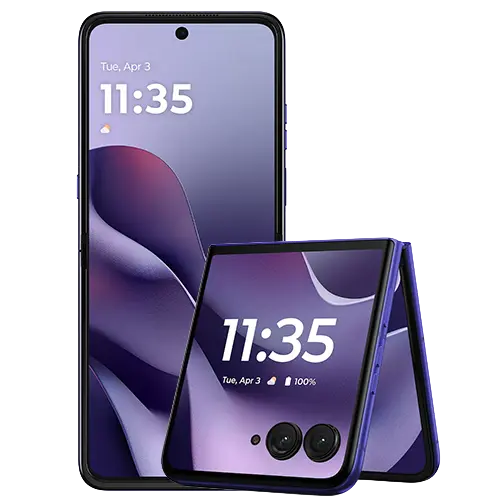

Motorola
Samsung
Razr Ultra (2026)
Galaxy Z Flip 7
Ranked #23 of 60
Ranked #41 of 60
Overall
Overall
Both the Motorola Razr Ultra (2026) and the Samsung Galaxy Z Flip 7 are flip-style foldables and the two most obvious choices if you want a phone that folds in half without going to a book-style device. The Razr Ultra is Motorola's top-tier flip, priced at $1,499.99 and built around flagship silicon, big batteries, and unusual back materials. The Galaxy Z Flip 7 is Samsung's mainstream flip for 2025 at $1,099.99, running Samsung's own Exynos chip and aimed at buyers who want the form factor without paying flagship-plus money. The $400 gap is the first thing to settle: Motorola is asking you to pay a premium for a flip, and the question is whether the hardware justifies it.
Much of it does. The Razr Ultra has the stronger chip, the longer battery life, much faster charging, and the better camera system overall, particularly for selfies and anything past 2x zoom. The Flip 7 answers with better speakers, a clearly better microphone, faster biometrics and file transfers, and a main camera that handles high-contrast scenes better. Where your priorities land decides which phone makes sense, and the price difference is large enough that it should weigh in too.
Design
| Motorola Razr Ultra (2026) | Samsung Galaxy Z Flip 7 | |
|---|---|---|
| Specifications | ||
| Dimensions (folded) | 88.1 x 74 x 15.7 mm | 85.5 x 75.2 x 13.7 mm |
| Dimensions (unfolded) | 171.5 x 74.0 x 7.2 mm | 166.7 x 75.2 x 6.5 mm |
| Weight | 199g | 188g |
| IP Rating | IP48 | IP48 |
| Frame | Aluminum | Aluminum |
| Front | Gorilla Glass Ceramic | Plastic (inner) / Gorilla Glass Victus 2 (outer) |
| Back | Vegan leather / Alcantara / Wood | Gorilla Glass Victus 2 |
| Screen-to-body ratio (inner) | 87.3% | 86.2% |
| Screen-to-body ratio (outer) | 78.1% | 83.9% |
Folded, the Razr Ultra measures 88.1 x 74 x 15.7mm; the Flip 7 is a bit smaller and noticeably thinner at 85.5 x 75.2 x 13.7mm. Unfolded, the gap holds: 171.5 x 74 x 7.2mm for the Razr against 166.7 x 75.2 x 6.5mm for the Flip. The Flip is also lighter at 188g versus 199g. Neither is heavy by flagship standards, but the Flip 7 is the more compact phone in every dimension.
Both use aluminum frames and carry an IP48 rating, which means protection against solid objects larger than 1mm and submersion in water. Materials diverge from there. The Razr Ultra fronts its cover display with Gorilla Glass Ceramic and offers vegan leather, Alcantara, or wood backs. The Flip 7 uses Gorilla Glass Victus 2 on both the cover display and the back, with a plastic layer over the inner folding screen, as is standard for foldables.
The Razr's inner display fills slightly more of the front at 87.3% screen-to-body versus 86.2%, with a taller 22:9 aspect ratio against the Flip's 21:9. On the cover side the Flip has the higher ratio, 83.9% to 78.1%, meaning thinner borders around its outer screen.
Bandicoot Lab doesn't formally test design or durability.
Display
Inner
| Motorola Razr Ultra (2026) (Inner) | Samsung Galaxy Z Flip 7 (Inner) | |
|---|---|---|
632/ 881 | 540/ 881 | |
The Razr Ultra's inner display is a 7-inch LTPO AMOLED at 1224 x 2992, which works out to 462 pixels per inch, with a refresh rate that scales from 1 to 165Hz. The Flip 7's 6.8-inch panel runs 1080 x 2520 at 397 PPI and tops out at 120Hz. Both resolutions are fine at arm's length, but the Razr's panel is meaningfully denser, and the 165Hz ceiling gives it an edge in motion smoothness.
Brightness splits in an unusual way. In manual mode the Flip 7 reaches 690 nits against the Razr's 474, so the Flip is the easier phone to read outdoors with auto-brightness off. With HDR content in auto mode the Razr pulls slightly ahead, peaking at 2,919 nits versus 2,785. Both hold brightness well across window sizes (56.3% and 54.8% stability) and both sustain output almost perfectly over a 30-minute run, at 98.9% and 98.7%. The Flip dims lower at night too, down to 0.79 nits against 2.44.
Color accuracy favors the Razr slightly. Its best mode keeps colors close enough to reference that errors won't be visible in normal use; the Flip 7 drifts a touch more on average, though its worst-case single color is better controlled. Neither will bother you. In HDR tone mapping the Razr tracks the reference curve more faithfully, while the Flip lifts highlights a bit brighter than mastered and starts clipping slightly earlier. Touch latency is a wash: 19ms versus 18.6ms.
Outer
| Motorola Razr Ultra (2026) (Outer) | Samsung Galaxy Z Flip 7 (Outer) | |
|---|---|---|
567/ 881 | 474/ 881 | |
The Razr's 4-inch cover display is the sharper of the two by a wide margin, 1080 x 1272 at 417 PPI against the Flip's 4.1-inch panel at 948 x 1048 and 342 PPI. It also keeps the full 1–165Hz LTPO range, where the Flip's cover screen runs 60–120Hz. If you spend real time on the cover screen, and that's half the point of a flip phone, the Razr's is simply the better panel for text and scrolling.
The Flip 7 counters on brightness. Its outer display tested meaningfully brighter than the Razr's, which tracks with the inner panels' manual-brightness results. The Razr's cover screen is a bit more accurate than its inner display, while the Flip's cover screen drifts slightly more than its inner one. In both cases the differences are modest.
Performance
| Motorola Razr Ultra (2026) | Samsung Galaxy Z Flip 7 | |
|---|---|---|
761/ 1012 | 578/ 1012 | |
The Razr Ultra runs a Qualcomm Snapdragon 8 Elite with 16GB of RAM. The Flip 7 uses Samsung's Exynos 2500 with 12GB. On paper that's flagship silicon against an in-house chip Samsung reserves for this phone, and the benchmarks bear out the gap.
In GeekBench the Razr scores 3,062 single-core and 9,161 multi-core against the Flip's 2,322 and 8,162. The single-core gap of roughly 30% is the one you'll feel; it drives app launches and general UI responsiveness. The GPU difference is larger. The Razr peaks at 6,420 in the Wild Life Extreme stress test and holds 68.6% of that under sustained load, while the Flip peaks at 5,387 and holds only 44%. Ray-tracing results in Solar Bay tell the same story: nearly identical peaks (11,538 versus 11,372) but 65.7% stability for the Razr against 44.2%. In a long gaming session the Flip 7 will shed more than half its initial performance; the Razr degrades far more gracefully.
The Flip claws one back in browser performance, scoring 26.5 in Speedometer to the Razr's 20.8. Day to day, both phones are fast. The difference shows up in sustained 3D workloads, where the Razr is clearly the stronger device.
Camera
| Motorola Razr Ultra (2026) | Samsung Galaxy Z Flip 7 | |
|---|---|---|
482/ 587 | 456/ 587 | |
Neither phone has a telephoto lens, so everything past 1x is digital crop. The Razr Ultra fields three 50-megapixel cameras: main, ultrawide, and front. The Flip 7 pairs a 50-megapixel main with a 12-megapixel ultrawide and a 10-megapixel front camera. Overall the systems score close, with the Razr ahead, but the strengths are distributed differently: Motorola wins on color accuracy and the front camera, Samsung on stabilization and main-camera dynamic range. Neither competes with camera-first flagships like the Pixel or Galaxy Ultra lines, which is the usual flip-phone trade.
At deep zoom the Razr allows up to 30x and the Flip stops at 10x. Both fall apart well before their limits. Detail at 10x and beyond is low on the Razr and lower still on the Flip; these are framing aids, not usable focal lengths. The Razr retains roughly twice the resolved detail at long zoom, which makes it the better choice if you crop often, but neither produces shareable results past mid-range zoom.
Main
| Motorola Razr Ultra (2026) (Main) | Samsung Galaxy Z Flip 7 (Main) | |
|---|---|---|
491/ 722 | 566/ 722 | |
At 1x the two main cameras resolve similar detail in bright light, and both hold up well as light drops. The Flip 7 is actually slightly more consistent in the dark; the Razr dips modestly in dim conditions. Zoom behavior is where they separate. The Razr's main camera covers 1x–30x and keeps crops reasonably clean through 2x and 3x before softening. The Flip covers 1x–10x and degrades faster once you leave native framing.
Both tune vivid, pushing saturation moderately above neutral in bright light. The Razr's hue accuracy is strong across all three lighting conditions, with only a mild warm pull in dim, warm light. The Flip is accurate in bright light but drifts increasingly as light warms and dims, developing a red-and-yellow cast that points to white balance correction failing to neutralize warm sources. Skin tones follow the same pattern: the Razr renders them reasonably close throughout, while the Flip shifts skin noticeably off-reference in bright light and only partially recovers in the dark.
Dynamic range goes the other way. The Flip 7's main camera retains tonal order cleanly in high-contrast scenes and preserves scene depth well. The Razr clips highlights earlier and loses more of the bright end, so backlit scenes and bright skies flatten sooner. The Flip also stabilizes video better from the main camera; the Razr's main-camera footage shows more residual motion handheld.
Ultrawide
| Motorola Razr Ultra (2026) (Ultrawide) | Samsung Galaxy Z Flip 7 (Ultrawide) | |
|---|---|---|
551/ 722 | 596/ 722 | |
The Razr's 50-megapixel f/2 ultrawide against the Flip's 12-megapixel f/2.2 looks like a mismatch on paper, but the Flip's ultrawide tested sharper in our scoring, and both hold detail respectably relative to their main lenses. The Razr's ultrawide softens more as light drops.
Color is the Flip ultrawide's weak point. It's accurate enough in bright light, but hue errors grow sharply in dim, warm conditions, driven by a strong red shift that again implicates white balance. The Razr's ultrawide leans slightly cool and restrained in bright light, with skin tones a bit off there, but it stays far more composed as light warms. Both ultrawides handle high-contrast scenes better than you'd expect, with the Flip's retaining slightly more depth.
Front
| Motorola Razr Ultra (2026) (Front) | Samsung Galaxy Z Flip 7 (Front) | |
|---|---|---|
557/ 722 | 303/ 722 | |
This is the Razr's clearest camera win. Its 50-megapixel front camera resolves high detail in bright and mid light and holds up acceptably in the dark. The Flip's 10-megapixel front camera starts behind and falls off hard in low light, where detail roughly halves.
The Razr's selfies lean muted, noticeably undersaturated with a slight cool cast, but hues and skin tones stay near reference across lighting. The Flip's front camera shifts skin tones well off-reference in every condition, and in dim warm light it develops a heavy red cast. The Razr's front camera produces steady handheld video, while the Flip's selfie footage is the shakiest output from either phone. If selfies and front-camera video matter to you, the Razr is the easy pick.
Battery
| Motorola Razr Ultra (2026) | Samsung Galaxy Z Flip 7 | |
|---|---|---|
584/ 836 | 516/ 836 | |
The Razr Ultra carries a 5,000mAh battery to the Flip 7's 4,300mAh, and the capacity gap shows in most tests. In video playback the Razr ran 31.23 hours on the inner display and 32.89 on the cover screen. The Flip managed 28.43 and 24.67 hours. Any of those figures translates to a phone that gets through two days of moderate use, but the Razr has more headroom, and its cover screen is the more efficient way to watch, while the Flip's cover screen is its less efficient one.
Web browsing drained 19% of the Razr over five hours against 23% for the Flip, pointing to roughly a full day of heavy browsing on either, with the Razr finishing with more in reserve. Gaming inverts: the Flip lost 21% during the hour-long stress test while the Razr lost 39%. Some of that is the Razr's GPU doing nearly half again as much work, but the practical result stands: the Flip is the more frugal gaming device, and the Razr will need a charger sooner if you game hard. Overnight standby drain is identical at 3%; neither phone bleeds meaningfully while idle.
Charging
| Motorola Razr Ultra (2026) | Samsung Galaxy Z Flip 7 | |
|---|---|---|
329/ 837 | 211/ 837 | |
The Razr Ultra charges at 68W wired and 30W wireless. The Flip 7 is limited to 25W wired and 15W wireless, and the results follow the spec sheet. Ten minutes on a cable gets the Razr to 27% versus 20% for the Flip; at 30 minutes it's 70% to 55%. That 30-minute figure is the practical one. The Razr goes from empty to most of a day's charge in half an hour, while the Flip needs noticeably longer to get there, and it started with the smaller battery.
Wireless charging is slow on both: 22% in 30 minutes for the Razr, 19% for the Flip. Treat wireless as overnight or desk charging on either phone.
Speaker
| Motorola Razr Ultra (2026) | Samsung Galaxy Z Flip 7 | |
|---|---|---|
544/ 897 | 704/ 897 | |
The two phones are equally loud, 77.6 dBA for the Razr and 77.2 for the Flip, but loudness is where the similarity ends. The Flip's speakers measured 5.35% average distortion against the Razr's 8.74%, and its frequency response is far more even across the range. In listening terms the Flip sounds cleaner at volume, with fuller bass and better-defined highs. The Razr's output is comparatively thin and uneven, with distortion you can hear when pushed. The Razr's speaker result is one of the weaker ones we've tested, and it's the most lopsided category in this matchup after charging.
Microphone
| Motorola Razr Ultra (2026) | Samsung Galaxy Z Flip 7 | |
|---|---|---|
610/ 1220 | 789/ 1220 |
The Flip 7's microphones are clearly above average, capturing voice with an even, natural response. The Razr's are middle of the road: acceptable for calls and casual video, but with more coloration in recordings. If you record voice memos, interviews, or video with speech regularly, the Flip is the better tool.
Other
| Motorola Razr Ultra (2026) | Samsung Galaxy Z Flip 7 | |
|---|---|---|
| Biometrics | 713/ 1181 | 869/ 1181 |
| Data Transfer | 116/ 943 | 389/ 943 |
| Specifications | ||
| Biometric type | Fingerprint | Fingerprint |
| Ports | USB-C 2.0 | USB-C 3.2 |
| Storage | 512GB | 256GB, 512GB |
Both phones use capacitive fingerprint sensors and neither offers hardware-based face unlock, though software camera-based unlock is available as a convenience option. The Flip's sensor averaged 121ms to unlock against the Razr's 147ms. Both are fast; the gap is measurable but not something you'll register in use.
Data transfer is a bigger practical difference. The Flip 7's USB-C 3.2 port hit 173 MB/s read and 171 MB/s write in our tests, while the Razr's USB-C 2.0 port managed 39 and 38. Moving a large video library off the Razr over cable takes more than four times as long. Storage: the Razr comes in a single 512GB configuration, the Flip in 256GB or 512GB.
Conclusion
The Razr Ultra is the stronger phone in most of the categories that define daily use. It has the faster and far more stable chip, longer battery life, charging that's roughly twice as quick, sharper displays inside and out with a higher refresh ceiling, and the better camera system overall, anchored by accurate color, a longer usable zoom range, and a front camera the Flip 7 can't approach. If you're buying a flip foldable as your primary camera-and-everything device and the $1,499.99 price doesn't put you off, it's the more complete package.
The Flip 7's case rests on the $400 it saves you plus a handful of genuine wins: noticeably better speakers, above-average microphones, faster fingerprint unlock, a USB port that transfers files at four times the speed, a brighter screen in manual mode, and a main camera that keeps high-contrast scenes intact where the Razr clips. It's also the smaller, lighter, thinner phone, which counts for something in a form factor people buy for pocketability.
If performance, battery, charging, and camera quality top your list, pay the premium for the Razr Ultra. If you want the flip form factor at a saner price and care more about media playback, call quality, and day-to-day polish than raw speed, the Flip 7 covers the essentials and keeps $400 in your pocket.
FAQ
Is the Motorola Razr Ultra worth $400 more than the Galaxy Z Flip 7?
For most buyers who want the stronger all-around phone, yes. The Razr Ultra has the faster chip, longer battery life, much quicker charging, sharper displays inside and out, and the better camera system overall, especially for selfies. The Flip 7 at $1,099.99 is the better value if you care more about speaker quality, call and recording quality, file transfer speed, and a smaller, lighter body.
Which has better battery life, the Razr Ultra or the Flip 7?
The Razr Ultra's 5000mAh battery lasts longer for video and browsing. It played video for 31.23 hours on the inner display and 32.89 hours on the cover screen, against 28.43 and 24.67 hours for the Flip 7 (4300mAh). Web browsing drained 19% on the Razr versus 23% on the Flip. Heavy gaming reverses this, since the Flip 7 lost 21% in the gaming test and the Razr lost 39%.
Is the Razr Ultra or Galaxy Z Flip 7 better for gaming?
The Razr Ultra holds its performance much better in long sessions. It kept 68.6% of its peak in the Wild Life Extreme stress test, while the Flip 7 kept 44%. The Flip 7 sheds more than half its initial graphics performance under sustained load. The Flip does use less battery while gaming, so the Razr will need a charger sooner.
Does the Razr Ultra or Flip 7 take better selfies?
The Razr Ultra's 50-megapixel front camera is the clear winner. It keeps high detail in bright and mid light, holds up acceptably in the dark, and keeps skin tones near reference. The Flip 7's 10-megapixel front camera loses roughly half its detail in low light, shifts skin tones off-reference in every condition, and produces the shakiest video of either phone.
Which charges faster, the Razr Ultra or the Flip 7?
The Razr Ultra charges much faster. Its 68W wired charging reaches 27% in 10 minutes and 70% in 30 minutes, while the Flip 7's 25W charging reaches 20% and 55%. Wireless is slow on both, at 22% in 30 minutes for the Razr (30W) and 19% for the Flip (15W).
Does the Flip 7 have better speakers and microphones than the Razr Ultra?
Yes, on both counts. The two phones reach nearly the same maximum volume, but the Flip 7 has lower distortion (5.35% versus 8.74%) and a more even frequency response, so it sounds cleaner and fuller. The Flip's microphones also capture voice more naturally, which makes it the better pick for voice memos and video with speech.
Related
Motorola
Razr Ultra (2026)
Samsung
Galaxy Z Flip 7

Samsung
Galaxy S26 Ultra
Samsung
Galaxy S26+
Samsung
Galaxy Z Fold 8 Ultra
Samsung
Galaxy Z Fold 8
Samsung
Galaxy S26

Motorola
Razr Fold
Motorola
Razr+ (2026)
Motorola
Razr (2026)

Motorola
Moto G Power (2026)

Motorola Razr Ultra (2026) vs Motorola Razr Ultra (2025)