Samsung Galaxy Z Flip 8 vs Motorola Razr+ (2026)
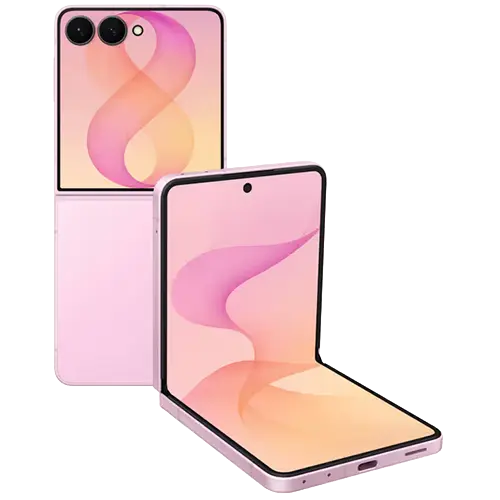
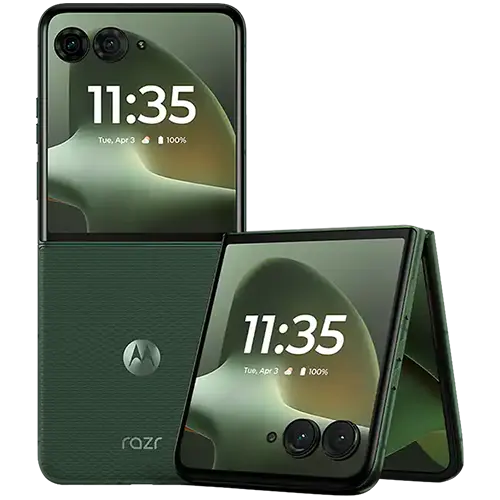
Samsung
Motorola
Galaxy Z Flip 8
Razr+ (2026)
Ranked #26 of 61
Ranked #49 of 61
Overall
Overall
The Galaxy Z Flip 8 and Razr+ (2026) are the two flip-style foldables most people will cross-shop, priced $100 apart. Samsung's at $1,199.99 is built around processing power and battery efficiency. Motorola's at $1,099.99 invests in display quality and charging speed while running a less powerful chip. Both are compact clamshells aimed at someone who wants a pocketable foldable with a capable camera system. Neither pretends to compete with the slab-style camera flagships.
Samsung pulls ahead in performance, battery life, and speaker quality. The processing gap is large — it affects everyday browsing speed, not just benchmarks — and battery efficiency is meaningfully better despite a smaller cell. Motorola counters with brighter, sharper, more responsive displays on both the inner and outer panels, plus meaningfully faster wired charging. The two camera systems land close to each other overall, trading advantages lens by lens.
Design
| Samsung Galaxy Z Flip 8 | Motorola Razr+ (2026) | |
|---|---|---|
| Specifications | ||
| Dimensions (folded) | 85.7 x 75.4 x 13.1 mm | 88.1 x 74 x 15.3 mm |
| Dimensions (unfolded) | 166.9 x 75.4 x 6.1 mm | 171.4 x 74.0 x 7.1 mm |
| Weight | 180g | 189g |
| IP Rating | IP48 | IP48 |
| Frame | Aluminum | Aluminum |
| Front | Plastic (inner) / Gorilla Glass Victus 2 (outer) | Gorilla Glass Victus |
| Back | Gorilla Glass Victus 2 | Vegan leather |
| Screen-to-body ratio (inner) | 87.1% | 85.1% |
| Screen-to-body ratio (outer) | 83.9% | 78.1% |
Both phones use aluminum frames and carry an IP48 rating, which provides protection against particles larger than 1mm and splashes but not full submersion. The Z Flip 8 is the more compact phone. Folded, it measures 85.7 × 75.4 × 13.1mm versus the Razr+'s 88.1 × 74.0 × 15.3mm. That 2.2mm difference in thickness is easy to feel in a pocket. Unfolded, the Samsung is shorter (166.9mm vs 171.4mm) and thinner (6.1mm vs 7.1mm), while the Motorola is slightly narrower at 74.0mm versus 75.4mm. The Z Flip 8 weighs 180g; the Razr+ comes in at 189g.
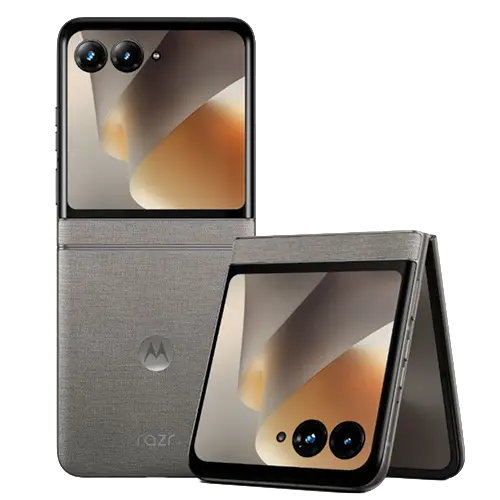
Materials differ. Samsung uses a plastic surface on the inner foldable display, with Gorilla Glass Victus 2 on the cover screen and back. Motorola covers its inner display with Gorilla Glass Victus and finishes the back in vegan leather. The glass surface on the Razr+'s inner display should resist scratches better than the Z Flip 8's plastic.
The Z Flip 8's inner display has a 21:9 aspect ratio with an 87.1% screen-to-body ratio; the Razr+ runs 22:9 at 85.1%. Thinner bezels on the Samsung. The cover screens show a wider gap: 83.9% screen-to-body for Samsung versus 78.1% for Motorola, giving the Razr+'s outer display more visible bezel.
Bandicoot Lab doesn't formally test design or durability, so this section covers what's on the spec sheet.
Display
Inner
| Samsung Galaxy Z Flip 8 (Inner) | Motorola Razr+ (2026) (Inner) | |
|---|---|---|
524/ 881 | 652/ 881 | |
Both phones have 6.9-inch AMOLED inner displays. The Z Flip 8 runs 1080 × 2520 at 397 pixels per inch with a 1–120Hz adaptive refresh rate. The Razr+ pushes to 1084 × 2640 at 414 PPI with a 1–165Hz range. The pixel density difference is minimal at normal viewing distances, but the Motorola's 165Hz ceiling offers smoother scrolling and animations than Samsung's 120Hz.
In manual brightness, the Z Flip 8 reaches 739 nits versus the Razr+'s 483 nits. That's a meaningful advantage for outdoor readability when you're adjusting the slider yourself. The Samsung also dims lower at the bottom end (0.82 nits vs 2.51 nits), which is easier on the eyes in a dark room. In auto-brightness mode with HDR content, the Razr+ pulls ahead at 3,236 nits peak versus 2,828 nits. The Razr+ also holds its HDR brightness more consistently as the bright area of the screen grows, maintaining 81.8% stability versus the Z Flip 8's 54.1%. Over a 30-minute sustained test, both panels hold up: 98.7% for Samsung, 100% for Motorola.
Color accuracy favors the Razr+. Colors track closer to reference, with neutral tones that look genuinely neutral. The Z Flip 8 is good but shows slightly more drift, particularly in grays and pastels. Both cover the sRGB gamut nearly completely (99.8% for Samsung, 98.9% for Motorola) with similar DCI-P3 coverage (76.3% vs 75.1%).
Touch latency separates the two most dramatically. The Razr+ responds in 6.8ms on average; the Z Flip 8 takes 28ms. That gap is large enough to feel during fast-paced gaming and quick gesture navigation. The Z Flip 8 boosts highlights above their mastered level in HDR content and starts clipping sooner, making HDR content look punchier but less faithful. The Razr+ tracks the reference curve more closely with more highlight headroom before clipping.
Outer
| Samsung Galaxy Z Flip 8 (Outer) | Motorola Razr+ (2026) (Outer) | |
|---|---|---|
427/ 881 | 592/ 881 | |
The Z Flip 8's cover screen is a 4.1-inch Super AMOLED at 948 × 1048 (342 PPI) with a 60–120Hz refresh rate. The Razr+'s outer display is a 4-inch LTPS AMOLED at 1272 × 1080 (417 PPI) running 30–165Hz. The Motorola's cover screen is significantly sharper and refreshes faster.
The Razr+'s outer display is also brighter and more color-accurate than the Z Flip 8's. The Samsung's cover screen has a slight edge in touch responsiveness, but the overall outer display experience favors the Motorola. The Razr+'s outer panel comes closer to matching the quality of its inner display; the Z Flip 8's cover screen drops off more noticeably from its main panel.
Performance
| Samsung Galaxy Z Flip 8 | Motorola Razr+ (2026) | |
|---|---|---|
844/ 1012 | 377/ 1012 | |
The Z Flip 8 runs a Qualcomm Snapdragon 8 Elite Gen 5 with 12GB of RAM. The Razr+ uses a Qualcomm Snapdragon 8s Gen 3, also with 12GB. The 8 Elite Gen 5 is a top-tier flagship chip; the 8s Gen 3 is a mid-range processor from a previous generation.
In GeekBench 6, the Z Flip 8 scores 3,644 single-core and 10,900 multi-core versus the Razr+'s 1,940 and 4,905. That's roughly double the CPU throughput. GPU benchmarks show a similar separation: the Samsung's peak Wild Life Extreme score of 7,314 more than doubles the Motorola's 3,149, and Solar Bay reflects the same gap (13,872 vs 5,250). Under sustained GPU load, the Z Flip 8 throttles more aggressively (37.8% stability in Wild Life Extreme vs 52.8%), but even after throttling, its sustained output exceeds the Razr+'s peak. Browser performance via Speedometer is 54.5 versus 12.3.
Web browsing, photo processing, and gaming all feel meaningfully faster on the Z Flip 8. The Motorola handles everyday tasks fine, but anything that taxes the processor exposes the difference quickly. If you game on your phone, the Samsung runs demanding titles at settings the Razr+ can't sustain.
Camera
| Samsung Galaxy Z Flip 8 | Motorola Razr+ (2026) | |
|---|---|---|
470/ 587 | 468/ 587 | |
Both phones carry a dual rear camera setup with no telephoto lens. The Z Flip 8 pairs a 50-megapixel f/1.8 main (23mm, 1/1.56" sensor) with a 12-megapixel f/2.2 ultrawide (13mm, 1/3.2" sensor). The Razr+ uses a 50-megapixel f/1.8 main (26mm, 1/1.95" sensor) and a 50-megapixel f/2 ultrawide (13mm, 1/2.76" sensor). The Motorola's larger main sensor and higher-resolution ultrawide look stronger on paper.
Overall camera scores are nearly identical. The Razr+'s main camera is sharper across all lighting, resolving more fine detail in bright, mid, and dark conditions. Samsung's main falls a step behind in sharpness but compensates with significantly better dynamic range in high-contrast scenes. The ultrawide story reverses: Samsung's 12-megapixel ultrawide resolves more detail than Motorola's 50-megapixel one, a result that defies the spec-sheet expectations. The Razr+ takes the front camera clearly, with better sharpness, dynamic range, and stabilization.
At 10x digital zoom, neither phone produces usable results. Both deep zoom scores are very low and nearly identical. Without a telephoto, detail falls off rapidly past 2–3x digital crop. By 10x, both outputs are heavily interpolated. If you regularly shoot past 3x, neither of these is the right phone.
Main
| Samsung Galaxy Z Flip 8 (Main) | Motorola Razr+ (2026) (Main) | |
|---|---|---|
568/ 722 | 501/ 722 | |
Both main cameras use 50-megapixel sensors at f/1.8. The Motorola's sensor is larger (1/1.95" vs 1/1.56") with a slightly longer 26mm focal length versus Samsung's 23mm. The Razr+ resolves visibly more detail across all three tested lighting conditions, a difference that's clear in side-by-side shots. Both phones handle their 1x–10x zoom range via digital crop from the main sensor. Detail holds reasonably to about 2x on both and degrades steadily beyond that, with the Motorola's larger sensor maintaining a slight edge through the mid-crop range.
Color character differs. The Z Flip 8's main camera has a consistently cool, blue-leaning cast. Saturation is pushed in bright light, making colors look vivid, but it fades in low light where the output turns muted. The Razr+ is closer to neutral in good light, with saturation that stays more consistent across conditions. In indoor and low light, it shifts warm as yellows and warm tones become more prominent. That warm shift is a white balance issue: as the light source drops from daylight toward tungsten temperatures, the processing overcorrects in the yellow direction.
Skin tones are a weak point for the Z Flip 8 in bright light. Faces look visibly off, pushed by the combination of high saturation and cool cast. In mid light the Samsung improves, but errors return in the dark. The Razr+ handles skin tones more evenly across conditions, with moderate errors that don't swing as much. Hue accuracy is slightly better on the Motorola across the board.
Dynamic range is where the Z Flip 8's main camera pulls ahead. High-contrast scenes retain more depth, with better shadow detail and more controlled highlights. The Razr+ loses more shadow information, resulting in flatter high-contrast shots. Both clip highlights in extreme contrast, but the Samsung preserves a wider range of tones in between.
Ultrawide
| Samsung Galaxy Z Flip 8 (Ultrawide) | Motorola Razr+ (2026) (Ultrawide) | |
|---|---|---|
522/ 722 | 426/ 722 | |
The Z Flip 8's ultrawide is a 12-megapixel f/2.2 (13mm, 1/3.2" sensor). The Razr+ has a 50-megapixel f/2 (13mm, 1/2.76" sensor). Despite the megapixel and sensor-size deficit, Samsung's ultrawide resolves more detail across all lighting conditions. The gap is consistent from bright to dark.
Both ultrawides push saturation hard. Colors are vivid bordering on oversaturated across all conditions, more so than either phone's main camera. Both lean cool with a blue cast that deepens in lower light. The Razr+'s ultrawide has somewhat better hue accuracy in indoor and dim conditions, and skin tones improve as the light gets warmer. Both produce poor skin tones in bright light. Stabilization favors the Razr+, with visibly less shake in handheld video.
Dynamic range favors the Z Flip 8's ultrawide. Samsung holds more shadow detail and produces a more natural tonal progression in high-contrast scenes. The Razr+'s ultrawide returns flatter shadows with less separation. Both clip highlights.
Front
| Samsung Galaxy Z Flip 8 (Front) | Motorola Razr+ (2026) (Front) | |
|---|---|---|
399/ 722 | 583/ 722 | |
The Z Flip 8 has a 10-megapixel f/2.2 front camera. The Razr+ uses a 32-megapixel f/2.4. The Motorola resolves more detail across all lighting conditions, with the advantage most pronounced in low light.
Color character splits. Samsung's front camera is lightly saturated and neutral-toned in good light, shifting warm as conditions dim. The Razr+'s front camera leans slightly cool in bright light and is less saturated overall, trending muted in low light. Skin tone accuracy trades back and forth: the Motorola handles faces better in bright light, while the Samsung is more accurate in dim conditions. Hue accuracy in mid and dark light is better on the Razr+.
The Razr+ has a substantial dynamic range advantage on the front camera. Selfies in front of bright windows or backlit scenes retain far more detail in both faces and backgrounds. The Z Flip 8's front camera clips more aggressively, losing information in highlights or shadows earlier. Video stabilization is also much better on the Razr+, with handheld footage staying controlled where the Samsung shows more movement. If you video-call or shoot front-facing content regularly, the Motorola is the stronger choice.
Battery
| Samsung Galaxy Z Flip 8 | Motorola Razr+ (2026) | |
|---|---|---|
573/ 836 | 445/ 836 | |
The Razr+ has the larger cell at 4,500mAh versus the Z Flip 8's 4,300mAh, but the Samsung gets more from less. In video playback, the Z Flip 8 lasts 27.56 hours on the inner display and 24.87 hours on the outer. The Razr+ manages 25 hours inner and 25.13 hours outer. Samsung's inner-display advantage is about two and a half hours. The Motorola's outer screen runtime nearly matches its inner performance, while the Z Flip 8 drops by close to three hours when switching to its cover display.
In a five-hour web browsing test, the Z Flip 8 drains 21% versus the Razr+'s 25%. Gaming shows the biggest separation: 18% drain during a 3DMark Wild Life Extreme stress test versus 26% for the Razr+. Both drop 3% over eight hours of overnight standby. Samsung's more efficient processor is the likely factor: it pulls less power while delivering much higher performance.
Both phones will get through a full day of moderate use. The Z Flip 8 has enough headroom to stretch into a second day for lighter users, while the Razr+ needs a nightly charge more consistently. If you game regularly, the efficiency gap becomes more pronounced. The Samsung lasts meaningfully longer per session.
Charging
| Samsung Galaxy Z Flip 8 | Motorola Razr+ (2026) | |
|---|---|---|
217/ 837 | 300/ 837 | |
The Razr+ charges at up to 45W wired; the Z Flip 8 tops out at 25W. Both support 15W wireless charging. The wired speed difference shows immediately.
After 10 minutes on the wire, the Razr+ reaches 27% versus the Z Flip 8's 20%. At 30 minutes, the gap widens: 70% for the Motorola versus 57% for the Samsung. If you top up during a quick break, the Razr+ gives you meaningfully more battery per minute of charge time. Wireless charging is closer: the Razr+ reaches 10% in 10 minutes and 23% in 30, versus 8% and 20% for the Z Flip 8. Both are slow enough on wireless that the difference is minor in practice.
Speaker
| Samsung Galaxy Z Flip 8 | Motorola Razr+ (2026) | |
|---|---|---|
706/ 897 | 488/ 897 | |
The Razr+ is louder, reaching 77.8 dBA versus the Z Flip 8's 75.4 dBA. That's where its speaker advantage ends.
The Z Flip 8 runs at 4.15% total harmonic distortion versus the Razr+'s 9.06%. Total harmonic distortion measures how much unwanted noise a speaker adds at a given volume; lower is cleaner. The Samsung stays clean at high volume while the Motorola introduces audible strain. The Z Flip 8 also produces fuller bass and clearer high-end detail, with a frequency response that extends lower and gives music and media more body. The Razr+ sounds thinner by comparison, with less bass presence and less vocal clarity. If you listen through your phone's speaker with any regularity, the Z Flip 8 is a clear step up.
Microphone
| Samsung Galaxy Z Flip 8 | Motorola Razr+ (2026) | |
|---|---|---|
694/ 1220 | 699/ 1220 |
Both phones perform above average for voice recording and calls. Their scores are nearly identical, and you'd be hard-pressed to tell them apart in a blind test. Neither has a weakness worth flagging.
Other
| Samsung Galaxy Z Flip 8 | Motorola Razr+ (2026) | |
|---|---|---|
| Biometrics | 437/ 1181 | 556/ 1181 |
| Data Transfer | 806/ 943 | 114/ 943 |
| Specifications | ||
| Biometric type | Fingerprint | Fingerprint |
| Ports | USB-C 3.2 | USB-C 2.0 |
| Storage | 256GB, 512GB | 256GB |
Both phones use capacitive fingerprint sensors. Neither offers hardware-based face unlock. The Razr+ unlocks at 189ms versus the Z Flip 8's 240ms. Both are quick enough that the difference is subtle in daily use, though the Motorola registers a touch faster.
Data transfer speeds are a different story. The Z Flip 8's USB-C 3.2 port delivers read speeds of 351 MB/s and write speeds of 329 MB/s. The Razr+'s USB-C 2.0 port manages 42 MB/s read and 36 MB/s write. That's roughly one-eighth the throughput. If you regularly move files to a computer, the Z Flip 8 is dramatically faster. Samsung also offers a 512GB storage option alongside the base 256GB; the Razr+ is available only with 256GB.
Conclusion
The Z Flip 8 is the faster, longer-lasting phone with the better speaker and far faster file transfers. The Razr+ has the better displays, faster wired charging, and a stronger front camera. Their rear camera systems are close enough overall that neither has an edge worth building a decision around.
The $100 premium for the Z Flip 8 buys processing power and battery efficiency you'll notice daily. Web pages load faster, photos process quicker, gaming sessions last longer, and the phone stretches further between charges. Motorola's display advantages are real and visible: brighter HDR, a dramatically more responsive touch panel, and a sharper, more capable cover screen. The faster wired charging also helps offset the shorter battery life.
If you prioritize the screen experience and don't need top-tier processing power, the Razr+ delivers genuinely better displays at $100 less. For someone who games, browses heavily, or wants the longest battery life possible, the Z Flip 8 justifies its price. The performance and efficiency advantages affect more daily moments than the display improvements do, which gives Samsung the stronger all-around case, but the Razr+ earns its spot for buyers who weight display quality highest.
FAQ
Does the Galaxy Z Flip 8 or Razr+ (2026) have better battery life?
The Z Flip 8 lasts longer despite its smaller 4,300mAh cell versus the Razr+'s 4,500mAh. It plays video for 27.56 hours on the inner display versus 25 hours, and drains 21% in a five-hour browsing test versus 25% for the Razr+. The Razr+ is slightly ahead only on the cover screen, at 25.13 hours versus 24.87.
Which charges faster, the Razr+ or the Galaxy Z Flip 8?
The Razr+ charges faster over a cable, at up to 45W versus 25W for the Z Flip 8. It reaches 27% in 10 minutes and 70% in 30 minutes, versus 20% and 57% for the Samsung. Both support 15W wireless charging, and the gap there is small.
Is the Razr+ fast enough for gaming compared with the Z Flip 8?
The Razr+ handles everyday tasks fine but is much weaker for demanding games. Its Snapdragon 8s Gen 3 scores 1,940 single-core and 4,905 multi-core in GeekBench 6, versus 3,644 and 10,900 for the Z Flip 8's Snapdragon 8 Elite Gen 5. The Z Flip 8 throttles more under sustained load, but its sustained GPU output still exceeds the Razr+'s peak. It also drains less battery in gaming, 18% versus 26% in a Wild Life Extreme stress test.
Which has the better screen, the Razr+ or the Galaxy Z Flip 8?
The Razr+ has the better displays overall. Its inner panel runs up to 165Hz versus 120Hz and has an average touch latency of 6.8ms versus 28ms. Its cover screen is also sharper and brighter. The Z Flip 8 gets brighter in manual mode (739 nits versus 483 nits) and dims lower for dark rooms.
Which has the better camera, the Galaxy Z Flip 8 or the Razr+?
The rear cameras are close, and each wins in different areas. The Razr+ has the sharper main camera and the stronger front camera. The Z Flip 8 has better dynamic range on the main and ultrawide lenses, and its 12-megapixel ultrawide resolves more detail than the Razr+'s 50-megapixel one. Neither has a telephoto lens, and detail falls off quickly past 2–3x.
Is the Galaxy Z Flip 8 worth $100 more than the Razr+?
For most people, yes. The extra $100 for the $1,199.99 Z Flip 8 gets you roughly double the processing power, longer battery life, a cleaner-sounding speaker, and much faster USB file transfers (351 MB/s read versus 42 MB/s). The $1,099.99 Razr+ is the better choice if you care most about display quality, front camera quality, and fast wired charging.
Related
Motorola
Razr+ (2026)
Samsung
Galaxy Z Flip 8

Samsung
Galaxy S26 Ultra
Samsung
Galaxy S26+
Samsung
Galaxy Z Fold 8 Ultra
Samsung
Galaxy Z Fold 8
Samsung
Galaxy S26
Motorola
Razr Ultra (2026)
Motorola
Razr Fold
Motorola
Razr (2026)

Motorola
Moto G Power (2026)

Samsung Galaxy Z Flip 8 vs Samsung Galaxy S26 Ultra