Samsung Galaxy Z Fold 8 vs Motorola Razr Fold
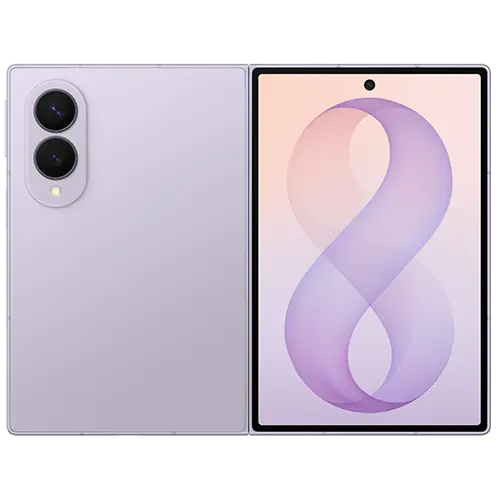
Samsung
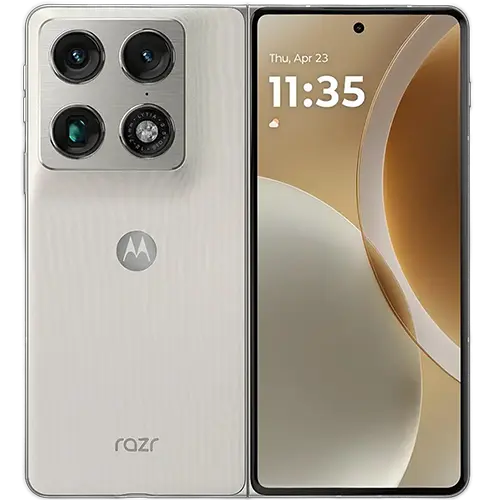
Motorola
Galaxy Z Fold 8
Razr Fold
Ranked #19 of 61
Ranked #27 of 61
Overall
Overall
Samsung and Motorola both sell a book-style foldable for $1,899.99, and the overlap mostly ends there. The Galaxy Z Fold 8 is the eighth iteration of the phone that defined the category: a tall, narrow slab that opens into a squarish tablet, refined over years into one of the thinnest and lightest foldables around. The Razr Fold is Motorola's first attempt at the format after years of flip phones, and it goes the other direction, with a larger inner screen, a wider cover display, and a camera system that reads like a flagship spec sheet rather than a foldable compromise.
The Fold 8 is the stronger phone for raw performance and battery efficiency, and it's noticeably lighter in the pocket. The Razr Fold answers with better displays inside and out, a more capable camera system anchored by a telephoto lens the Samsung simply doesn't have, and cleaner speakers. Neither phone sweeps the other. Which one makes sense depends heavily on whether you care more about the screen and cameras or the chip and the battery.
Design
| Samsung Galaxy Z Fold 8 | Motorola Razr Fold | |
|---|---|---|
| Specifications | ||
| Dimensions (folded) | 81.9 x 123.9 x 9.7 mm | 160.05 × 73.6 × 9.89 mm |
| Dimensions (unfolded) | 161.4 x 123.9 x 4.5 mm | 160.05 × 144.46 x 4.55 mm |
| Weight | 201g | 243g |
| IP Rating | IP48 | IP48/IP49 |
| Frame | Aluminum | Aluminum |
| Front | Gorilla Glass Victus Ceramic 3 | Gorilla Glass Ceramic 3 |
| Back | Gorilla Glass Victus 2 | — |
| Screen-to-body ratio (inner) | 89.0% | — |
| Screen-to-body ratio (outer) | 86.9% | — |
Both phones use aluminum frames, but the proportions differ a lot. Folded, the Fold 8 measures 81.9 x 123.9 x 9.7mm and weighs 201g; the Razr Fold is 160.05 x 73.6 x 9.89mm and 243g. That 42g gap is meaningful for a phone you'll carry folded most of the day. Unfolded, they're nearly identical in thickness (4.5mm vs 4.55mm), but the Razr opens into a wider 144.46mm panel against the Samsung's 123.9mm.
Samsung specifies Gorilla Glass Victus Ceramic 3 on the front and Victus 2 on the back. Motorola lists Gorilla Glass Ceramic 3 on the front and doesn't specify the back material. Both carry IP48, meaning submersible in fresh water but only protected against solid objects larger than 1mm, not dust. The Razr adds an IP49 rating, which covers high-pressure, high-temperature water jets. Neither is dust-tight, which remains the standing caveat with foldables.
Samsung quotes an 89% screen-to-body ratio on the inner display and 86.9% on the cover, so bezels are thin on both panels. The aspect ratios shape daily use more than any other spec here: the Fold 8's cover screen is a narrow 10:16, while the Razr's is a long 21:9 that behaves like a conventional phone. Inside, the Samsung is 4:3 and the Razr is a nearly square 8:7.2.
Bandicoot Lab doesn't formally test design or durability, so this section covers what's on paper.
Display
Inner
| Samsung Galaxy Z Fold 8 (Inner) | Motorola Razr Fold (Inner) | |
|---|---|---|
559/ 881 | 658/ 881 | |
The Fold 8 has a 7.6" LTPO AMOLED at 2448 x 1848 (404 PPI); the Razr Fold has a larger 8.1" AMOLED at 2484 x 2232 (412 PPI). Both run 1–120Hz.
Brightness splits by mode. In manual mode the Samsung reaches 740 nits to the Razr's 543, so it's easier to read outdoors with auto-brightness off. With HDR content the order flips: the Razr peaks at 4,142 nits against the Samsung's 3,469. Neither holds its peak well as the bright area grows; HDR stability sits at 45% for the Samsung and 41.6% for the Razr, so full-screen bright scenes run far dimmer than the headline numbers. Both panels hold brightness over time almost perfectly, at 98.7% and 97.9% over a 30-minute run.
Color accuracy favors the Razr. Its best mode shows errors small enough that you'd struggle to spot them against a reference, and it covers 97.7% of the P3 gamut. The Samsung's best mode drifts moderately, and P3 coverage tops out at 76.9%, which is low for a flagship panel. Wide-gamut content won't look as rich as intended. Tone mapping follows the same pattern: the Razr tracks the HDR reference curve closely, while the Samsung pushes highlights noticeably brighter than mastered. Both start clipping at the same point near the top of the signal range. Touch latency is 16.3ms vs 15.1ms, a difference you won't feel.
Outer
| Samsung Galaxy Z Fold 8 (Outer) | Motorola Razr Fold (Outer) | |
|---|---|---|
560/ 881 | 691/ 881 | |
The Fold 8's cover display is a 5.5" LTPO AMOLED at 1248 x 1972 (428 PPI), 1–120Hz. The Razr's is a 6.6" LTPO P-OLED at 2520 x 1080 (415 PPI) that runs from 30Hz up to 165Hz, the higher ceiling of any panel on either phone.
The Razr's cover screen is brighter than the Samsung's by a wide margin. The Fold 8's outer panel is the dimmer of its two displays, while the Razr's is its brighter one. Color accuracy on the outer panels is close, with the Razr slightly ahead and the Samsung's cover screen measurably more accurate than its own inner display. Given the Razr's conventional 21:9 shape, its cover screen works as a complete phone. The Samsung's narrow cover display is more of a triage surface.
Performance
| Samsung Galaxy Z Fold 8 | Motorola Razr Fold | |
|---|---|---|
887/ 1012 | 668/ 1012 | |
The Fold 8 runs the Snapdragon 8 Elite Gen 5 with 12GB of RAM (16GB optional); the Razr Fold runs the Snapdragon 8 Gen 5 with 16GB standard.
The CPU gap is large. The Samsung posts 3,646 single-core and 11,070 multi-core in GeekBench against the Razr's 2,628 and 9,178. Browser performance is where it gets lopsided: 53.3 in Speedometer vs 16.9. That's more than a threefold difference, and it's one you'll actually feel in heavy web apps on the Razr.
Graphics are more interesting. The Samsung's peak Wild Life Extreme run hits 7,126 to the Razr's 5,401, but it only holds 47.1% of that under sustained load, while the Razr holds 68.6%. Work out the sustained numbers and the Razr ends a long gaming session slightly ahead. For short bursts the Samsung is faster everywhere; for a thirty-minute gaming session the two land closer than the peak scores suggest.
Camera
| Samsung Galaxy Z Fold 8 | Motorola Razr Fold | |
|---|---|---|
430/ 587 | 481/ 587 | |
The Razr Fold has the stronger camera system overall, and the hardware explains most of it. Its main sensor is physically larger, and it carries a 3x telephoto with a 50-megapixel sensor where the Fold 8 has nothing between its main lens and digital zoom. Samsung caps zoom at 10x; Motorola goes to 100x. Neither phone troubles camera-focused flagships like a Pixel or a Galaxy Ultra, but the Razr gets closer.
The long-zoom gap is the widest in the whole matchup. The Fold 8's deep zoom output is poor, with detail collapsing well before 10x as the main sensor runs out of pixels to crop. The Razr's telephoto keeps deep zoom usable considerably further, and its average detail across the digital range is well ahead of what the Samsung manages. If you zoom past 5x with any regularity, this section alone decides the comparison.
On color character, the two diverge. The Razr's main camera is neutral and restrained, with saturation close to reference in all lighting. The Samsung sits near neutral on its main lens but pushes its ultrawide noticeably vivid in bright light. Accuracy problems show up on specific lenses for each phone, covered below.
Main
| Samsung Galaxy Z Fold 8 (Main) | Motorola Razr Fold (Main) | |
|---|---|---|
517/ 722 | 537/ 722 | |
The Razr's 50-megapixel f/1.6 main camera uses a 1/1.28" sensor, considerably larger than the Samsung's 1/1.56" f/1.8 unit. The Razr resolves more detail in bright light and holds nearly all of it in the dark, while the Samsung drops off meaningfully as light falls. In dim conditions the gap is obvious in side-by-side crops.
Color accuracy also favors the Razr. Its hues stay close to reference across all three lighting conditions, and skin tones are at their best in dim light. The Samsung's hue errors are moderate everywhere, and its skin tones drift visibly in both bright and dark conditions. Neither shows a strong white balance pull; these are tuning and sensor differences rather than correction failures, though the Razr picks up a slight warm lean as light dims.
Dynamic range is the Samsung's one clear win on the main lens. High-contrast scenes retain more shadow detail and more believable depth, while the Razr's tonal handling shows some unevenness in smooth gradients and flattens difficult scenes more readily. Both clip bright highlights.
Zoom range matters here too. The Razr's main lens only needs to cover 1x to 3x before the telephoto takes over, and it crops cleanly across that range. The Samsung's main lens has to stretch from 1x all the way to 10x, and detail softens well before the top end.
Ultrawide
| Samsung Galaxy Z Fold 8 (Ultrawide) | Motorola Razr Fold (Ultrawide) | |
|---|---|---|
528/ 722 | 422/ 722 | |
The Fold 8's ultrawide is a 50-megapixel f/1.9 at 14mm; the Razr's is 50 megapixels at f/2.0 and a wider 12mm. This is Samsung's best lens. It's sharper than the Samsung's own main camera, holds detail almost unchanged from bright light to dark, and has the better dynamic range of the two ultrawides, keeping high-contrast scenes from going flat.
The Razr's ultrawide trails both the Samsung's ultrawide and its own main lens, and its tonal handling is weaker, with shadow detail giving way sooner. Both ultrawides have a skin tone problem in bright light. The Razr's is the worse of the two, with faces drifting far from reference, and the Samsung's isn't far behind. Portraits at 0.5x or 0.6x in daylight aren't advisable on either phone. The Samsung's ultrawide also leans cool and pushes saturation visibly, where the Razr's stays slightly muted.
Telephoto
| Samsung Galaxy Z Fold 8 (Telephoto) | Motorola Razr Fold (Telephoto) | |
|---|---|---|
| — | 476/ 722 | |
Only the Razr has one: a 50-megapixel f/2.4 at 3x (71mm) on a large 1/1.95" sensor. Its sharpness is highly consistent, with detail in near-dark conditions matching bright light. That's rare for a telephoto, where dim light usually forces a fallback to the main sensor. Detail holds well as you push past 3x, degrading gradually rather than falling off a cliff, which is what makes the long end of the 100x range even worth attempting.
Skin tones through the telephoto are solid in all lighting. General hue accuracy slips in warmer light, and the cause is white balance: the processing pulls yellow as the light gets warmer rather than the sensor confusing colors. Dynamic range is the lens's weak point; high-contrast telephoto shots lose shadow detail and look flatter than the same scene at 1x.
The Fold 8 covers 3x the only way it can, by cropping the main sensor, and the results soften accordingly. At this price, the missing telephoto is hard to defend.
Front Inner
| Samsung Galaxy Z Fold 8 (Front Inner) | Motorola Razr Fold (Front Inner) | |
|---|---|---|
332/ 722 | 566/ 722 | |
The Samsung's inner selfie camera is 10 megapixels at f/2.2; the Razr's is 32 megapixels at f/2.4. The Razr is clearly sharper in all lighting and its dynamic range is in a different class. Backlit selfies keep facial detail and sky together on the Razr; on the Samsung the background blows out or the face goes dark.
Color is a split. The Razr's skin tones are accurate in mid and low light but drift badly in bright light, and it desaturates noticeably as light dims. The Samsung is more consistent, with moderate skin tone drift in bright light and hue accuracy that degrades in the dark. The Samsung's inner front camera also tested very poorly for video stabilization, so handheld selfie video from the open phone will look shaky.
Front Outer
| Samsung Galaxy Z Fold 8 (Front Outer) | Motorola Razr Fold (Front Outer) | |
|---|---|---|
336/ 722 | 449/ 722 | |
Cover-screen selfie cameras: 10 megapixels f/2.2 on the Samsung, 20 megapixels f/2.4 on the Razr. The pattern from the inner cameras mostly repeats. The Razr is sharper in bright and mid light, though both fall off in the dark, and its dynamic range advantage holds, keeping high-contrast selfies from clipping. The Samsung's outer camera shows a visible warm-magenta cast in low light that comes from white balance correction falling behind, while the Razr's low-light color stays closer to neutral. Stabilization on the outer cameras is adequate on both. On either phone, the better move for selfies is using the main camera with the cover screen as a viewfinder anyway.
Battery
| Samsung Galaxy Z Fold 8 | Motorola Razr Fold | |
|---|---|---|
622/ 836 | 481/ 836 | |
The Razr Fold carries a 6000mAh battery against the Fold 8's 4800mAh, a 25% capacity advantage. The test results mostly erase it.
Video playback on the inner screens: 27.76 hours for the Samsung, 26.22 for the Razr. On the cover screens the Razr edges ahead at 39.69 hours to 37.67. Call it a wash; both numbers translate to two-plus days of mixed use. Everywhere else the Samsung's efficiency wins outright. Five hours of continuous web browsing drains 25% of the Samsung and 32% of the Razr. Twenty loops of a GPU stress test cost the Samsung 19% and the Razr 29%. Overnight, the Samsung loses 2% to the Razr's 4%.
In practice both phones will get most people through a full day, but the Samsung does it with headroom despite the smaller cell, and gamers in particular will see the gap. The Razr spends its extra 1200mAh covering a less efficient platform.
Charging
| Samsung Galaxy Z Fold 8 | Motorola Razr Fold | |
|---|---|---|
313/ 837 | 394/ 837 | |
The Razr advertises 80W wired to the Samsung's 45W, but the percentages tell a different story. At 10 minutes the Samsung sits at 31% to the Razr's 25%; at 30 minutes it's 71% to 65%. The Razr is pushing more watts into a battery 25% larger, and in absolute energy it's moving faster, but if what you care about is the percentage on screen before you leave the house, the Samsung refills quicker.
Wireless flips it. The Samsung's 20W pad charging delivers 8% in 10 minutes and 20% in 30; the Razr's 15W manages 11% and 26%. Neither is quick, but the Razr makes better use of less rated power.
Speaker
| Samsung Galaxy Z Fold 8 | Motorola Razr Fold | |
|---|---|---|
691/ 897 | 749/ 897 | |
The Fold 8 is the louder phone at 78.5 dBA max against the Razr's 74.5. The Razr is the cleaner one, with roughly half the Samsung's distortion at volume, and its output stays composed where the Samsung starts to strain.
The Razr has fuller bass and slightly better high-end clarity, making it the more pleasant speaker for music and video at normal volumes. The Samsung's advantage is pure output. If you regularly max the volume in a noisy room, the Samsung is the pick; for everything else the Razr sounds better.
Microphone
| Samsung Galaxy Z Fold 8 | Motorola Razr Fold | |
|---|---|---|
719/ 1220 | 364/ 1220 |
This one isn't close. The Fold 8's microphone tested well above average, with an even, natural frequency response that keeps voices sounding like themselves. The Razr's tested well below average, with an uneven response that colors recordings noticeably. For calls, voice notes, or video with usable audio, the Samsung is the clear pick.
Other
| Samsung Galaxy Z Fold 8 | Motorola Razr Fold | |
|---|---|---|
| Biometrics | 707/ 1181 | 641/ 1181 |
| Data Transfer | 730/ 943 | 612/ 943 |
| Specifications | ||
| Biometric type | Fingerprint | Fingerprint |
| Ports | USB-C 3.2 | USB-C 3.2 |
| Storage | 256GB, 512GB, 1TB | 512GB |
Both phones use capacitive fingerprint sensors, and both are quick: 149ms average unlock on the Samsung, 164ms on the Razr. You won't notice the difference. Neither phone has hardware-based face unlock; what's offered is camera-based and less secure.
Data transfer over the shared USB-C 3.2 port favors the Samsung, at 328 MB/s read and 284 MB/s write to the Razr's 273 and 249. Storage configurations differ in philosophy: the Samsung offers 256GB, 512GB, or 1TB, while the Razr comes in a single 512GB configuration. That single tier is a reasonable default, but there's no cheaper entry point and no way up.
Conclusion
Price won't break this tie, so usage has to. The Razr Fold is the better phone to look at and shoot with. Its displays are more accurate, cover more of the P3 gamut, and its cover screen in particular is brighter, faster, and shaped like a phone you'd actually use closed. Its camera system has the telephoto the Fold 8 lacks, the better main sensor, and a long-zoom range the Samsung can't approach. The speakers are cleaner and fuller too.
The Fold 8 is the better phone to live with as a computer. Its chip is substantially faster, the browser performance gap is enormous, and its battery efficiency means a smaller cell outlasts the Razr's bigger one in browsing, gaming, and standby. It's also 42g lighter, its microphone is far better for calls and recordings, and its wired charging gets you to a higher percentage faster despite the lower wattage.
If you bought a foldable for the big screen and the cameras, the Razr Fold serves that purpose better. If you bought it as a productivity machine that happens to unfold, the Fold 8 is the stronger tool. The one unqualified caution: anyone who records a lot of audio or lives on speakerphone should think hard before picking the Razr, because its microphone is a genuine weak point rather than a trade-off.
FAQ
Does the Galaxy Z Fold 8 or Motorola Razr Fold have the better camera?
The Razr Fold has the stronger camera system overall. It has a larger main sensor and a 50-megapixel 3x telephoto, which the Fold 8 lacks, and it stays usable at much longer zoom distances. The Fold 8 has better dynamic range on the main and ultrawide lenses, and its ultrawide is its best camera.
Which has better battery life, the Fold 8 or the Razr Fold?
The Fold 8 is more efficient despite its smaller 4800mAh cell against the Razr Fold's 6000mAh. Five hours of web browsing drains 25% on the Fold 8 and 32% on the Razr, and a GPU stress test costs 19% versus 29%. Video playback is close: 27.76 hours on the Samsung's inner screen against 26.22 on the Razr, with the Razr slightly ahead on the cover screen.
Does the Razr Fold's 80W charging make it faster than the Fold 8's 45W?
Not by percentage. The Fold 8 reaches 31% in 10 minutes and 71% in 30, against 25% and 65% for the Razr Fold, because the Razr's battery is larger. Wirelessly the Razr is quicker, at 26% in 30 minutes versus 20% for the Fold 8.
Is the Fold 8 better than the Razr Fold for gaming?
The Fold 8 is faster in short bursts, with a peak Wild Life Extreme result of 7,126 against 5,401. It holds only 47.1% of that under sustained load, while the Razr Fold holds 68.6%. Over a long session the two end up close, with the Razr slightly ahead. The Fold 8 also uses less battery during gaming.
Which foldable has the better screen, the Razr Fold or the Galaxy Z Fold 8?
The Razr Fold has the better displays overall. Its inner screen is larger at 8.1 inches, far more accurate in color, and covers 97.7% of the P3 gamut against 76.9% for the Fold 8. Its 21:9 cover screen works like a regular phone, while the Fold 8's narrow 10:16 cover display suits quick checks. The Fold 8 is brighter in manual mode inside, at 740 nits versus 543.
Which is better for calls and voice recording, the Fold 8 or the Razr Fold?
The Fold 8 by a wide margin. Its microphone keeps voices natural and even, while the Razr Fold's has an uneven response that colors recordings noticeably. The Razr's speakers are cleaner at volume, but the Fold 8 gets louder, at 78.5 dBA versus 74.5.
Related
Samsung
Galaxy Z Fold 8
Motorola
Razr Fold

Samsung
Galaxy S26 Ultra
Samsung
Galaxy S26+
Samsung
Galaxy Z Fold 8 Ultra
Samsung
Galaxy S26
Motorola
Razr Ultra (2026)
Samsung
Galaxy Z Flip 8
Motorola
Razr+ (2026)
Motorola
Razr (2026)

Motorola
Moto G Power (2026)
Google Pixel 11 Pro Fold vs Samsung Galaxy Z Fold 8