Poco F9 Ultra vs Google Pixel 11 Pro XL
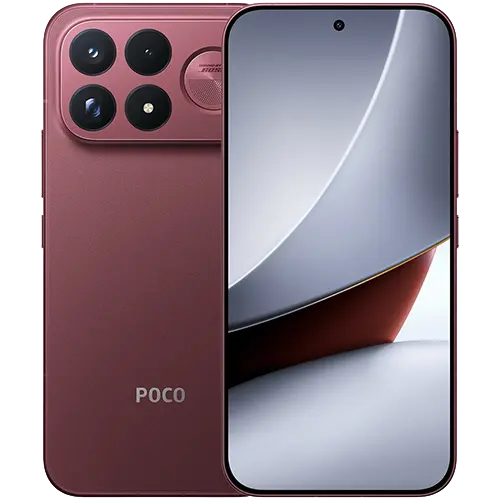
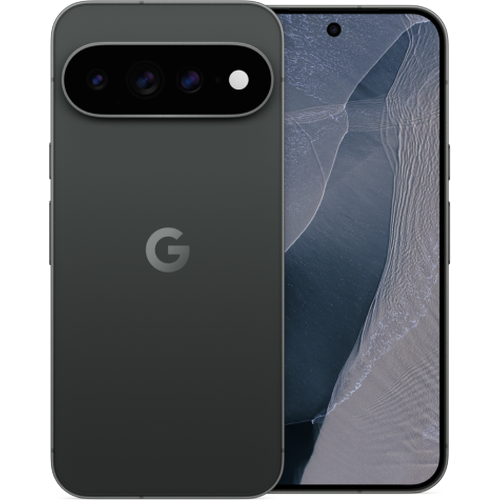
Poco
F9 Ultra
Pixel 11 Pro XL
Ranked #1 of 61
Ranked #24 of 61
Overall
Overall



The Poco F9 Ultra is a $799 flagship from Xiaomi's value brand, designed to compete with phones that cost considerably more. It pairs flagship-class silicon, a triple-camera system with a 5x optical telephoto, and an enormous battery in a package that undercuts most premium devices by hundreds of dollars. The Google Pixel 11 Pro XL, at $1,299, is Google's top-end phone, built around its own processor, its computational photography pipeline, and a glass-and-aluminum body. Both share IP68 protection, 5x telephoto lenses, and current-generation chipsets, so the comparison is direct despite the $500 price gap.
The Poco leads in battery life and raw processing power by wide margins, and its display gets substantially brighter. It also scores higher on cameras overall, with sharper results from most lenses and much steadier video. The Pixel counters with a more color-accurate and higher-resolution display, a better speaker, a far stronger microphone, and a telephoto camera that outperforms the Poco's in difficult light. The price difference sets up an expectation that the Pixel should win comfortably, but the data runs the other way more often than not.
Design
| Poco F9 Ultra | Google Pixel 11 Pro XL | |
|---|---|---|
| Specifications | ||
| Dimensions | 163.5 x 77.9 x 8.7 mm | 162.7 x 76.5 x 8.5 mm |
| Weight | 235g | 226g |
| IP Rating | IP68 | IP68 |
| Frame | Aluminum | Aluminum |
| Front | Gorilla Glass 7i | Gorilla Glass Victus 2 |
| Back | Plastic | Gorilla Glass Victus 2 |
| Screen-to-body ratio | 91.5% | 89.6% |
The Poco F9 Ultra measures 163.5 × 77.9 × 8.7mm and weighs 235g. The Google Pixel 11 Pro XL comes in at 162.7 × 76.5 × 8.5mm and 226g.
Both phones use aluminum frames and carry IP68 ratings, meaning they're rated for submersion in freshwater to the specified depth. The meaningful material difference is front and back glass. The Pixel uses Gorilla Glass Victus 2 on both sides; the Poco pairs Gorilla Glass 7i on the front with a plastic rear panel. Plastic is lighter and more shatter-resistant, but it's a cost-saving choice that's more prone to surface scratching than glass. At $799 versus $1,299, the material gap tracks with the price gap.
The Poco's screen-to-body ratio is 91.5% versus the Pixel's 89.6%, which means visibly thinner bezels. Aspect ratios are close at 19.5:9 and 20:9. The 9g weight difference and slightly larger footprint of the Poco are minor in practice, especially given how similar the overall proportions are. Bandicoot Lab doesn't formally test design or durability; this section covers what's on the spec sheet.
Display
| Poco F9 Ultra | Google Pixel 11 Pro XL | |
|---|---|---|
879/ 881 | 718/ 881 | |
The Poco F9 Ultra has a 6.9-inch AMOLED panel at 1200 × 2608 resolution (416 pixels per inch), refreshing between 30 and 185Hz. The Pixel 11 Pro XL uses a 6.8-inch LTPO OLED at 1344 × 2992 (486 PPI), with a 1 to 120Hz refresh range. The Pixel's higher resolution means sharper text and finer detail, visible if you look closely. Its LTPO technology lets the refresh rate drop to 1Hz on static content, saving power. The Poco's 185Hz ceiling offers smoother motion in games and apps that support it, though content above 120Hz remains uncommon. The Poco dims to 0.75 nits in manual mode; the Pixel's minimum is 1.9 nits. If you read in bed, the Poco is gentler on the eyes.
Brightness splits by use case. In manual mode — what you control with the slider — the Pixel reaches 1,403 nits versus the Poco's 863 nits. That's a meaningful gap in direct sunlight. For HDR content in auto-brightness, the Poco peaks at 11,983 nits, over three times the Pixel's 3,577 nits. That peak only holds at small bright areas of the image. HDR brightness stability across window sizes is 19.2% on the Poco, meaning output drops sharply as the bright portion of the frame grows. The Pixel holds 68.3% of its peak across window sizes, delivering more consistent HDR viewing. Over a sustained 30-minute test, both hold up well: 98.9% for the Poco, 98.1% for the Pixel.
Color accuracy favors the Pixel. In its best display mode, colors track close to reference with minimal visible drift. The Poco shows moderate drift, with certain hues pulling visibly away from target. The difference is noticeable in side-by-side viewing. sRGB gamut coverage is close at 97% and 98.9%; DCI-P3 coverage is similar at 71.9% and 74.4%.
For HDR tone mapping, the Poco follows the reference curve more closely through most of the luminance range but aggressively pushes highlights brighter than mastered and starts clipping at 85% input level. The Pixel deviates more from the reference overall but handles highlights with restraint, preserving detail up to 95% input before clipping. In practice, the Poco makes HDR content look punchier; the Pixel holds more information in the brightest parts of the image. Touch latency is 9.9ms on the Pixel versus 13.7ms on the Poco. Both are fast, but the Pixel's edge is large enough to feel in responsive games or quick interactions.
Performance
| Poco F9 Ultra | Google Pixel 11 Pro XL | |
|---|---|---|
864/ 1012 | 494/ 1012 | |
The Poco F9 Ultra runs Qualcomm's Snapdragon 8 Elite Gen 5 with 16GB of RAM. The Google Pixel 11 Pro XL uses Google's Tensor G6 with 12GB. These are architecturally different processors with different design priorities.
In CPU workloads, the Poco leads by a wide margin. GeekBench 6 single-core lands at 3,546 versus 2,645 for the Pixel — roughly a 34% gap. Multi-core is wider: 10,605 versus 7,269. GPU performance diverges even more. In the Wild Life Extreme stress test, the Poco's peak score of 7,439 more than doubles the Pixel's 3,425. The Pixel throttles less under sustained load, holding 76.8% stability versus the Poco's 70.9%, but the baseline is so much lower that sustained output still trails significantly. Demanding games will run with noticeably more headroom on the Poco.
Browser performance flips. The Pixel scores 26.2 on Speedometer versus the Poco's 16.9. This is a Tensor strength — Google optimizes heavily for web workloads, and you'll feel it in faster page loads and smoother scrolling.
For most tasks — gaming, multitasking, photo processing, anything that leans on raw CPU or GPU power — the Poco has substantially more overhead. The Pixel's advantage is specific to browser performance, where Google's software-silicon integration pays off.
Camera
| Poco F9 Ultra | Google Pixel 11 Pro XL | |
|---|---|---|
548/ 587 | 468/ 587 | |
The Poco F9 Ultra and Pixel 11 Pro XL both carry triple rear cameras with 5x optical telephoto lenses. The Poco scores higher overall, driven by stronger sharpness from most lenses and significantly better video stabilization across the board. The Poco keeps handheld footage controlled on every camera; the Pixel's main camera shows substantial residual shake, and the front and ultrawide lenses also produce less stable video. The Pixel's one clear camera advantage is its telephoto, where a larger sensor pays off in low light and dynamic range.
Sharpness tells a split story. The Poco's 200-megapixel main sensor and 50-megapixel ultrawide resolve more detail than their Pixel counterparts in bright and moderate lighting. The telephoto is closer: the Poco is sharper at native 5x in good light, while the Pixel's larger 1/1.95-inch telephoto sensor holds detail better as light drops. The front camera is where the Pixel pulls clearly ahead, delivering sharper results across all conditions by a meaningful margin. At extreme digital zoom beyond 10x, the Pixel retains more detail despite extending to a higher maximum of 120x versus the Poco's 100x.
Color tuning differs visibly. The Pixel renders images with heavily boosted saturation, especially on the main camera, giving photos a punchy, vivid character. The Poco stays closer to reality, with mild saturation lifts on the main and telephoto lenses. For hue accuracy in good light, the Poco is stronger on most lenses. Both phones shift warm as light dims — a white balance limitation as the processing struggles to compensate for warmer illuminants. Our color tests span three conditions from bright daylight-equivalent down to dim interior light, with progressively warmer color temperatures. The Pixel's main camera carries consistent hue errors even in ideal lighting, pointing to a sensor-level limitation beyond just white balance.
Main
| Poco F9 Ultra (Main) | Google Pixel 11 Pro XL (Main) | |
|---|---|---|
582/ 722 | 467/ 722 | |
The Poco's main camera uses a 200-megapixel f/1.68 sensor at 24mm on a 1/1.4-inch chip. The Pixel's is 50 megapixels at f/1.68 and 25mm on a slightly larger 1/1.3-inch sensor. Both cover 1x through 5x before handing off to the telephoto. The Poco resolves more detail across all lighting conditions, and the advantage grows through the 2x to 4x digital crop range, where its higher megapixel count provides more data to work with.
Color character is distinctly different. The Pixel pushes saturation well above reality, particularly in bright and moderate lighting, giving images an obvious vivid boost. The Poco renders colors closer to life with a mild vivid lift. Hue accuracy in bright light is clearly better on the Poco — colors land closer to their true values. Skin tones are a mixed bag: the Poco's bright-light skin accuracy is poor, with faces pulling well away from reference, though mid and low-light skin rendering improves substantially. The Pixel's skin accuracy is more consistent across conditions, with moderate error throughout. Both phones drift warm as light drops. The Poco's warm shift tracks predictably with the illuminant change — a white balance issue. The Pixel shifts from a cool lean in bright and moderate light to warm in dim light, an overcorrection pattern, layered on top of the baseline hue confusion that persists regardless of conditions.
The Pixel pulls more detail from shadows in high-contrast scenes, capturing a wider range from dark to bright. The tonal rendering in those recovered shadows is rougher, with more visible processing artifacts. The Poco's range is narrower but transitions from shadow to highlight are smoother. Both clip highlights on the main camera.
Ultrawide
| Poco F9 Ultra (Ultrawide) | Google Pixel 11 Pro XL (Ultrawide) | |
|---|---|---|
551/ 722 | 397/ 722 | |
The Poco mounts a 50-megapixel f/2.4 ultrawide at 18mm (0.7x equivalent); the Pixel uses 48 megapixels at f/1.7 and 13mm (0.5x), capturing a noticeably wider field of view. The Poco resolves more detail in bright and moderate lighting. In low light, the two converge. Compared to their own main cameras, both ultrawides lose sharpness as expected, but the Poco's ultrawide keeps pace with its main sensor in bright light — a strong result for that lens.
Saturation tuning mirrors the main cameras: the Pixel pushes ultrawide shots vivid, while the Poco stays near neutral in bright conditions and slightly muted in low light. Skin tones are a problem for both. The Poco shows significant skin drift in bright light; the Pixel's skin accuracy is worst in moderate lighting, with faces shifting noticeably. Both phones struggle with hue accuracy on the ultrawide in dim conditions, and both shift warm. The Poco's yellow cast in the darkest test condition is the more pronounced of the two. Dynamic range is similar between the phones. Both clip highlights, and the shadow-to-highlight range is limited. The Pixel's tonal transitions are rougher, with more visible artifacts in recovered areas.
Telephoto
| Poco F9 Ultra (Telephoto) | Google Pixel 11 Pro XL (Telephoto) | |
|---|---|---|
605/ 722 | 629/ 722 | |
The Poco uses a 50-megapixel f/3 telephoto at 120mm (5x optical), with digital zoom extending to 100x. The Pixel's telephoto is 48 megapixels at f/2.8 and 106mm (also 5x), extending to 120x, but on a substantially larger 1/1.95-inch sensor versus the Poco's 1/2.75-inch. That sensor size gap defines this comparison.
At native 5x in bright light, the Poco resolves more detail. In moderate light, the two are close. In low light, the Pixel pulls ahead clearly — the larger sensor collects roughly twice the light, and it shows. Both phones push saturation mildly on the telephoto. Hue accuracy at 5x is strong on the Poco in bright conditions and moderate on the Pixel; both degrade in low light, with both shifting warm. Skin tones are handled well by both telephoto lenses, with the Pixel slightly more accurate. The Pixel has a meaningful dynamic range advantage here. It captures more shadow-to-highlight information and is the only lens across either phone that avoids clipping highlights entirely — bright skies and specular reflections retain detail that both main cameras lose. As zoom pushes past 5x into digital territory, both phones lose detail, but the Pixel holds up better through that range.
Both phones keep telephoto video reasonably steady. The Poco is the steadier of the two, consistent with its stabilization advantage across the system.
Front
| Poco F9 Ultra (Front) | Google Pixel 11 Pro XL (Front) | |
|---|---|---|
521/ 722 | 463/ 722 | |
The Pixel's 42-megapixel front camera at 17mm resolves substantially more detail than the Poco's 32-megapixel sensor at 21mm across all lighting conditions. The gap is consistent from bright through dim light, and it's large enough to be obvious in selfies and video calls.
Color character splits the other direction. The Poco's front camera runs slightly cool and muted, with saturation pulled below reality. Selfies look somewhat flat, especially in low light. The Pixel adds a mild vivid lift that brings faces and scenes closer to how you'd expect them to look. Hue accuracy is better on the Poco, with colors staying more truthful across conditions. The Pixel's front camera shows increasing hue error as light drops. Skin tone accuracy is poor on both in bright light — faces drift noticeably from reference on each — with the Pixel's error the larger of the two in that condition. The Poco captures a wider shadow-to-highlight range from the front camera, with cleaner tonal transitions and no artifacts in recovered areas. Front-camera video stabilization is clearly better on the Poco, with the Pixel's front footage showing significant residual movement.
Battery
| Poco F9 Ultra | Google Pixel 11 Pro XL | |
|---|---|---|
836/ 836 | 536/ 836 | |
The Poco F9 Ultra packs an 8,050mAh battery, 57% larger than the Pixel 11 Pro XL's 5,115mAh cell. That capacity difference shows up across the board.
Video playback runs to 42.89 hours on the Poco and 28.75 hours on the Pixel. Neither number maps directly to real-world mixed use, but they illustrate the scale of the gap. The Poco's result means you could comfortably stretch two full days of typical use between charges. The Pixel's 28.75 hours still gets you through a day with headroom, but not much beyond that. Web browsing drains 15% of the Poco's battery over five hours versus 20% on the Pixel. Gaming drain during the Wild Life Extreme stress test is identical at 22% on both — the Poco's larger battery is offset by its more power-hungry GPU running at higher performance. Standby drain over eight hours is 3% on the Poco and 4% on the Pixel.
Every use case except sustained gaming favors the Poco, and even there the matched percentage translates to the Poco having far more charge left in absolute terms. If battery life is something you think about, the Poco removes that concern almost entirely.
Charging
| Poco F9 Ultra | Google Pixel 11 Pro XL | |
|---|---|---|
629/ 837 | 456/ 837 | |
The Poco F9 Ultra supports 100W wired and 50W wireless charging. The Pixel 11 Pro XL offers 45W wired and 25W wireless with Qi2 magnetic alignment, meaning it snaps to compatible wireless pads and chargers for consistent placement.
On paper, the Pixel charges faster by wire in percentage terms: 29% at ten minutes versus the Poco's 24%, and 77% at thirty minutes versus 61%. Context matters here. The Poco's battery is 57% larger, so 61% at thirty minutes represents more total energy than the Pixel's 77%. The Poco's charger pushes more power into a much bigger tank. If your concern is getting to a usable charge level quickly, the Pixel reaches higher percentages sooner. If you care about total runtime gained per minute on the charger, the Poco delivers more.
Wireless charging is close. The Poco reaches 42% at thirty minutes; the Pixel reaches 44%. The Pixel's Qi2 magnetic alignment is a practical benefit — you don't have to fiddle with pad placement to hit the charging coil.
Speaker
| Poco F9 Ultra | Google Pixel 11 Pro XL | |
|---|---|---|
863/ 897 | 897/ 897 | |
The Pixel 11 Pro XL reaches 76.6 dBA maximum volume; the Poco F9 Ultra hits 75 dBA. Both are loud enough for use without headphones in most rooms. The Pixel produces clearer high-end detail and better vocal separation, making spoken content and music sound more defined. The Poco delivers fuller bass and lower distortion at 2.36% total harmonic distortion versus the Pixel's 3.79%, meaning it stays cleaner as you push volume up and produces less harshness in the upper registers.
Both are excellent speaker systems. The Pixel extends higher in frequency, which benefits detail in music playback. The differences between them are subtle enough that preference depends on whether you value clarity or fullness more.
Microphone
| Poco F9 Ultra | Google Pixel 11 Pro XL | |
|---|---|---|
355/ 1220 | 820/ 1220 |
The Pixel 11 Pro XL has an excellent microphone with smooth, even frequency response — well above average. The Poco F9 Ultra's microphone is well below average, with uneven response that can make voice recordings and calls sound inconsistent. If you record audio, take voice notes, or frequently use speakerphone, the Pixel is a significant step up.
Other
| Poco F9 Ultra | Google Pixel 11 Pro XL | |
|---|---|---|
| Biometrics | 822/ 1181 | 687/ 1181 |
| Data Transfer | 943/ 943 | 323/ 943 |
| Specifications | ||
| Biometric type | Fingerprint | Fingerprint |
| Ports | USB-C 3.2 Gen 1 | USB-C 3.2 |
| Storage | 256GB, 512GB, 1TB | 256GB, 512GB, 1TB |
Both phones use ultrasonic fingerprint sensors. The Poco F9 Ultra unlocks in an average of 128ms; the Pixel 11 Pro XL takes 153ms. Both are fast enough that you won't notice the difference day to day. Neither phone has hardware-based face unlock.
Data transfer speeds differ substantially. The Poco reads at 419 MB/s and writes at 423 MB/s; the Pixel manages 128 MB/s and 151 MB/s. If you regularly move large files to or from your phone, the Poco is about three times faster. The Poco uses a USB-C 3.2 Gen 1 port; the Pixel uses USB-C 3.2. Both phones are available in 256GB, 512GB, and 1TB storage configurations.
Conclusion
A $799 phone outperforming a $1,299 phone in most categories is the central finding here. The Poco F9 Ultra stretches battery life far beyond what the Pixel can match, delivers stronger CPU and GPU performance, puts out a brighter display, produces sharper images from most camera lenses, and keeps video stabilized across the board. Its weak spots are narrow: a poor microphone, moderate display color accuracy, and a front camera that can't match the Pixel's sharpness.
The Pixel 11 Pro XL's strengths are specific and genuine. Its display is sharper, more color-accurate, and handles HDR highlights with more restraint. Its speaker is excellent. Its microphone is one of the best available. Its telephoto camera, backed by a large sensor, handles low light and dynamic range better than the Poco's, and its glass construction feels like the premium product its price suggests. Someone who records audio, values display fidelity, or leans on the telephoto for portraits and events in mixed lighting will find real reasons to choose the Pixel.
The $500 gap makes this simpler than most head-to-head comparisons. Unless the Pixel's particular advantages align closely with how you use your phone, the Poco F9 Ultra offers more total capability for substantially less.
FAQ
Does the Poco F9 Ultra or Pixel 11 Pro XL have better battery life?
The Poco F9 Ultra, by a wide margin. Its 8,050mAh battery lasted 42.89 hours in video playback versus 28.75 hours for the Pixel's 5,115mAh cell, and web browsing drained 15% over five hours versus 20%. Gaming drain was identical at 22% on both, though the Poco's larger battery leaves more charge in absolute terms.
Which charges faster, the Poco F9 Ultra or the Pixel 11 Pro XL?
The Pixel reaches higher percentages sooner by wire: 29% at ten minutes and 77% at thirty, versus 24% and 61% for the Poco. The Poco's 100W charger feeds a battery 57% larger, so its 61% at thirty minutes still adds more total energy than the Pixel's 77%. Wireless is close, with the Poco at 42% and the Pixel at 44% after thirty minutes. The Pixel also has Qi2 magnetic alignment.
Is the Poco F9 Ultra better than the Pixel 11 Pro XL for gaming?
Yes. The Poco's GPU stress-test peak was more than double the Pixel's, and its CPU results lead by a wide margin. The Pixel throttles less under sustained load, holding 76.8% stability versus the Poco's 70.9%, but its output stays well below the Poco's. The Pixel's one performance edge is browser speed, where it scored 26.2 on Speedometer versus 16.9.
Which phone has the better camera, the Poco F9 Ultra or the Pixel 11 Pro XL?
The Poco's main and ultrawide cameras resolve more detail in bright and moderate light, its colors are closer to reality, and its video is much steadier on every lens. The Pixel's telephoto is the better camera in low light and captures more dynamic range, with a larger sensor that keeps detail better beyond 5x. The Pixel also pushes saturation noticeably higher, which some people prefer.
Is the Pixel 11 Pro XL or Poco F9 Ultra better for selfies and video calls?
The Pixel's front camera is clearly sharper in every lighting condition, and its microphone is smooth and well above average. The Poco's front camera looks flatter and slightly cool, and its microphone is well below average with uneven response. The Poco does keep front-camera video steadier and holds hue accuracy better as light drops.
Is the Pixel 11 Pro XL worth $500 more than the Poco F9 Ultra?
For most people the Poco F9 Ultra gives more for $799. It leads in battery life, CPU and GPU power, data transfer speed, video stability, and main-camera sharpness. The Pixel is worth the premium if you record audio, want a sharper and more color-accurate display with steadier HDR brightness, shoot a lot with the telephoto in dim light, or want a glass back instead of the Poco's plastic one.
Related
Poco
F9 Ultra
Pixel 11 Pro XL
Poco
F9 Pro
Pixel 11 Pro
Pixel 11
Pixel 11 Pro Fold
Pixel 10a
Poco F9 Ultra vs Honor Magic8 Pro
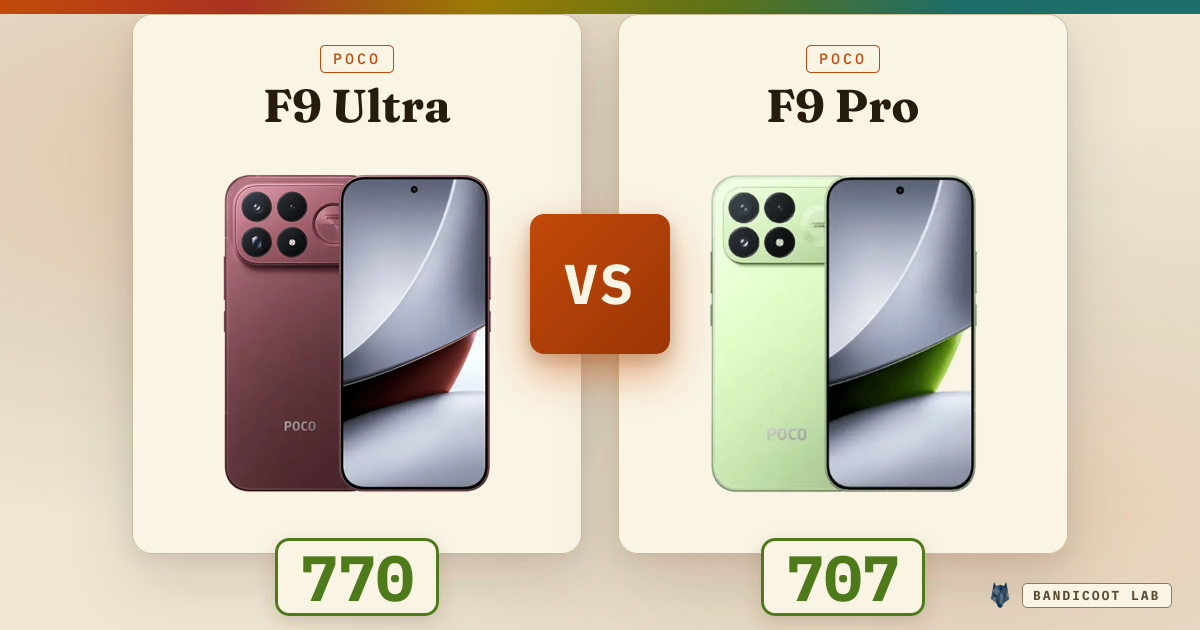
Poco F9 Ultra vs Poco F9 Pro

Poco F9 Ultra vs Samsung Galaxy S26 Ultra
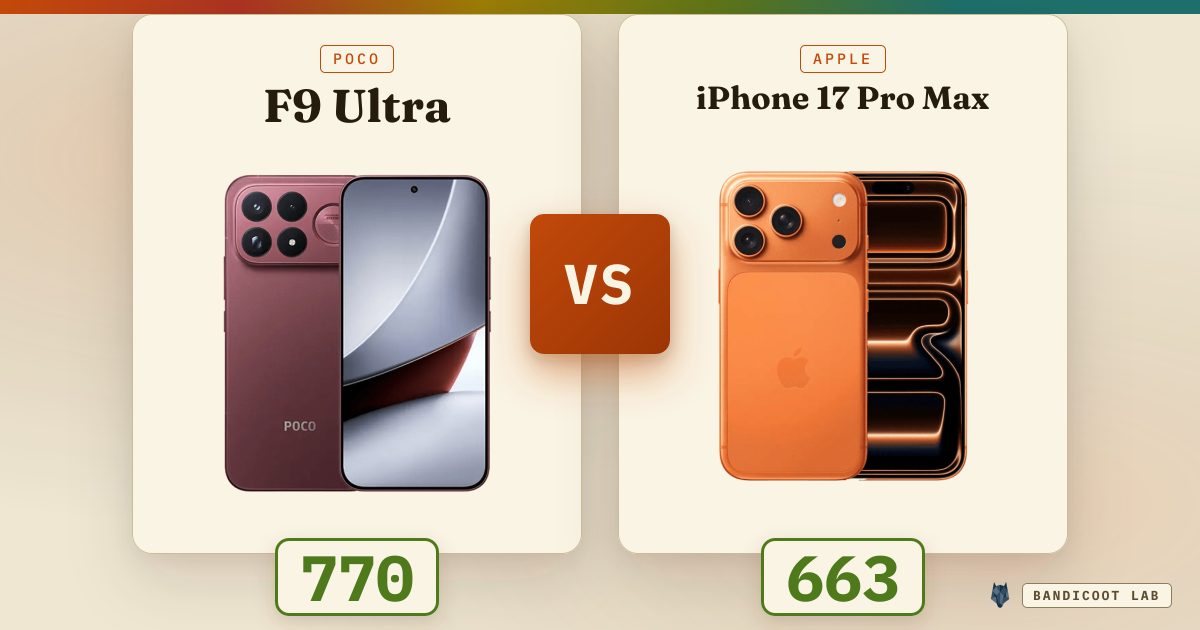
Poco F9 Ultra vs Apple iPhone 17 Pro Max
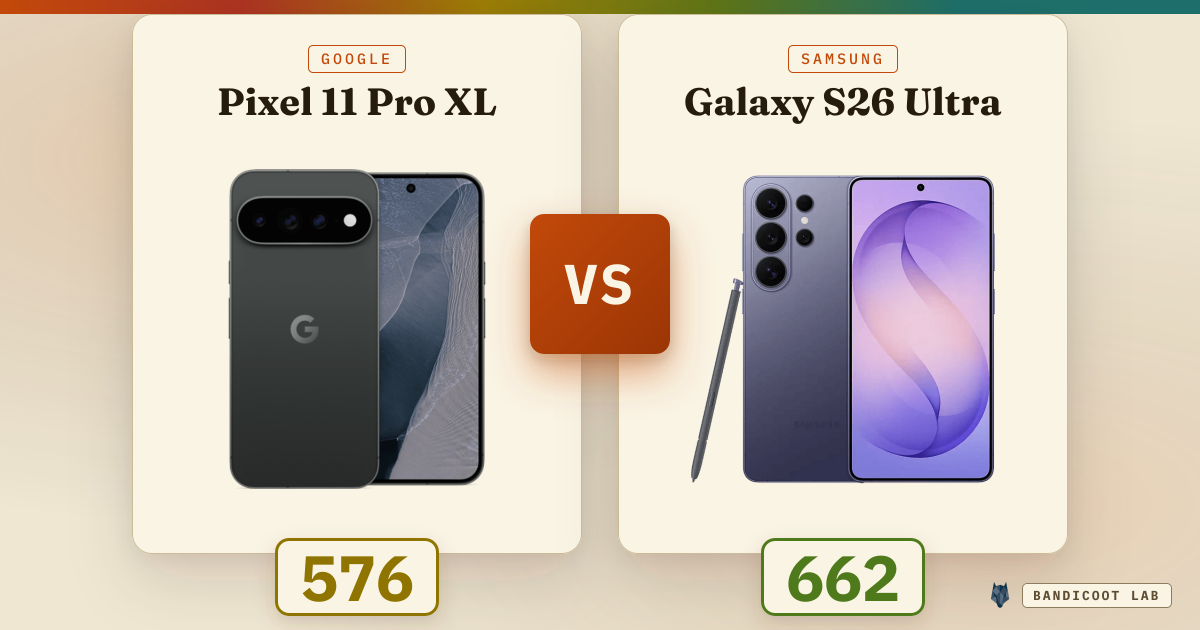
Google Pixel 11 Pro XL vs Samsung Galaxy S26 Ultra