Xiaomi 17T Pro vs Xiaomi 17
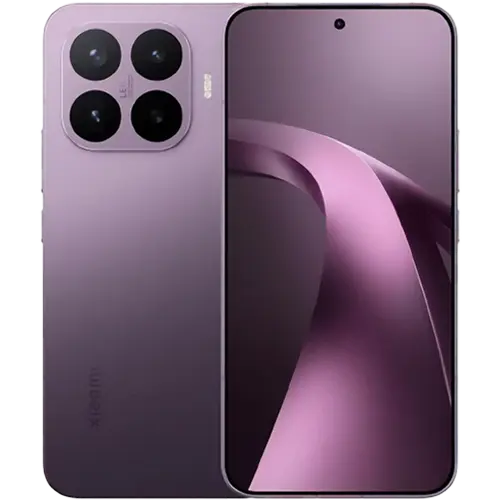
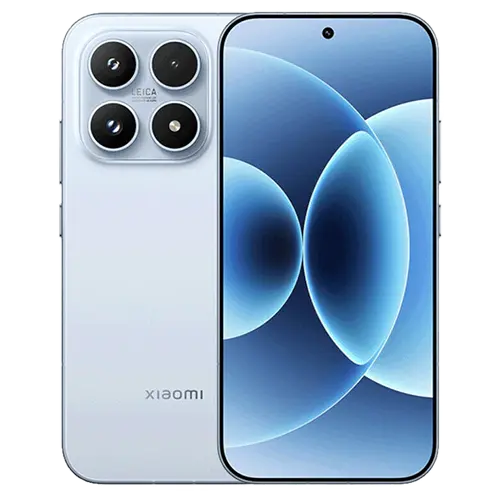
Xiaomi
Xiaomi
17T Pro
17
Ranked #12 of 60
Ranked #15 of 60
Overall
Overall
The Xiaomi 17T Pro and Xiaomi 17 share a brand and a generation but target different buyers. The 17T Pro is the bigger, longer-lasting option, built around a large display, a massive battery, and a periscope telephoto that reaches 120x digital zoom. The Xiaomi 17 is a compact flagship that prioritizes refined processing power, a better speaker system, and a smaller footprint that's easier to live with day to day.
The 17T Pro has the stronger battery life and charges faster, especially wirelessly. Its main camera is sharper, and that 5x telephoto gives it more optical reach. The Xiaomi 17 counters with a better display, faster CPU and significantly better AI performance, a speaker that's in a different league, and quicker biometrics. The camera is mixed: the 17's ultrawide is clearly stronger, its dynamic range is broader on the main sensor, and its front camera handles color more consistently. Neither phone runs away with everything, and the $100 price difference only makes the decision harder.
Design
| Xiaomi 17T Pro | Xiaomi 17 | |
|---|---|---|
| Specifications | ||
| Dimensions | 162.2 x 77.5 x 8.25 mm | 151.1 x 71.8 x 8.1 mm |
| Weight | 219g | 191g |
| IP Rating | IP68 | IP68 |
| Frame | Aluminum | Aluminum |
| Front | Gorilla Glass 7i | Xiaomi Shield Glass |
| Back | Fiberglass | Glass |
| Screen-to-body ratio | 91.1% | 89.5% |
The Xiaomi 17T Pro is the larger phone by a significant margin: 162.2 x 77.5 x 8.25mm and 219g, versus 151.1 x 71.8 x 8.1mm and 191g for the Xiaomi 17. That's 28 grams of difference, which you'll feel in a pocket. Both use aluminum frames and carry IP68 ratings, meaning they're rated for submersion in fresh water up to the certified depth.
The front glass differs. The 17T Pro uses Gorilla Glass 7i, while the Xiaomi 17 uses Xiaomi's own Shield Glass. The back materials diverge more meaningfully: the 17T Pro uses fiberglass, the 17 uses glass. Glass backs enable wireless charging on both, but fiberglass is lighter and more resistant to shattering. The 17T Pro's 6.83-inch display achieves a 91.1% screen-to-body ratio, meaning thinner bezels relative to its size. The Xiaomi 17's smaller 6.3-inch panel sits at 89.5%. Both use a similar aspect ratio, 19.5:9 and 19.6:9 respectively.
Bandicoot Lab doesn't formally test design or durability, so these comparisons reflect specifications only.
Display
| Xiaomi 17T Pro | Xiaomi 17 | |
|---|---|---|
609/ 881 | 680/ 881 | |
Both phones use AMOLED panels at 120Hz, but the implementation differs. The Xiaomi 17's LTPO panel can drop as low as 1Hz, saving power during static content. The 17T Pro's range starts at 30Hz. The Xiaomi 17 is also sharper at 460 PPI versus 447 PPI, though that gap is small enough that you'd struggle to see it without magnification.
Manual brightness is nearly identical: 632 nits on the Xiaomi 17 versus 625 nits on the 17T Pro. HDR peak brightness is also close, with the 17T Pro reaching 3,653 nits and the Xiaomi 17 at 3,583 nits. Both panels hold their HDR brightness similarly across window sizes, at around 56%. Over a sustained 30-minute HDR test, both are excellent, holding 98.7% of their brightness.
Color accuracy favors the Xiaomi 17. Its best-calibrated mode produces colors that stay very close to reference across the spectrum, with only minor drift in the most demanding patches. The 17T Pro is decent but shows more visible deviation, particularly in midtones, where colors drift enough to notice in side-by-side comparisons. Both panels cover sRGB almost completely and about 74% of the wider DCI-P3 gamut.
For HDR tone mapping, both panels clip at the same input level, but they handle the curve differently. The Xiaomi 17 pushes highlights noticeably brighter than mastered, which makes HDR content pop but strays further from the filmmaker's intent. The 17T Pro applies a lighter boost, staying closer to the reference PQ curve. If you prefer punchy HDR, the Xiaomi 17's approach works; if you prefer accuracy, the 17T Pro is closer to faithful.
Touch latency is 12.2ms on the Xiaomi 17 versus 16.3ms on the 17T Pro. That 4ms gap is not perceptible.
Performance
| Xiaomi 17T Pro | Xiaomi 17 | |
|---|---|---|
753/ 1012 | 811/ 1012 | |
The Xiaomi 17T Pro runs a MediaTek Dimensity 9500 with 12GB of RAM. The Xiaomi 17 uses a Qualcomm Snapdragon 8 Elite Gen 5, available in 12GB or 16GB configurations.
In CPU benchmarks, the Snapdragon 8 Elite Gen 5 leads. GeekBench 6 single-core comes in at 3,612 versus 3,331 for the Dimensity 9500, and multi-core is 10,650 versus 10,150. These gaps are modest and won't show up in most daily tasks, but they give the Xiaomi 17 an edge in sustained, CPU-heavy workloads like complex app switching or export-heavy workflows.
GPU performance tilts toward the 17T Pro. Its peak Wild Life Extreme score is 7,062 versus 6,333 on the Xiaomi 17, and it also leads in the Solar Bay stress test with a peak of 13,185 versus 10,704. Stability under sustained load is similar: the 17T Pro holds about 62% in Wild Life Extreme and 61% in Solar Bay, while the Xiaomi 17 manages 66.8% and 68.1%. The Xiaomi 17 throttles less, but it starts from a lower peak.
Browser performance is dramatically different. The Xiaomi 17 scores 23 on the Speedometer test versus 9.1 for the 17T Pro. You'll feel that in web-heavy use, where pages with complex JavaScript load and respond faster on the Xiaomi 17.
Camera
| Xiaomi 17T Pro | Xiaomi 17 | |
|---|---|---|
515/ 587 | 494/ 587 | |
Both phones carry 50-megapixel main sensors of the same 1/1.31-inch size, but the lens configurations and processing diverge. The 17T Pro pairs its main camera with a 12-megapixel ultrawide and a 50-megapixel 5x periscope telephoto, reaching 120x digital zoom. The Xiaomi 17 matches with a 50-megapixel ultrawide and a 50-megapixel 3x telephoto, topping out at 60x digital zoom.
The 17T Pro's main camera is the sharper of the two across all lighting conditions. Detail holds well from bright light through dim scenes. The Xiaomi 17's main is solid but visibly softer. The Xiaomi 17 gains ground on the ultrawide, which resolves significantly more detail than the 17T Pro's 12-megapixel unit. At the telephoto level, the 17T Pro's 5x lens is sharper in bright light, but the two converge as light drops.
At extreme zoom levels beyond 10x, both phones rely on digital cropping and neither produces particularly sharp results. The 17T Pro's 120x max zoom captures more distant subjects, but detail at those levels is rough. The Xiaomi 17's 60x ceiling means less reach, and its deep zoom detail is also modest. If long zoom is important to you, the 17T Pro gets you closer to the subject, but don't expect clean results past about 10–15x on either phone.
Both phones push saturation slightly, giving images a vivid character. The 17T Pro is more restrained about it, landing close to neutral in most conditions. The Xiaomi 17 runs warmer and a touch more saturated in bright light. Neither produces dull or flat-looking images out of the box.
Hue accuracy is broadly similar on both main cameras. The 17T Pro shows slightly more drift as lighting dims, with a mild warm shift in low light that looks like a white balance correction issue rather than a sensor limitation. The Xiaomi 17 follows a similar pattern but with a stronger yellow push under warm, dim lighting, also pointing to white balance behavior. Skin tones on both phones shift noticeably in bright light. The 17T Pro's main camera renders skin tones most accurately in mid light; the Xiaomi 17 is closest in low light.
Main
| Xiaomi 17T Pro (Main) | Xiaomi 17 (Main) | |
|---|---|---|
551/ 722 | 569/ 722 | |
The 17T Pro's main camera is sharper across the board. It holds detail well from bright to dark scenes, with only a modest drop in the darkest conditions. The Xiaomi 17's main camera is clearly softer, particularly in mid and bright light, where you'd expect it to perform best. Both use the same sensor size, so the gap comes down to lens and processing differences.
The 17T Pro covers 1x to 5x before handing off to its telephoto. It holds detail well through about 2x digital crop, with gradual softening beyond that. The Xiaomi 17 covers 1x to 3x before its telephoto takes over, and its crops at 2x are softer than the 17T Pro's at the same level.
Dynamic range is a genuine difference. The Xiaomi 17's main camera retains more shadow detail and handles high-contrast scenes with more depth. The 17T Pro clips highlights and compresses shadows more aggressively, making contrasty scenes look flatter. Both clip highlights, but the Xiaomi 17 gives you more to work with in the shadows.
Color character on the main cameras is similar. The 17T Pro adds a touch of saturation evenly, while the Xiaomi 17 pushes saturation a bit more, particularly in bright light. In mid light, both settle close to neutral. In low light, the Xiaomi 17 drifts toward yellow-warm tones, while the 17T Pro stays closer to neutral with a slight warm lean.
Ultrawide
| Xiaomi 17T Pro (Ultrawide) | Xiaomi 17 (Ultrawide) | |
|---|---|---|
533/ 722 | 605/ 722 | |
The Xiaomi 17's ultrawide is the standout here. Its 50-megapixel, 1/2.76-inch sensor resolves substantially more detail than the 17T Pro's 12-megapixel, 1/3.06-inch unit. The gap is largest in bright light and narrows somewhat in darker conditions, but the Xiaomi 17's ultrawide is sharper across the board. It also comes closer to matching its own main camera's detail level, whereas the 17T Pro's ultrawide drops off more steeply from its main.
Dynamic range is also stronger on the Xiaomi 17's ultrawide, with better shadow retention. Both clip highlights.
Color between the two ultrawide cameras differs meaningfully. The Xiaomi 17's ultrawide leans slightly desaturated in most lighting, giving landscapes a natural but sometimes muted look. The 17T Pro's ultrawide runs closer to neutral saturation. Skin tones are problematic on both in bright light, with large shifts from reference. In mid and low light, both improve considerably, with the Xiaomi 17 getting closer to accurate skin rendering.
Hue accuracy on the Xiaomi 17's ultrawide degrades in low light with a strong yellow push, consistent with white balance struggling under warm illumination. The 17T Pro's ultrawide shows moderate hue errors across conditions without as clear a pattern, suggesting the sensor itself is the limiting factor.
Video stabilization on the ultrawide favors the 17T Pro, which keeps handheld footage noticeably more controlled.
Telephoto
| Xiaomi 17T Pro (Telephoto) | Xiaomi 17 (Telephoto) | |
|---|---|---|
522/ 722 | 499/ 722 | |
The 17T Pro's 5x telephoto (115mm) and the Xiaomi 17's 3x telephoto (60mm) serve different purposes. The 17T Pro's longer reach is better for isolating distant subjects, while the Xiaomi 17's 3x is a more versatile portrait and mid-range zoom lens.
At their native focal lengths in bright light, the 17T Pro's telephoto is sharper. As light drops to mid levels, the gap narrows, and in low light the 17T Pro's detail falls off considerably while the Xiaomi 17's holds more steadily. Beyond their native lengths, both rely on digital cropping. The 17T Pro can push further before things break down, simply because it starts from a longer optical base, but neither produces clean detail at the far ends of their zoom range.
Dynamic range is close between the two telephoto cameras. Both clip highlights, and the Xiaomi 17 has slightly better tonal gradation. The 17T Pro produces cleaner tonal transitions without the inversions that occasionally appear on the Xiaomi 17.
Color tuning diverges. The 17T Pro's telephoto sits close to neutral saturation, almost slightly undersaturated in mid and low light, giving a restrained look. The Xiaomi 17's telephoto pushes saturation harder in bright light and settles closer to neutral as light dims. Skin tones are handled well by both in bright and mid light, but both drift in low light.
Hue accuracy degrades on both telephoto cameras under warmer, dimmer lighting. The 17T Pro shows an increasing yellow push as light warms, a clear white balance issue. The Xiaomi 17 shows a similar trend with an additional warm-magenta lean in mid light.
The Xiaomi 17's telephoto shows more shake in video, while the 17T Pro keeps things steadier. At 5x magnification, that matters.
Front
| Xiaomi 17T Pro (Front) | Xiaomi 17 (Front) | |
|---|---|---|
542/ 722 | 429/ 722 | |
Both front cameras use 21mm equivalent lenses. The 17T Pro has a 32-megapixel sensor, the Xiaomi 17 a 50-megapixel one. Sharpness favors the 17T Pro across all lighting conditions, which is a bit unexpected given the megapixel difference. The gap is clearest in bright and mid light and narrows in low light.
Dynamic range on the front camera is a clear win for the Xiaomi 17. It retains much more shadow and highlight information, making selfies in mixed lighting look more natural. The 17T Pro clips highlights and compresses the tonal range heavily.
Color is where the Xiaomi 17's front camera pulls ahead most convincingly. It renders skin tones more accurately across all three lighting conditions, and its hue accuracy is the best of any lens on either phone. Colors stay controlled even in low light, with only a mild warm shift. The 17T Pro's front camera starts well in bright light with very accurate skin tones, but accuracy drops noticeably in mid and low light.
Both front cameras produce slightly desaturated images, which tends to give selfies a more natural look than oversaturated alternatives. The 17T Pro desaturates more aggressively as light dims.
Battery
| Xiaomi 17T Pro | Xiaomi 17 | |
|---|---|---|
695/ 836 | 513/ 836 | |
The 17T Pro's 7,000mAh battery is substantially larger than the Xiaomi 17's 6,330mAh cell, and that capacity advantage translates directly to endurance.
In video playback, the 17T Pro lasts 30.6 hours versus 26.3 hours for the Xiaomi 17. Both are strong. The 17T Pro's result means you could get through roughly two full days of mixed use before reaching for a charger. The Xiaomi 17 is more like a day and a half of heavy use.
Web browsing drain over a five-hour test tells a starker story: the 17T Pro uses 18% versus 26% on the Xiaomi 17. That's a meaningful gap. If your day is mostly scrolling, messaging, and reading, the 17T Pro will comfortably outlast the Xiaomi 17.
Gaming drain during the one-hour stress test is closer: 23% on the 17T Pro versus 25% on the Xiaomi 17. Both will get through a long gaming session without anxiety, but the 17T Pro's larger battery gives it more buffer.
Standby drain is where the 17T Pro pulls furthest ahead. Over an eight-hour overnight idle, it loses just 2% versus 7% on the Xiaomi 17. The Xiaomi 17's standby drain is high enough to be annoying. If you don't charge overnight, you'll notice the difference in the morning.
Charging
| Xiaomi 17T Pro | Xiaomi 17 | |
|---|---|---|
718/ 837 | 415/ 837 | |
Both phones support 100W wired and 50W wireless charging, but the real-world results are very different.
Wired charging is close. The 17T Pro reaches 33% in 10 minutes and 79% in 30 minutes. The Xiaomi 17 hits 31% in 10 minutes and 74% in 30 minutes. Given the 17T Pro's larger battery, that parity in percentages actually means more energy delivered in the same time.
Wireless charging is where the comparison falls apart. The 17T Pro reaches 19% in 10 minutes and 48% in 30 minutes. The Xiaomi 17 manages just 4% in 10 minutes and 9% in 30 minutes. Both phones are rated for 50W wireless, but the Xiaomi 17's wireless charging performance is barely functional by comparison. If wireless charging matters to your routine, the 17T Pro is the only real option here.
Speaker
| Xiaomi 17T Pro | Xiaomi 17 | |
|---|---|---|
636/ 897 | 845/ 897 | |
The Xiaomi 17 has a clearly better speaker system. Its frequency response is much more even, with deep, full bass and clean highs. Distortion is well-controlled at 5.19% THD.
The 17T Pro is louder, peaking at 76.3 dBA versus 71 dBA. Its frequency response is less balanced, with bass that doesn't extend as low and more unevenness across the range. Distortion is higher at 8.16% THD, and you can hear it at higher volumes as harshness in the upper frequencies.
The Xiaomi 17 is one of the better-sounding phone speakers around. The 17T Pro gets louder, which is useful in noisy environments, but the Xiaomi 17 sounds better at any shared volume level.
Microphone
| Xiaomi 17T Pro | Xiaomi 17 | |
|---|---|---|
390/ 1220 | 467/ 1220 |
Neither phone stands out for microphone quality. The Xiaomi 17 is slightly more even across frequencies, making it the better of the two for voice calls and casual recording. The 17T Pro's microphone is more uneven, which can make voices sound less natural. Both fall below average.
Other
| Xiaomi 17T Pro | Xiaomi 17 | |
|---|---|---|
| Biometrics | 461/ 1181 | 646/ 1181 |
| Data Transfer | 108/ 943 | 762/ 943 |
| Specifications | ||
| Biometric type | Fingerprint | Fingerprint |
| Ports | USB-C 2.0 | USB-C 3.2 |
| Storage | 256GB, 512GB, 1TB | 256GB, 512GB, 1TB |
Fingerprint unlocking is faster on the Xiaomi 17 at 163ms versus 228ms on the 17T Pro. The Xiaomi 17 uses an ultrasonic sensor, while the 17T Pro uses an optical one. You'll notice the difference in daily use. The ultrasonic sensor also tends to be more reliable with wet or oily fingers. Neither phone has hardware-based face unlock.
Data transfer speeds are dramatically different. The Xiaomi 17 uses USB-C 3.2 and reaches read speeds of 323 MB/s and write speeds of 341 MB/s. The 17T Pro uses USB-C 2.0, maxing out at 38 MB/s read and 36 MB/s write. If you regularly transfer large files to a computer, the Xiaomi 17 is roughly nine times faster. Both phones are available in 256GB, 512GB, and 1TB storage configurations.
Conclusion
The Xiaomi 17T Pro is the endurance and charging champion. Its battery lasts longer across every test, its wireless charging actually works at speed, and its main camera is the sharper of the two. The 5x telephoto gives it real optical reach that the Xiaomi 17 can't match. If battery life is your primary concern, or if you want the best main camera sharpness and long zoom capability between these two, the 17T Pro delivers.
The Xiaomi 17 is the more refined device. It has the better display, faster processor, a speaker that sounds better, faster biometrics, and USB-C 3.2 for actual file transfer speeds. Its ultrawide camera is significantly stronger, its main camera captures better dynamic range, and its front camera handles color more accurately. It's also 28 grams lighter and noticeably more compact.
Someone who prioritizes battery life and telephoto reach saves money with the 17T Pro and gets more of what they care about. Someone who wants a compact, fast all-rounder with a great speaker and better everyday polish pays the premium for the Xiaomi 17. The wireless charging gap alone could be the deciding factor if you've built your routine around a wireless pad.
FAQ
Does the Xiaomi 17T Pro or Xiaomi 17 have better battery life?
The 17T Pro lasts longer across every test: 30.6 hours of video playback versus 26.3 hours for the Xiaomi 17, and less than a third of the web browsing drain over five hours. Standby is where the gap is most jarring — the Xiaomi 17 loses 7% overnight idle compared to just 2% on the 17T Pro. If you skip nightly charging, that difference will show up every morning.
Is the Xiaomi 17's wireless charging actually faster than the 17T Pro's?
No — despite both being rated for 50W wireless, the Xiaomi 17 reaches only 9% in 30 minutes wirelessly, while the 17T Pro hits 48% in the same window. Wired charging is close between the two phones, but if your routine relies on a wireless pad, only the 17T Pro delivers meaningful wireless charging speed.
Which phone is better for photography — the 17T Pro or the Xiaomi 17?
It depends on which lens matters most to you. The 17T Pro's main camera is sharper across lighting conditions, and its 5x telephoto gives it more optical reach. The Xiaomi 17 counters with a much stronger ultrawide, broader dynamic range on the main sensor, and a front camera that keeps color and skin tones more consistent across lighting. If you shoot a lot of wide scenes or selfies, the Xiaomi 17 has the edge; for reach and main-camera sharpness, the 17T Pro wins.
Is the Xiaomi 17 worth the extra $100 over the 17T Pro?
The Xiaomi 17's advantages over the 17T Pro are real and varied: a more color-accurate display, far faster CPU and AI performance, a genuinely better speaker, 65ms quicker fingerprint unlocking, and USB-C 3.2 transfer speeds roughly nine times faster than the 17T Pro's USB-C 2.0. You also get a 28-gram lighter phone in a notably more compact body. The 17T Pro beats it on battery life, wireless charging, main camera sharpness, and telephoto reach. The $100 premium for the Xiaomi 17 is worth it if everyday polish, processing speed, or speaker quality drives your decision — not if endurance or zoom reach does.
Which phone is better for gaming — the Xiaomi 17 or the 17T Pro?
The 17T Pro posts higher peak GPU scores in both the Wild Life Extreme and Solar Bay benchmarks, giving it more raw graphics headroom. The Xiaomi 17 throttles less under sustained load, so it stays more consistent over longer sessions, but it starts from a lower ceiling. The Xiaomi 17 also has 4ms lower touch latency, which is borderline perceptible in fast-paced games. Gaming battery drain is close — 25% versus 23% — so neither phone has a major endurance advantage during play.
Related
Xiaomi
17T Pro
Xiaomi
17
Xiaomi
17 Ultra
Xiaomi
15T Pro
Xiaomi 17T Pro vs Xiaomi 15T Pro
Xiaomi 17T Pro vs Samsung Galaxy S26
Xiaomi 17T Pro vs OnePlus 15
Xiaomi 17T Pro vs Google Pixel 10 Pro
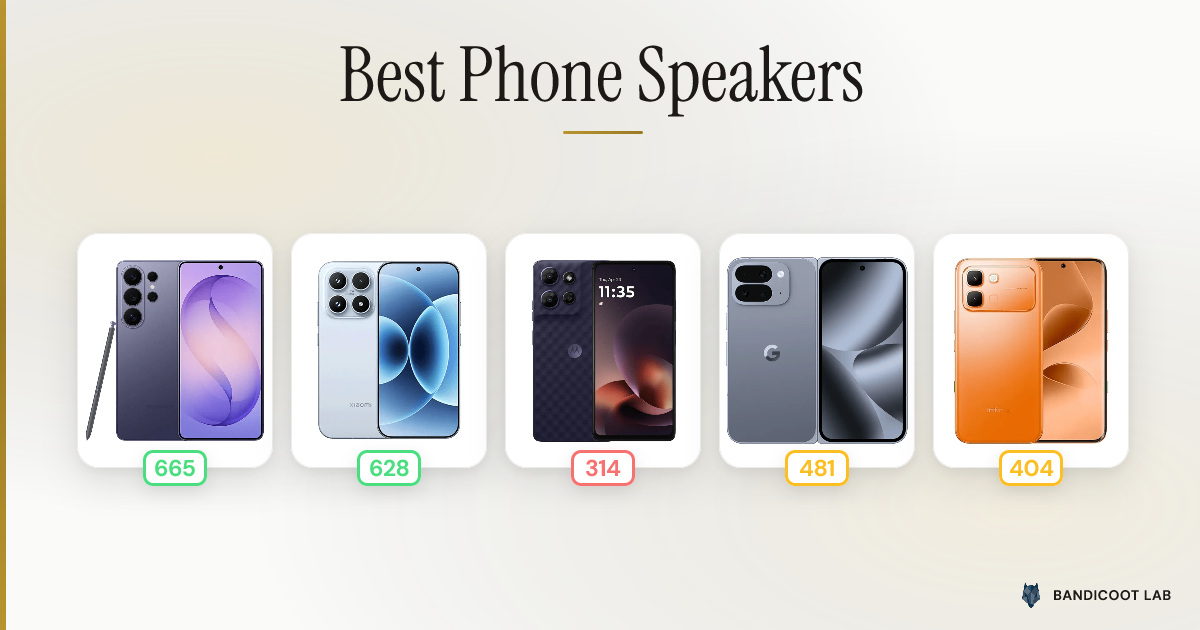
Best Phone Speakers
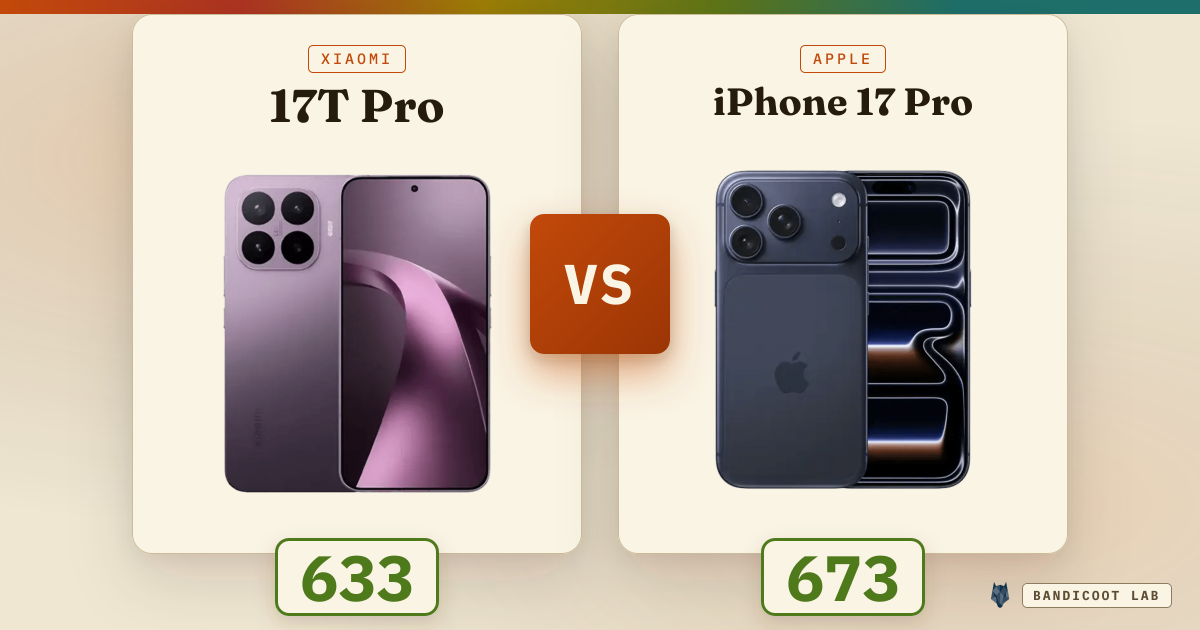
Xiaomi 17T Pro vs Apple iPhone 17 Pro
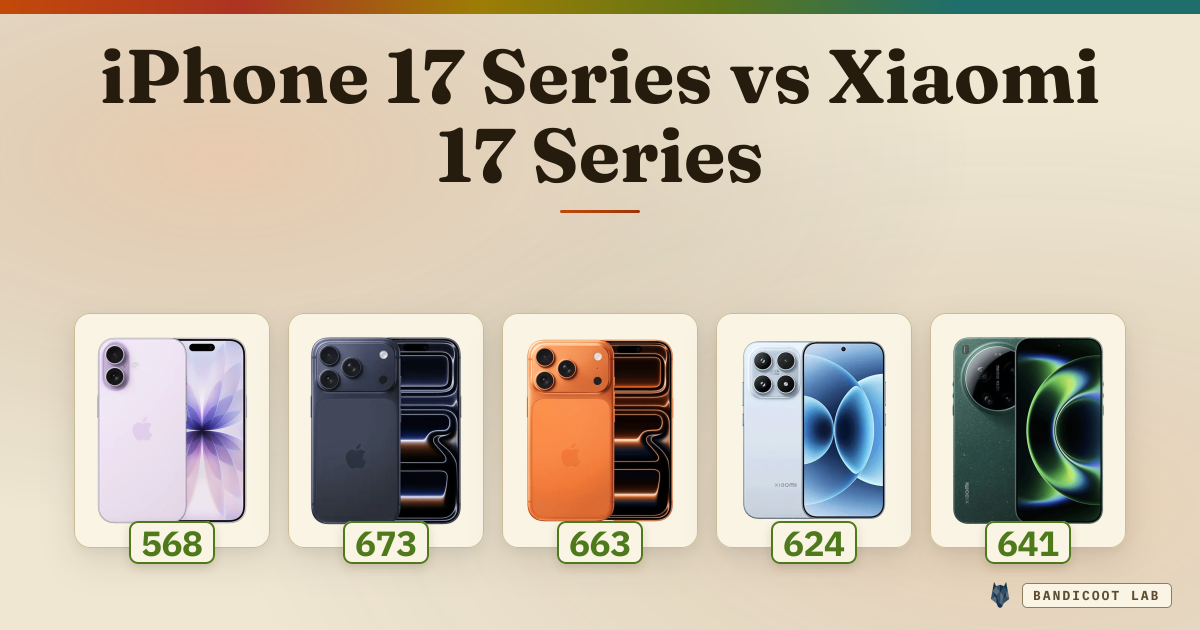
iPhone 17 Series vs Xiaomi 17 Series

Samsung Galaxy S26 Series vs Xiaomi 17 Series