RedMagic 12 Pro vs Poco F9 Ultra


RedMagic
Poco
12 Pro
F9 Ultra
Ranked #5 of 62
Ranked #1 of 62
Overall
Overall


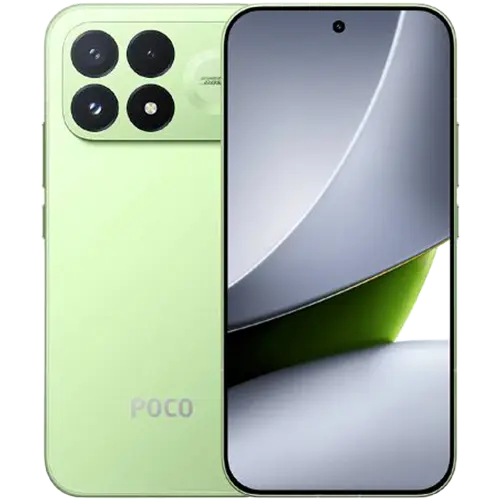
The RedMagic 12 Pro is a $949 gaming phone built around the fastest available mobile processor, with everything else playing a supporting role. The Poco F9 Ultra costs $150 less at $799 and spreads its budget more evenly: a value flagship with a full camera system and a strong display, competing across every category rather than dominating one.
The Poco comes out ahead in more places. It has a brighter display, substantially longer battery life, a far more capable camera system, and better speakers. The RedMagic leads in raw CPU and GPU performance and has faster wireless charging. Whether that processing advantage is worth the $150 premium depends on what you actually do with your phone.
Design
| RedMagic 12 Pro | Poco F9 Ultra | |
|---|---|---|
| Specifications | ||
| Dimensions | 163.03 x 75.96 x 8.55 mm | 163.5 x 77.9 x 8.7 mm |
| Weight | 223g | 235g |
| IP Rating | IP68/IP69 | IP68 |
| Frame | Aluminum | Aluminum |
| Front | Gorilla Glass 7i | Gorilla Glass 7i |
| Back | Gorilla Glass 7i | Plastic |
| Screen-to-body ratio | 96.3% | 91.5% |
Both phones use aluminum frames and Gorilla Glass 7i on the front. The RedMagic also uses Gorilla Glass 7i on the back; the Poco uses plastic. The RedMagic is lighter at 223g versus 235g and slightly more compact at 163.03 x 75.96 x 8.55mm compared to 163.5 x 77.9 x 8.7mm. Aspect ratios are in the same tall-and-narrow range: 19.9:9 for the RedMagic, 19.5:9 for the Poco.
The RedMagic's 96.3% screen-to-body ratio means very thin bezels around its 6.85-inch panel. The Poco's 91.5% on its 6.9-inch display leaves noticeably more border. The RedMagic carries both IP68 and IP69 ratings. IP68 covers submersion to the rated depth; IP69 adds resistance to high-pressure, high-temperature water jets. The Poco is rated IP68 only.
Bandicoot Lab doesn't formally test design or durability. Everything in this section is based on published specifications.
Display
| RedMagic 12 Pro | Poco F9 Ultra | |
|---|---|---|
599/ 881 | 879/ 881 | |
Both panels are AMOLED, refreshing up to 185Hz. The RedMagic's resolution is 1216 x 2688 at 431 pixels per inch; the Poco's is 1200 x 2608 at 416 PPI. You won't notice that pixel density difference.
Brightness separates them. In manual mode, the Poco reaches 863 nits to the RedMagic's 718 nits. For HDR content with auto brightness, the Poco peaks at 11,983 nits; the RedMagic peaks at 1,769 nits. The Poco achieves that figure with small bright elements on screen. As HDR content fills more of the display, its brightness drops to about 19% of peak. The RedMagic holds 100% of its peak brightness regardless of how much screen area is lit. Even with the Poco's steep drop-off at larger window sizes, it still delivers more HDR brightness than the RedMagic at every content size. Over a sustained 30-minute test, both hold their output well: 98.9% for the Poco, 98.5% for the RedMagic. The Poco also dims lower for dark-room viewing, reaching 0.75 nits at minimum versus the RedMagic's 1.66 nits.
Color accuracy is the RedMagic's strength. In its best display mode, colors stay close to reference with minimal visible drift. The Poco shows slightly more color error, and its DCI-P3 gamut coverage is only 71.9% compared to the RedMagic's 96.4%. sRGB coverage is closer: 97% for the Poco, 99.7% for the RedMagic. That P3 gap is meaningful. Wide-gamut content, including HDR video and photos shot in wider color spaces, won't render its full color range on the Poco.
The Poco's tone mapper follows the HDR reference curve more closely in overall shape but pushes highlights dramatically above their mastered brightness, making HDR content look lifted and punchy. It begins clipping at 85% of the input signal. The RedMagic barely boosts highlights above reference, but its overall tone curve deviates more from the standard. It clips later, at 90%.
Touch latency is 12.2ms on the RedMagic and 13.7ms on the Poco. That 1.5ms gap isn't perceptible.
Performance
| RedMagic 12 Pro | Poco F9 Ultra | |
|---|---|---|
1000/ 1012 | 864/ 1012 | |
The RedMagic 12 Pro runs the Snapdragon 8 Elite Extreme Gen 6; the Poco F9 Ultra uses the previous-generation Snapdragon 8 Elite Gen 5. Both are configured with 16GB of RAM in the tested units, with 12GB options available from each.
The generational gap shows in CPU benchmarks. The RedMagic scores 4,090 single-core and 11,916 multi-core in GeekBench 6, compared to the Poco's 3,546 and 10,605. That's roughly a 15% single-core lead and 12% in multi-core. GPU peak performance follows: 8,599 in Wild Life Extreme versus 7,439, and 16,595 in Solar Bay versus 13,336. The Poco sustains its GPU performance better under extended loads. It holds 70.9% stability in Wild Life Extreme versus the RedMagic's 65.6%, and 67.1% versus 60% in Solar Bay. In a long gaming session, the Poco throttles less.
Browser performance shows a larger gap than the raw silicon alone suggests. The RedMagic scores 28.6 on Speedometer; the Poco scores 16.9. That's nearly 70% faster. You'll feel it in complex web apps and JavaScript-heavy pages.
For app launches, scrolling, and everyday navigation, both chips are more than fast enough. You'll feel the RedMagic's advantage in sustained gaming, heavy multitasking, and web browsing.
Camera
| RedMagic 12 Pro | Poco F9 Ultra | |
|---|---|---|
382/ 587 | 548/ 587 | |
The camera systems aren't in the same class. The Poco F9 Ultra carries a 200-megapixel main camera (f/1.68, 24mm, 1/1.4-inch sensor), a 50-megapixel ultrawide, and a 50-megapixel 5x telephoto, with digital zoom extending to 100x. The RedMagic 12 Pro has a 50-megapixel main and a 50-megapixel ultrawide. No telephoto. Digital zoom tops out at 10x.
Sharpness across the system reflects that hardware gap. Both main cameras resolve well at 1x in good light, and the difference between them there is small. Beyond 1x, the Poco's larger, higher-resolution sensor holds detail longer through its digital crop range before the telephoto takes over at 5x. The RedMagic relies on digital crop for its entire 1x to 10x range, and quality drops quickly past 2-3x. At 10x, its maximum, it produces very little useful detail. The Poco at 10x is still working from its dedicated telephoto and delivers far more usable results. At extreme zoom levels beyond that, quality naturally degrades, but the Poco maintains enough detail for framing and identification even at very long distances. The Poco's ultrawide is dramatically sharper than the RedMagic's as well. The RedMagic's front camera is slightly sharper than the Poco's, and that's its only sharpness advantage across the entire system.
Color separates them further. The Poco produces mildly saturated images in bright light and maintains consistent color as conditions dim, with a slight warm lean under warmer lighting. Hue accuracy holds well throughout. The RedMagic's processing pushes saturation harder in bright light, producing a vivid, punchy look. Under warm mid and low light, its white balance overcorrects heavily toward blue, causing hue accuracy to degrade. Colors that look fine outdoors drift significantly under warm indoor or evening light. Both phones show elevated skin tone errors in bright light, but in mid and low light the Poco is far more accurate. The RedMagic's skin tones are off in every condition.
Main
| RedMagic 12 Pro (Main) | Poco F9 Ultra (Main) | |
|---|---|---|
440/ 722 | 582/ 722 | |
The RedMagic's 50-megapixel main covers 1x to 10x entirely through digital crop. The Poco's 200-megapixel main (f/1.68, 24mm, 1/1.4-inch sensor) handles 1x to 5x before handing off to the telephoto. At 1x, both are sharp in bright and mid light. The Poco edges ahead slightly in bright conditions; the RedMagic holds a small advantage in low light. As you crop in, the Poco maintains cleaner detail through 3-4x where the RedMagic has already softened visibly.
The Poco leans mildly saturated in bright light, with consistent rendering as lighting dims and a subtle warm lean in warmer conditions. Hue accuracy stays solid across the range. The RedMagic pushes saturation in bright light, producing vivid colors, especially reds and greens. In warmer mid and low light, white balance overcorrects aggressively toward blue, with a secondary magenta cast appearing in mid-light conditions. This tracks with the change in ambient color temperature: as the lighting shifts warmer, the processing swings harder in the opposite direction. It's a white balance processing issue rather than a sensor limitation. Skin tones are inaccurate on both phones in bright light. In mid and low light, the Poco's skin rendering is strong; the RedMagic's remains poor.
The Poco captures more shadow detail in high-contrast scenes but clips highlights. The RedMagic preserves highlights better but recovers less shadow information overall. Stabilization is a major gap: the Poco keeps handheld video steady, while the RedMagic shows significant shake.
Ultrawide
| RedMagic 12 Pro (Ultrawide) | Poco F9 Ultra (Ultrawide) | |
|---|---|---|
371/ 722 | 551/ 722 | |
The Poco's 50-megapixel ultrawide (f/2.4, 18mm) resolves roughly twice the detail of the RedMagic's 50-megapixel ultrawide in bright and mid light. In low light both drop, but the Poco still resolves more. Neither ultrawide matches its own main camera, but the Poco's comes closer, maintaining strong detail where the RedMagic's looks soft.
Color patterns mirror the main cameras. The Poco's ultrawide leans slightly warm in dimmer conditions, with good hue accuracy throughout. Skin tones show error in bright light but are solid in mid and low light. The RedMagic's ultrawide oversaturates in bright light and shows the same blue-shifting white balance overcorrection in warmer lighting. Hue accuracy degrades considerably. Skin tones are poor across all conditions.
The Poco retains more range in high-contrast scenes, recovering deeper shadows. Both clip highlights, but the RedMagic clips more aggressively and captures less overall tonal range. The Poco's ultrawide also handles handheld video with less visible shake.
Telephoto
| RedMagic 12 Pro (Telephoto) | Poco F9 Ultra (Telephoto) | |
|---|---|---|
| — | 605/ 722 | |
The RedMagic 12 Pro doesn't have a telephoto lens. All zoom beyond 1x comes from digital crop on the main sensor. The Poco F9 Ultra carries a 50-megapixel 5x telephoto (f/3, 120mm) that takes over from the main camera at 5x and handles zoom through its 100x digital maximum.
At its native 5x, the Poco's telephoto is sharp in bright and mid light and drops in low light, as expected for a smaller sensor at f/3. Detail holds reasonably as the lens crops digitally beyond 5x, softening gradually rather than falling off a cliff. At very long zoom levels, images lose fine detail, but subjects remain recognizable. The telephoto produces the best skin tones of any lens on either phone, with low error in mid and low light. Colors lean mildly vivid with a subtle warm lean in dimmer conditions, consistent with the Poco's other lenses. Hue accuracy is good. Dynamic range is narrower than the main camera, with highlights clipping in high-contrast scenes. Stabilization stays well-controlled.
Front
| RedMagic 12 Pro (Front) | Poco F9 Ultra (Front) | |
|---|---|---|
415/ 722 | 521/ 722 | |
The RedMagic's 16-megapixel front camera is slightly sharper than the Poco's 32-megapixel front (f/2.2, 21mm) across all lighting levels. The difference is small, and both produce adequate selfie detail.
Color accuracy tells a different story. The Poco's front camera carries a consistent, subtle cool-green cast across all conditions. That cast holds steady regardless of light temperature, pointing to a tuning choice rather than a processing artifact. Hue accuracy is excellent and barely changes from bright to dim. Skin tones are good in mid and low light; bright-light skin tone error matches the pattern seen across the Poco's rear lenses. The RedMagic's front camera shows moderate hue errors even in bright light, and accuracy worsens significantly in warm, dim conditions. The bias pattern doesn't track cleanly with light temperature, suggesting sensor-level limitations rather than a simple white balance problem. Skin tones are inconsistent, with large errors in both bright and dark conditions. Saturation drops sharply in low light, leaving colors looking washed out.
The Poco captures wider dynamic range, retaining more of the background in high-contrast selfies, though it clips the brightest highlights. The RedMagic holds highlights without clipping but recovers less shadow detail. The Poco's front camera is also noticeably steadier for video.
Battery
| RedMagic 12 Pro | Poco F9 Ultra | |
|---|---|---|
732/ 836 | 836/ 836 | |
The RedMagic 12 Pro has an 8,400mAh battery; the Poco F9 Ultra has 8,050mAh. The Poco lasts longer despite the smaller capacity.
In video playback, the Poco ran for 42.89 hours before dying. The RedMagic lasted 30.49 hours. That 42.89-hour figure is nearly 1.8 days of continuous playback. In normal mixed use, the Poco should comfortably last two days between charges. The RedMagic's 30.49 hours will get most people through a full day with room to spare, but the efficiency gap is wide.
During our GPU stress test (20 loops of 3DMark Wild Life Extreme), the Poco drained 22% of its battery. The RedMagic drained 35%. The higher-clocked chip costs power. Web browsing drain is nearly identical: 14% over five hours for the RedMagic, 15% for the Poco. Overnight standby slightly favors the RedMagic at 2% drain versus 3%.
Charging
| RedMagic 12 Pro | Poco F9 Ultra | |
|---|---|---|
678/ 837 | 629/ 837 | |
The RedMagic 12 Pro charges at 80W wired and 80W wireless. The Poco F9 Ultra is rated at 100W wired and 50W wireless.
Despite the different wattage ratings, wired charging speed is identical: both reach 24% at 10 minutes and 61% at 30 minutes. The RedMagic's larger battery and lower wattage perfectly offset the Poco's smaller battery and higher wattage.
Wireless charging is where the RedMagic's 80W rating pays off. It reaches 19% at 10 minutes and 48% at 30 minutes, compared to 17% and 42% for the Poco. For overnight wireless charging this won't matter. For quick wireless top-ups, the RedMagic delivers more.
Speaker
| RedMagic 12 Pro | Poco F9 Ultra | |
|---|---|---|
598/ 897 | 863/ 897 | |
Both phones reach similar max volume: 75 dBA for the Poco, 74.2 dBA for the RedMagic. The Poco's speakers are clean and well-balanced, with full bass, crisp high-end detail, and low distortion at 2.36% THD. The RedMagic has similar bass presence but significantly less clarity, and it suffers from severe distortion that muddies the output. Music and dialog sound rougher and less defined, particularly at higher volumes. The gap in speaker quality is one of the widest between these two phones.
Microphone
| RedMagic 12 Pro | Poco F9 Ultra | |
|---|---|---|
625/ 1220 | 355/ 1220 |
The RedMagic's microphone produces more even, natural-sounding recordings. It's an above-average performer. The Poco's microphone is well below average, with more uneven frequency response. For video recording or voice notes, the RedMagic captures noticeably better audio.
Other
| RedMagic 12 Pro | Poco F9 Ultra | |
|---|---|---|
| Biometrics | 889/ 1181 | 822/ 1181 |
| Data Transfer | 945/ 945 | 943/ 945 |
| Specifications | ||
| Biometric type | Fingerprint | Fingerprint |
| Ports | USB-C 3.2 Gen 2 | USB-C 3.2 Gen 1 |
| Storage | 256GB, 512GB, 1TB | 256GB, 512GB, 1TB |
Both phones unlock quickly via fingerprint. The RedMagic uses an optical sensor averaging 118ms; the Poco uses an ultrasonic sensor at 128ms. That 10ms difference isn't perceptible. Neither phone has hardware-based face unlock.
Data transfer speeds are effectively identical: the RedMagic reads at 422 MB/s and writes at 420 MB/s; the Poco reads at 419 MB/s and writes at 423 MB/s. The RedMagic's USB-C 3.2 Gen 2 port theoretically supports higher peak throughput than the Poco's USB-C 3.2 Gen 1, but measured speeds don't reflect that difference. Both phones are available in 256GB, 512GB, and 1TB configurations.
Conclusion
The Poco F9 Ultra wins in most categories that affect daily use. Its display is dramatically brighter, its battery lasts markedly longer, its camera system is in a different league, and its speakers are far cleaner. It does all of this for $150 less than the RedMagic 12 Pro. Its weak spots are narrow: lower color accuracy and gamut coverage on the display, a below-average microphone, and less raw processing power.
The RedMagic 12 Pro's case is specific. Its Snapdragon 8 Elite Extreme Gen 6 delivers meaningfully more CPU and GPU throughput, and its browser performance is dramatically faster. It charges faster wirelessly, has a more color-accurate display with full P3 gamut coverage, and captures better audio through its microphone. If your use centers on gaming, emulation, or processing-intensive tasks, that's a real advantage. The camera system is a serious weakness, and the speakers are poor.
Most people use their phone for media, browsing, photography, and communication. For that profile, the Poco is the stronger phone at the lower price. The RedMagic makes sense for the narrower audience that prioritizes raw performance above everything else and can live with a camera that barely competes.
FAQ
Does the RedMagic 12 Pro or Poco F9 Ultra have the better camera?
The Poco F9 Ultra has the better camera system by a wide margin. It has a 200-megapixel main, a 50-megapixel ultrawide, and a 5x telephoto, while the RedMagic 12 Pro has only a main and an ultrawide, so all its zoom is digital crop. The RedMagic's white balance also shifts heavily toward blue under warm light, and its skin tones are off in every condition. Its front camera is slightly sharper, which is its one camera advantage.
Which lasts longer on a charge, the Poco F9 Ultra or the RedMagic 12 Pro?
The Poco F9 Ultra lasts noticeably longer despite its smaller 8,050mAh battery. It ran 42.89 hours of video playback versus 30.49 hours for the RedMagic's 8,400mAh cell. In the GPU stress test the Poco drained 22% of its battery against 35% for the RedMagic. Web browsing drain was nearly identical, and the RedMagic is slightly better in overnight standby.
Is the RedMagic 12 Pro actually better for gaming than the Poco F9 Ultra?
The RedMagic 12 Pro has higher peak CPU and GPU performance, and its browser speed is much faster. The Poco F9 Ultra holds its GPU performance better under long loads, at 70.9% stability in Wild Life Extreme versus 65.6% and 67.1% versus 60% in Solar Bay. The Poco also uses far less battery during heavy GPU work. The RedMagic suits you if you want the highest peak frame rates, while the Poco throttles less in long sessions.
Do the Poco F9 Ultra and RedMagic 12 Pro charge at the same speed?
Wired charging is identical: both reach 24% at 10 minutes and 61% at 30 minutes, even though the Poco is rated at 100W and the RedMagic at 80W. Wireless favors the RedMagic, which hits 19% at 10 minutes and 48% at 30 minutes versus 17% and 42% for the Poco. The wireless gap only matters for quick top-ups, not overnight charging.
Which has the better display, the Poco F9 Ultra or the RedMagic 12 Pro?
It depends on what you value. The Poco F9 Ultra is brighter, with 863 nits in manual mode versus 718 nits, and it is far brighter in HDR. It also dims lower for dark rooms. The RedMagic 12 Pro has more accurate color and covers 96.4% of DCI-P3 compared with the Poco's 71.9%, so wide-gamut content renders more fully on the RedMagic.
Is the RedMagic 12 Pro worth $150 more than the Poco F9 Ultra?
For most people, no. The $799 Poco F9 Ultra has the better camera, longer battery life, brighter display, and cleaner speakers. The $949 RedMagic 12 Pro is worth the premium mainly if peak CPU and GPU power, fast browser performance, wireless charging speed, or microphone quality matter more to you than everything else.
Related
Poco
F9 Ultra
RedMagic
12 Pro
Poco
F9 Pro

RedMagic
11S Pro

RedMagic
11 Air
RedMagic 12 Pro vs Xiaomi 17T Pro
RedMagic 12 Pro vs OnePlus 15
RedMagic 12 Pro vs RedMagic 11S Pro
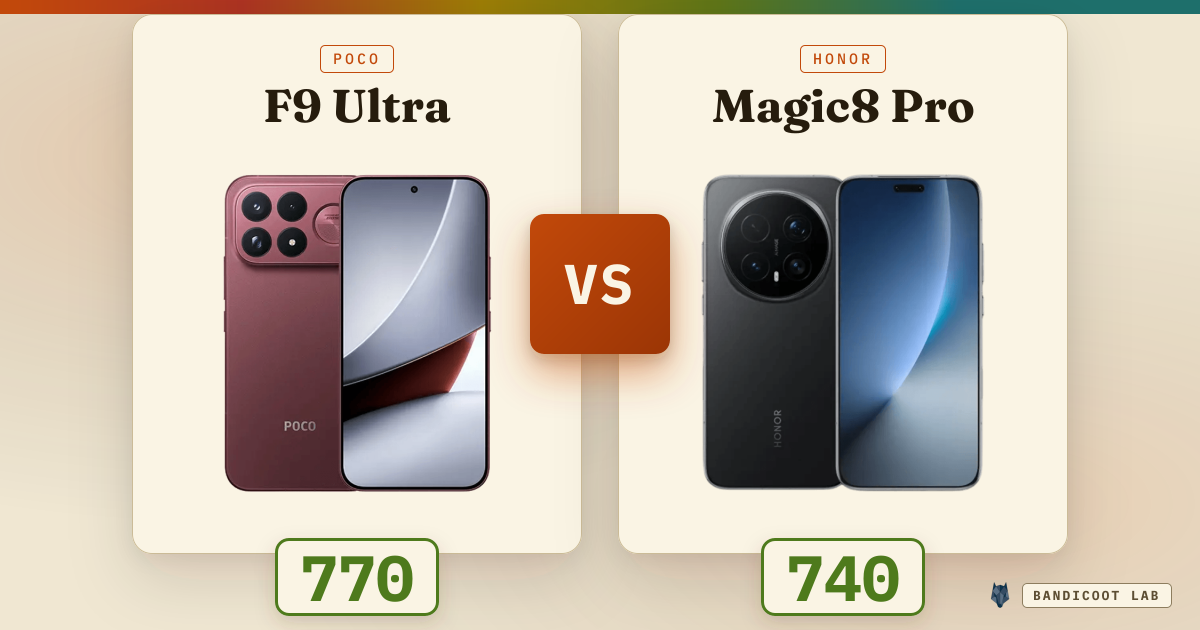
Poco F9 Ultra vs Honor Magic8 Pro
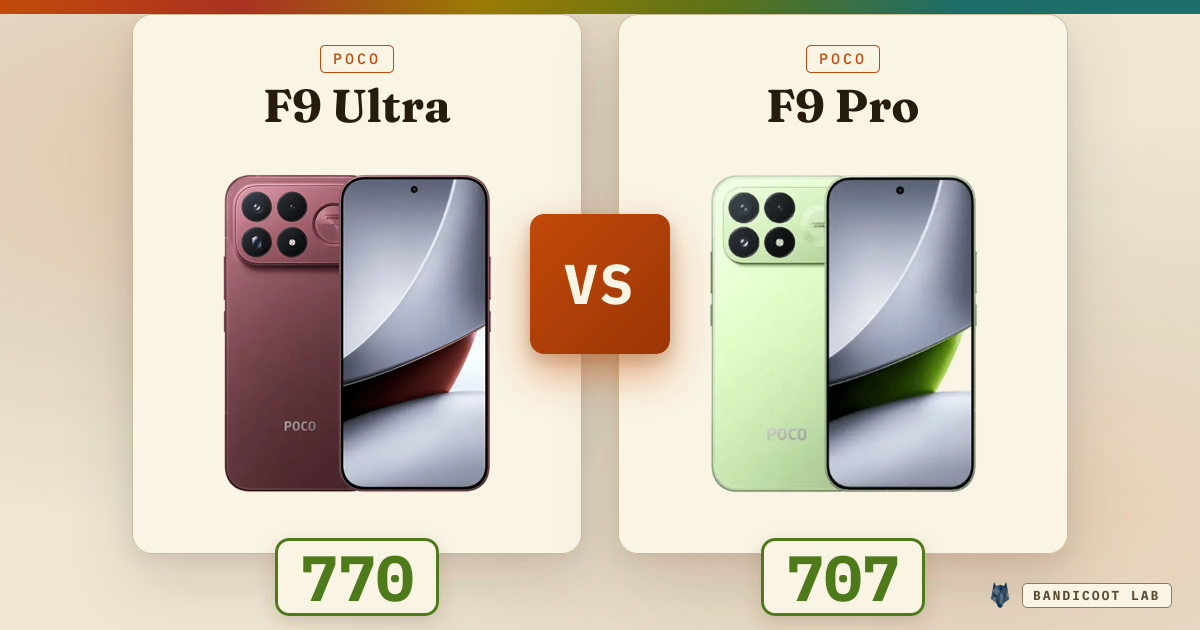
Poco F9 Ultra vs Poco F9 Pro
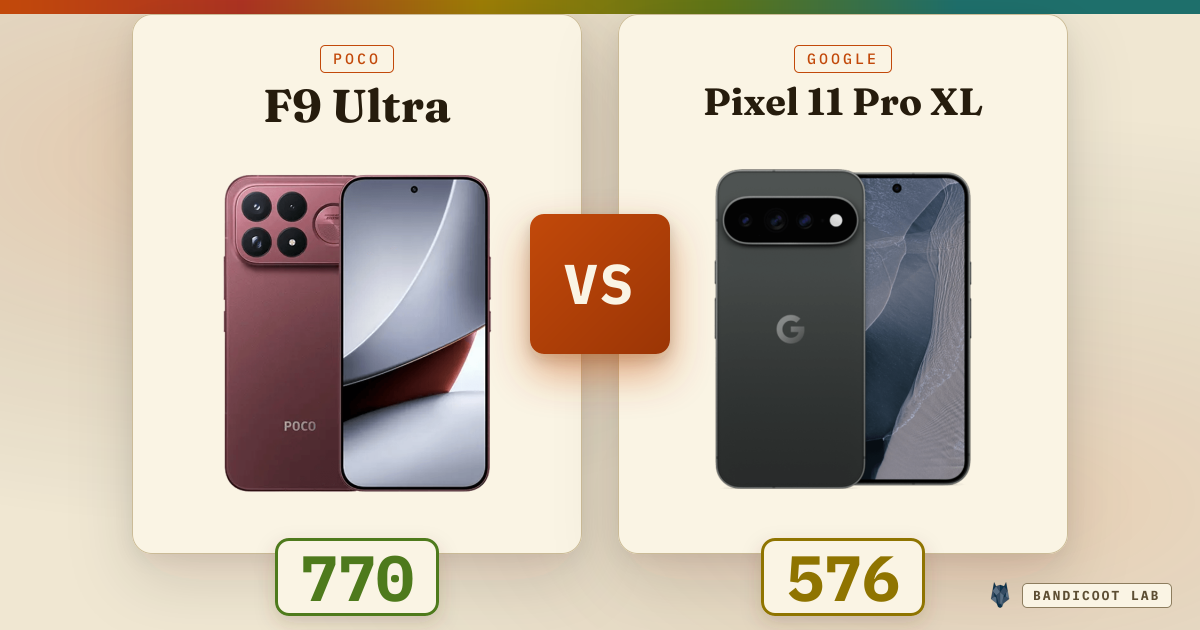
Poco F9 Ultra vs Google Pixel 11 Pro XL

Poco F9 Ultra vs Samsung Galaxy S26 Ultra